For a moment, no one spoke.
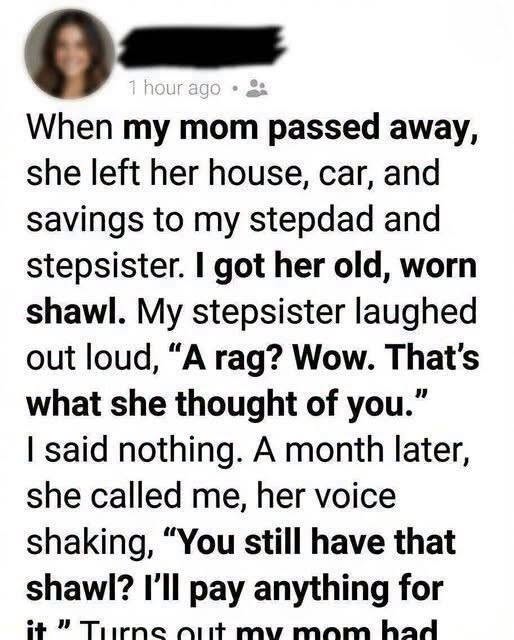
Then my sister, Lila, laughed.
“That’s it?” she said. “You got the old shawl?”
A few people smiled politely.
Compared to everything else being distributed, it looked almost worthless.
I picked it up without saying anything.
I thanked the attorney and took it home.
That evening, I unfolded it across my lap.
The fabric was worn from years of use.
The edges were slightly frayed.
As I lifted it closer, I caught the faint scent of lavender.
Suddenly, it wasn’t just a shawl.
It was my mother.
I remembered cold mornings when she wrapped it around her shoulders before making breakfast.
I remembered her sitting beside my grandmother during long afternoons when illness had made even simple conversations difficult.
Many relatives had kept their distance from my grandmother because she was stubborn and demanding.
My mother never did.
She visited.
She cared for her.
She stayed.
Whenever people asked why she carried so much responsibility without complaint, she always answered the same way.
“Family isn’t measured only by what we receive. Sometimes it’s measured by what we choose to give.”
Weeks later, Lila called unexpectedly.
Her voice had changed.
The teasing was gone.
“I need to ask you something about the shawl,” she said quietly.
She explained that another conversation with the family attorney had revealed something the rest of us hadn’t understood.
The shawl was connected to a private family arrangement my grandmother had established years earlier.
My mother knew about it.
She intentionally left the shawl to me because she believed I would understand what it represented.
Not money.
Trust.
Memory.
Quiet acts of love that no one else had noticed.
Lila asked whether I would sell it.
She offered money.
Then more money.
But by then I understood something she still didn’t.
The shawl had never been valuable because of what it was worth.
Its value came from the life woven into it.
Every thread reminded me of mornings, conversations, sacrifices, and a woman who kept choosing kindness even when no one applauded her for it.
Years have passed since that afternoon in the lawyer’s office.
The shawl still rests safely in my home.
Not because it is rare.
Not because it is expensive.
Because it reminds me that the greatest inheritance is often not the one that increases our wealth.
It is the one that quietly shapes the kind of person we become.
Sometimes the gifts people overlook carry the deepest stories.
And sometimes the simplest things become priceless because of the love they continue to hold.