The house was empty.
The furniture was gone.
Family photographs had disappeared from the walls.
Even Isabella’s crib and toys were missing.
Only a manila envelope remained on the kitchen counter.
His name was written across the front.
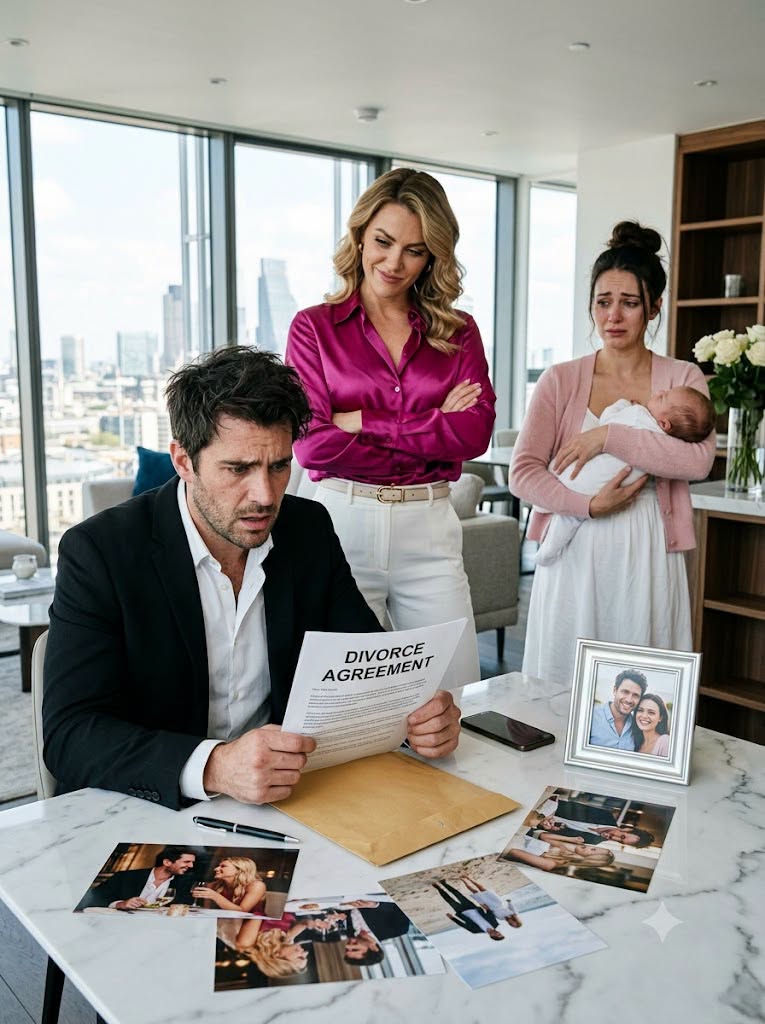
Inside were divorce papers, financial records, and photographs documenting his affair.
Sophie had known the truth for months.
She had quietly prepared her departure, filed for divorce, and requested primary custody, citing abandonment and financial misconduct.
Leighton stood alone in the home he had already abandoned long before Sophie ever left it.
As the legal process unfolded, more painful truths emerged.
Hospital security records showed Camille visiting the hospital the night Isabella was born.
Messages revealed that while Sophie was recovering from childbirth, Leighton had been telling Camille he wished she had been there instead.
The deepest betrayal had not been physical.
It was emotional.
Sophie had endured one of life’s most vulnerable moments believing her husband was beside her, while his heart was somewhere else.
When Leighton confronted Camille, hoping for remorse, she dismissed the damage.
To her, the marriage had already been over.
Responsibility belonged to someone else.
Soon the affair became known at work.
Professional trust quickly disappeared.
Leighton was placed on administrative leave, and Camille’s behavior became increasingly reckless, including threats and messages that further complicated the legal case.
Only then did Leighton fully understand that every attempt to hide the truth had only made the consequences heavier.
He returned money he had concealed and stopped trying to defend what could no longer be defended.
In court, Sophie spoke quietly about recovering from childbirth alone while her husband invested his time, affection, and honesty elsewhere.
She never raised her voice.
She didn’t need to.
The truth carried enough weight on its own.
Leighton admitted his failures.
The court granted Sophie primary custody, allowing him only supervised visits while he began rebuilding trust through consistent actions rather than promises.
Separate evidence eventually led to Camille’s arrest for stalking and threatening behavior, bringing an end to the instability surrounding the family.
Leighton entered therapy.
His visits with Isabella were short, structured, and carefully supervised.
At first, he focused on earning the privilege of simply being present.
Over time, he began learning that fatherhood is not measured by biology alone, but by reliability, patience, and sacrifice.
Sophie never suggested reconciliation.
Some relationships end because trust has been broken too deeply to restore.
She chose respectful co-parenting instead of returning to a marriage that no longer felt safe.
When Isabella celebrated her first birthday, they stood together in the same room for her sake.
Nothing more.
Nothing less.
Months later, after the divorce became final, Sophie and Leighton exchanged a quiet handshake outside the courthouse.
Not as husband and wife.
As two parents accepting that their daughter’s future mattered more than their past.
Years later, when Isabella turned five, they celebrated together with clear boundaries and honest communication.
The marriage had not survived.
But the family found a healthier shape.
Leighton could never erase the choices that broke his home.
He could only choose what kind of father he would become afterward.
Sometimes redemption does not look like getting a second chance at the relationship we lost.
Sometimes it looks like becoming the person we should have been all along—for the child who is still watching.