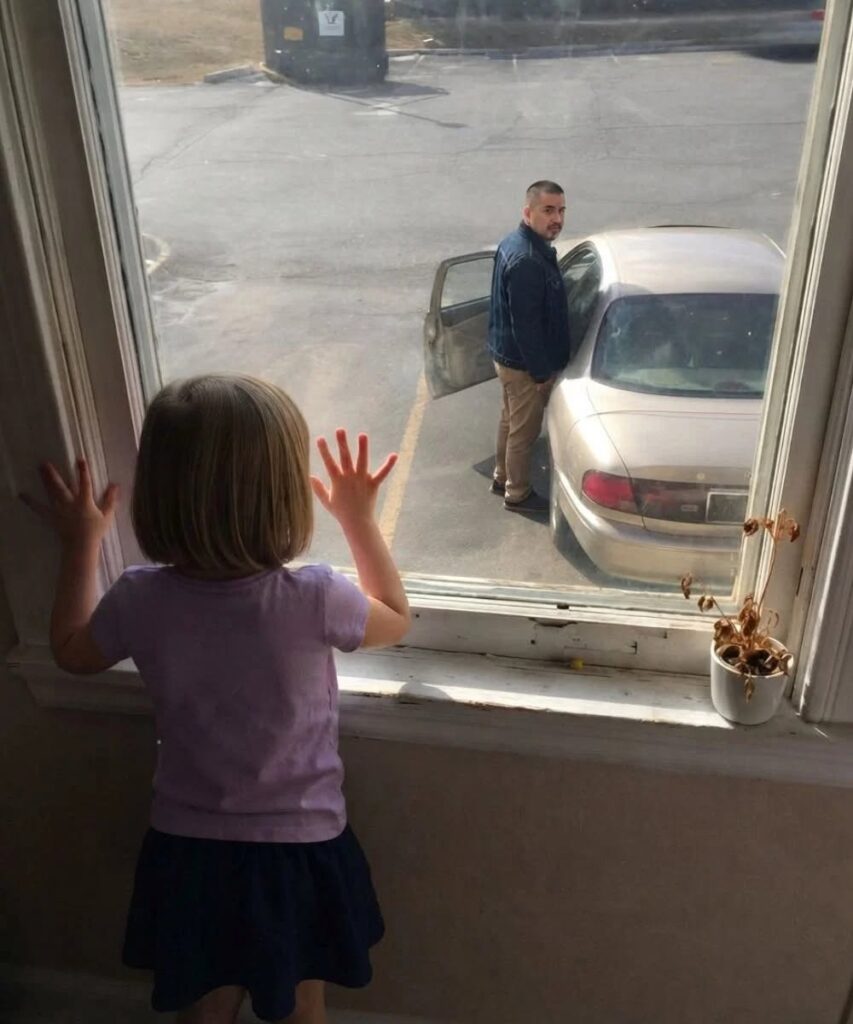
She sat cross-legged on the bedroom floor, holding up a purple sweater.
“Are we going somewhere fun?”
“We’re going somewhere new,” I told her.
“Will Daddy come?”
My hands stopped folding for half a second.
“Not today, sweetheart.”
She accepted the answer with the easy trust of a child and placed the sweater inside the box.
I turned away before she could see me cry.
I worked part-time at a dental office, but my wages barely covered groceries, daycare, and the minimum payments on two credit cards.
Every apartment I called required something I did not have.
A security deposit.
A good credit score.
Three months of pay stubs.
References.
Proof that my life had not just fallen apart.
Some landlords stopped responding the moment I mentioned that I had a child.
Others spoke to me in the careful tone people use when they have already decided no.
Then, one afternoon, I noticed a handwritten sign taped inside the window of a neighborhood grocery store.
GARAGE APARTMENT FOR RENT.
PALMER STREET.
$800.
ASK FOR ALVAREZ.
I copied the number onto the back of a receipt and called from the parking lot.
The apartment stood behind an old blue house at the end of Palmer Street.
It had one bedroom, a tiny kitchen, and a bathroom floor that tilted slightly toward the tub. The refrigerator buzzed constantly, and the window above the sink looked out over several rows of tomato plants.
To anyone else, it might have seemed cramped and outdated.
To me, it looked like safety.
Trixie ran into the bedroom and stared up at the ceiling.
“Can I put glow-in-the-dark stars up there?”
“We’ll see.”
“That means no.”
“It means we’ll see.”
She opened the closet and frowned.
“It’s small.”
“So are your clothes.”
That made her laugh.
Mr. Alvarez met us in the driveway.
He was in his seventies, with silver hair, heavy eyebrows, and a gray work shirt buttoned neatly to his throat.
His face revealed almost nothing.
He looked at me.
Then at Trixie.
Then at my battered car.
“Do you smoke?”
“No.”
“Do you have a dog?”
“No.”
He pointed at Trixie.
“Is she yours?”
“Yes.”
He nodded once.
“Eight hundred a month. Due on the first. No lease. I don’t like paperwork.”
I nearly cried from relief.
“Is there a deposit?”
“No.”
“Application fee?”
“No.”
“Do you need proof of income?”
He stared at me for a long moment.
“Can you pay eight hundred dollars?”
“Yes.”
“Then move in Saturday.”
That was the entire interview.
We arrived with six boxes, two suitcases, a secondhand sofa, and a mattress my sister had given us.
Trixie slept in the bedroom.
I slept on the narrow sofa in the living room.
On our first night, rain hammered the roof so loudly that Trixie came out carrying her blanket.
“I can’t sleep.”
I lifted one side of my blanket.
“Come here.”
She curled against me.
“Do you like our new house?”
I looked around the little room.
The refrigerator buzzed.
The rain leaked beneath the corner of one window.
The floor creaked whenever either of us moved.
“I think I will,” I said.
“I like the tomatoes.”
“They aren’t ours.”
“We can still look at them.”
That became our life.
I worked mornings at the dental office and evening shifts at a bakery three nights a week.
I used coupons.
I patched my shoes.
I learned which utility companies allowed a few extra days before charging a late fee.
But the rent was always paid first.
On the first day of every month, I wrote Mr. Alvarez a check for eight hundred dollars and slid it beneath his back door.
He never gave me a receipt.
I never asked for one.
He mostly kept to himself, but he had a way of noticing problems before I mentioned them.
A loose step would be repaired while I was at work.
A leaking faucet would suddenly stop dripping.
Sometimes a bag of oranges appeared outside our door.
If I thanked him, he shrugged.
“The tree made too many.”
Three months after we moved in, I noticed something strange.
My rent check had not cleared.
The eight hundred dollars remained in my account.
At first, I assumed Mr. Alvarez had forgotten to deposit it.
I knocked on his door.
“I think you misplaced my check,” I said. “I can write another one.”
He looked at me without expression.
“It’s handled.”
“What does that mean?”
“It means it’s handled.”
Then he closed the door.
December came.
That check did not clear either.
Neither did January’s.
Or February’s.
Every month, I wrote another check.
Every month, the money remained in my account.
Whenever I asked Mr. Alvarez about it, he gave me the same answer.
“It’s handled.”
The years passed.
Trixie turned five, then six, then seven.
She learned to read.
She stopped asking when her father would visit.
Instead, she began asking whether she could paint the bedroom yellow.
I received more hours at the dental office and eventually left the bakery.
I paid off one credit card.
Then the other.
Our lives slowly became steadier.
But the rent checks still never cleared.
By the end of our third year in the apartment, nearly twenty-nine thousand dollars remained untouched in my account.
I never spent a cent of it.
I treated the money as though it already belonged to Mr. Alvarez.
I kept expecting him to deposit all the checks at once.
Every time my balance grew, so did my anxiety.
Finally, I reached my limit.
One afternoon, I crossed the yard and knocked on his back door.
When he opened it, I did not apologize for disturbing him.
“I need an explanation.”
He studied my face.
“For what?”
“You know exactly what.”
He remained silent.
“I have paid you every month for three years,” I continued. “Not one check has cleared. I cannot keep pretending this is normal.”
Mr. Alvarez looked at me for several seconds.
Then he disappeared inside.
When he returned, he was carrying an old shoebox.
Its corners were worn, and one side had been repaired with yellowing tape.
He held it toward me.
“What is this?”
“Open it.”
For the first time since we moved in, he invited me into the main house.
His kitchen was neat and quiet.
Old photographs covered one wall.
In several of them, a younger Mr. Alvarez stood beside a beautiful dark-haired woman who had his eyes.
I sat at the table and removed the shoebox lid.
Inside were all my rent checks.
Every single one.
They had been arranged in careful bundles and labeled by month and year.
August.
September.
October.
Three years of rent.
“You kept them?”
“Yes.”
“Why?”
He sat across from me.
“You paid on time.”
“That doesn’t explain why you never cashed them.”
“No,” he said. “It doesn’t.”
His eyes moved toward the photographs on the wall.
“My daughter’s name was Sofia.”
I followed his gaze.
The dark-haired woman was not his wife.
She was his daughter.
“She had a little girl named Camila,” he continued. “Sofia married young. Her husband was charming when they first met.”
Mr. Alvarez’s hands tightened on the table.
“Then he began controlling her money. Her clothes. The people she was allowed to speak to.”
I did not interrupt.
“One day, she came here with Camila. She asked whether they could stay.”
“What did you say?”
He closed his eyes.
“I told her to go home and fix her marriage.”
The kitchen clock ticked above the stove.
“Why?”
“I was stubborn.”
His voice had become quieter.
“I believed marriage was a promise you kept no matter how difficult it became. I told her a woman could not run away every time life became uncomfortable.”
“What happened?”
His expression answered before he spoke.
“Six weeks later, they died in a car accident.”
I covered my mouth.
“Her husband was driving. He had been drinking.”
Mr. Alvarez stared down at his hands.
“I had an empty apartment. I had savings. My daughter stood in this kitchen and asked me for help, and I sent her back.”
“You could not have known.”
“I knew she was frightened.”
His eyes lifted to mine.
“That should have been enough.”
The room seemed to shrink around us.
“When you arrived here,” he said, “you had the same expression Sofia had that day.”
“What expression?”
“Like you were trying not to ask for too much.”
My eyes filled.
“You had your little girl beside you. Your car barely worked. You looked at that tiny apartment as though it were a palace.”
“It felt like one.”
“I decided to give you time.”
“Time for what?”
“To stand again.”
I looked down at the shoebox.
“Then why did you keep making me write the checks?”
“Because I did not want you to feel like a charity case.”
His answer broke something open inside me.
“You paid every month,” he continued. “You kept your word. You did your part. What I chose to do afterward was my business.”
“Nearly twenty-nine thousand dollars is not a small choice.”
“No.”
“You could have used that money.”
“I have enough.”
“You wear the same shirt every day.”
“I own seven identical shirts.”
A startled laugh escaped me.
For the first time, the corner of his mouth lifted.
Then he reached beneath the checks and removed a white envelope.
My name was written across the front.
He pushed it toward me.
Inside was a signed letter confirming that the money in my account belonged to me and that he had no intention of cashing any of the checks.
Beneath it was another document.
I read it once.
Then again.
My hands began to shake.
“This cannot be real.”
“It is.”
Mr. Alvarez was transferring ownership of the garage apartment to me.
Not the entire blue house.
Only our small unit and the narrow strip of land surrounding it.
The buzzing refrigerator.
The crooked bathroom floor.
The window overlooking the tomatoes.
All of it.
“I cannot accept this.”
“You can.”
“You barely know me.”
“I have watched you for three years.”
He began listing the things he had noticed.
How I left for work before sunrise.
How I sat beside Trixie every evening while she practiced reading.
How I paid every bill before buying anything for myself.
How I continued writing the rent checks even after it became clear he might never cash them.
“You could have spent the money,” he said. “You never touched it.”
“Because it belonged to you.”
He shook his head.
“It never did.”
I began to cry.
Not quietly.
Not gracefully.
I cried for the frightened woman who had arrived with six boxes and no idea what would happen next.
I cried for Sofia and Camila.
And I cried for the old man sitting across from me, who had carried one terrible mistake for years and had chosen to turn his regret into mercy.
Mr. Alvarez did not try to stop me.
He remained at the table and let me cry.
When I finally managed to breathe again, I asked, “Why are you doing this now?”
“Because you came to my door angry.”
I stared at him.
He shrugged.
“You were not afraid anymore.”
That answer stayed with me.
Three years earlier, I would have apologized for knocking.
I would have accepted his vague answer and returned to the apartment to worry alone.
But that afternoon, I had demanded the truth.
Somewhere between the bakery shifts, the overdue bills, the repaired shoes, and the bedtime stories, I had changed.
I was no longer the woman who believed she had to accept whatever anyone offered her.
I looked down at the ownership papers.
“What about Trixie?”
“The apartment will be yours,” he said. “One day, it can belong to her.”
“When did you decide?”
He looked at the photograph of Sofia and Camila.
“When I saw Trixie learning to ride her bicycle in the driveway.”
I laughed through my tears.
“She crashed into your tomato plants.”
“She apologized to every one of them.”
“She felt terrible.”
“She is a good child.”
I reached across the table and placed my hand over his.
“You saved us.”
He shook his head.
“You saved yourselves. I only kept the door open.”
That evening, I sat beside Trixie on the sofa.
“I have something important to tell you.”
Her eyes widened.
“Are we getting a dog?”
“No.”
She sighed dramatically.
“Then what?”
“This apartment belongs to us now.”
She stared at me.
“What do you mean?”
“It means we do not have to leave. It is our home.”
“Even the sink window?”
“Even the sink window.”
“And the crooked floor?”
“That too.”
“And my bedroom?”
“Yours.”
She threw her arms around me so hard that I nearly fell sideways.
Then she looked through the kitchen window.
Mr. Alvarez stood beside his tomato plants, tying one of the vines to a wooden stake.
Before I could stop her, Trixie raced outside.
She crossed the yard and wrapped both arms around him.
Mr. Alvarez froze.
For several seconds, he did not seem to know what to do.
Then, slowly, he rested one hand against her back.
I watched from the window.
For the first time since I had met him, his face revealed everything.
Grief was there.
So was regret.
But beneath both was something softer.
Love.
Years later, the shoebox still sits on the highest shelf of my closet.
Every rent check remains inside.
I keep them because they remind me that kindness does not always arrive with speeches, applause, or grand promises.
Sometimes it looks like an old man in a gray shirt quietly refusing to cash a check.
Sometimes it is a tiny apartment with a noisy refrigerator, a crooked floor, and a window overlooking somebody else’s tomatoes.
And sometimes the person who helps rebuild your life is not someone who carries you.
It is someone who quietly keeps the door open long enough for you to stand on your own.