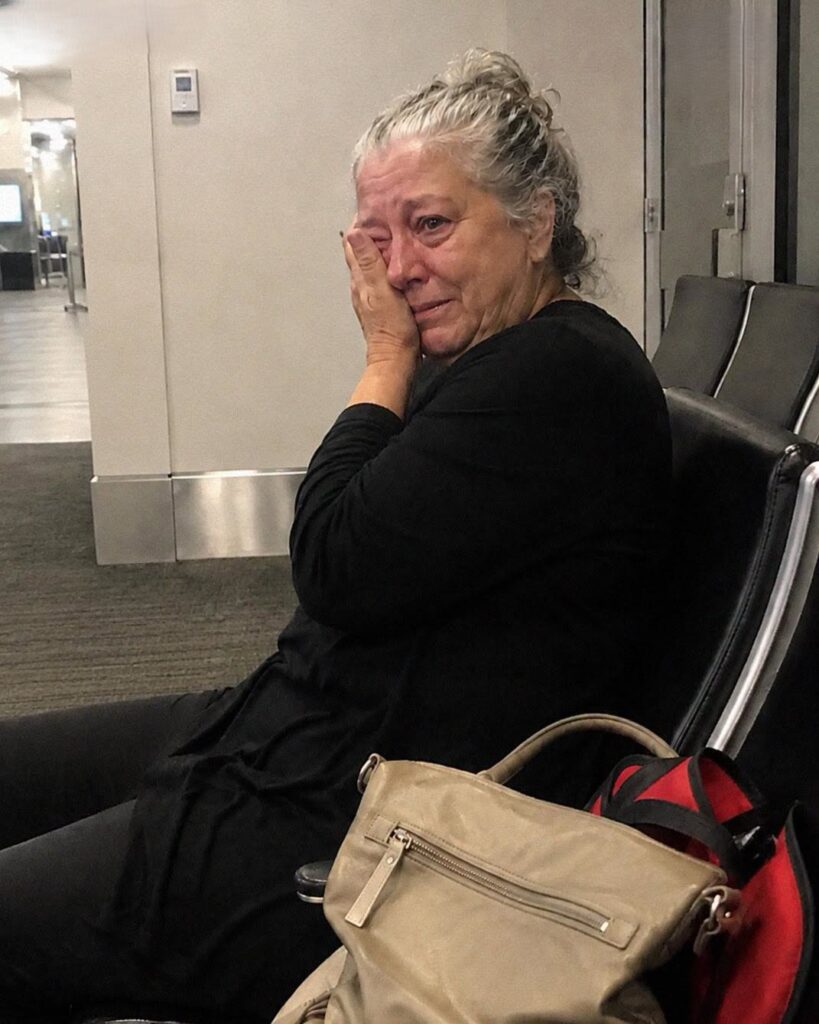
I did not expect flowers.
I did not expect anyone to understand what it felt like to return to an empty marriage.
I only expected one of my children to pick me up.
Instead, my son answered the phone and said, “Mom, take a cab. We’re busy.”
Jason’s voice cut through the terminal noise before I could even tell him where I was standing.
“Jason, I haven’t slept in three days.”
He exhaled sharply.
“Dad is gone, Mom. Stop making everyone responsible for your grief.”
In the background, I heard my grandson laughing.
Then a voice shouted, “Tell Melissa I claimed Grandpa’s truck!”
My throat closed.
“Jason—”
“You can get home by yourself.”
The line went dead.
I remained beside the empty baggage carousel, holding the phone against my ear long after he had hung up.
The airport smelled of stale coffee, wet coats, and floor cleaner. Families reunited around me. Children ran into waiting arms. Husbands lifted suitcases while wives kissed their cheeks.
I stood alone.
A young airline clerk finally approached.
“Ma’am, I’m sorry. Your suitcase did not make the connection in Zurich. We’ll deliver it when it arrives.”
“Thank you,” I whispered.
I moved to a bench near the glass doors and called my daughter.
Melissa answered after several rings.
“Mom, I’m in the middle of something.”
“I just landed.”
“You knew Dad was sick. This wasn’t exactly unexpected.”
I closed my eyes.
“I need a ride home.”
“You can take a cab.”
“Melissa—”
“We’re all exhausted too.”
She ended the call.
Rain slid down the tall windows in silver streams.
For several minutes, I watched it and thought of Henry.
Every morning of our marriage, he placed a small sealed envelope inside his coat before leaving for work.
“Bills,” he always said, patting the pocket. “I’ll drop them at the post office.”
I never questioned him.
Not once in forty years.
Henry had been a quiet man. He folded his hands when he prayed and rarely raised his voice. Even when disappointed, he spoke gently.
The last time he tried to warn me about our children, we were sitting at the kitchen table.
“They take us for granted, Eleanor.”
“They’re still our children.”
He had looked at me for a long moment.
Then he nodded.
He never argued.
Over the years, birthday visits became shorter. Phone calls came mostly when Jason needed money or Melissa needed someone to watch the children.
Henry noticed.
I chose not to.
A taxi driver tapped lightly on the window beside me.
“No luggage, ma’am?”
“No luggage.”
He placed my carry-on in the trunk and drove me toward the house Henry and I had built together.
My phone remained silent.
As the city moved past the rain-streaked window, I remembered another call.
A week before Henry died, a young journalist named Claire Bennett had contacted me from the local news station.
She had asked whether our family would be willing to speak on camera about Henry.
“He was a very private man,” I had told her. “I’m sorry.”
She said she understood and left her number.
I found it in my recent calls.
My thumb hovered above the screen.
I could not press it.
Not yet.
The taxi pulled away, leaving me in the driveway of the house where I had lived for thirty-two years.
The porch light was on.
Through the curtains, I could see movement. My grandchildren were laughing inside.
When I opened the front door, I stopped.
Small strips of masking tape had been placed on nearly everything.
MELISSA was written across the glass door of my jewelry cabinet.
JASON had been stuck to Henry’s toolbox.
SOPHIE appeared on the old rocking chair.
There were labels on lamps, paintings, silverware boxes, and pieces of furniture that had belonged to my parents.
My family had begun dividing our life before I had even returned from burying Henry.
Melissa stepped out of the kitchen with a dish towel over one shoulder.
“You finally made it.”
I stared at her.
“What took you so long? We had to make dinner ourselves.”
I did not answer.
“Mom, don’t act like that. We’re all tired.”
I picked up my carry-on and moved toward the stairs.
“Fine,” she called after me. “Ignore me. That’s mature.”
Upstairs, I closed the bedroom door.
Henry’s flannel shirt lay folded across his pillow exactly where I had left it before flying to Switzerland.
I lifted it to my face.
It still carried the faint scent of his soap.
Then I remembered Marcus.
He had approached me beside Henry’s grave after most of the mourners had gone.
He was a young man wearing a suit slightly too large for him.
“Mrs. Carter,” he had said, “your husband paid for my mother’s surgery ten years ago. She is alive because of him.”
I had not known Marcus.
I had not known anything about the surgery.
I had barely known how to respond.
Now, sitting on our bed, I searched for Claire Bennett’s number again.
She answered on the second ring.
“Eleanor, I’m so sorry. I heard about Henry.”
“You called last week,” I said. “You said you wanted to tell his story.”
There was a pause.
“Yes.”
“Is the offer still open?”
“It was always going to be.”
Something about her words made me sit straighter.
“I will come to you. Six o’clock. I’ll bring Henry’s records. He kept everything in his study.”
“I can send a car.”
“Thank you.”
Claire hesitated.
“I would also like to send a small crew to your house in the morning for exterior footage. They will stay on the public sidewalk. If the curtains are open, they may film what can be seen from outside. They will not knock or disturb anyone.”
I looked toward the bedroom door.
Downstairs, Jason and Melissa were laughing.
For forty years, I had protected them from embarrassment, disappointment, and consequence.
“Do not hide anything,” I said. “Show exactly what Henry wanted people to see.”
Claire became quiet.
“Eleanor, Henry came to the station several months ago.”
My fingers tightened around the phone.
“Henry?”
“He asked me to wait until you contacted me.”
“What did he want?”
“He insisted that I explain everything in person.”
I looked at the rain beyond the bedroom window.
“Six o’clock,” I said.
“I’ll be there.”
I did not go downstairs for dinner.
Before dawn the next morning, I dressed quietly and removed a small key from Henry’s nightstand.
His study had always been private.
For forty years, I respected every closed drawer and sealed envelope.
But if I walked away now, I knew I would never understand the man who had slept beside me for most of my life.
I unlocked the bottom desk drawer.
Inside was a leather folder I had never seen.
The first page contained a handwritten bank ledger.
Rows of dates, names, and amounts filled Henry’s neat columns.
One entry stopped my breath.
Three years earlier, Henry had wired twenty-two thousand dollars to a children’s hospital in Denver.
Beside the amount, he had written three words.
Jason’s canceled debt.
I sat down.
Jason had told us that year that he had handled his bankruptcy alone.
Henry had paid the debt and never mentioned it.
The rest of the folder contained letters, receipts, photographs, hospital statements, scholarship documents, and thank-you notes addressed to initials rather than names.
A lifetime of quiet generosity had been hidden inside one drawer.
I closed the folder and tucked it beneath my arm.
Before leaving the house, I walked through every room and pulled open the curtains.
Gray morning light fell across the labels covering our belongings.
No one woke.
No one noticed I had gone.
That evening, the family gathered in the living room to watch the six o’clock news.
The air smelled of pot roast and impatience.
Jason sat in Henry’s recliner with a strip of blue tape stuck to one arm.
Melissa balanced a plate on her knees.
“Once the truck is settled, we should sell the cabin,” Jason said.
“That’s fine,” Melissa replied. “As long as I receive my share.”
I sat silently in the corner.
“Mom, say something,” she demanded.
“I’m listening.”
Jason leaned back.
“She’ll come around.”
Only Sophie, my fifteen-year-old granddaughter, seemed uneasy.
“Grandma, would you like more water?”
“No, sweetheart. Thank you.”
The anchor introduced the lead story.
A photograph filled the television screen.
It showed me sitting in Claire’s studio earlier that day with my hands folded in my lap.
Sophie’s fork slipped from her fingers.
“Grandma?”
Jason sat upright.
“What is this?”
On screen, I spoke about Henry’s envelopes and the questions I had never asked.
Then Claire’s voice took over.
“For more than thirty years, Henry Carter quietly paid for medical treatment for six local children. He funded trade-school tuition for four veterans, paid off the mortgage of a recently widowed neighbor, and created a community-college scholarship under another name.”
Melissa’s mouth fell open.
A woman appeared on the screen, wiping tears from her cheeks.
“I never knew who paid for my son’s treatment. I found out last week when the funeral director gave me a letter Henry had left behind.”
Another face appeared.
A mechanic stood inside a repair shop.
“Henry saved my daughter’s life. I thought the money came from an anonymous charity.”
I turned toward Jason.
“Denver,” I said quietly. “Three years ago.”
His face changed.
“What?”
“Twenty-two thousand dollars.”
Melissa looked between us.
“What twenty-two thousand dollars?”
Jason did not answer.
He knew exactly what I meant.
Melissa leaned forward.
“Was the will changed?”
I kept my eyes on the television.
“Mom, was there an amendment?”
Marcus appeared next.
He spoke about his mother’s surgery and the check that had arrived without a return address in 2013.
“Turn it off,” Jason snapped.
No one moved.
“I said turn it off.”
Claire returned to the screen.
“There is one final part of Henry’s story. It concerns the person he loved most.”
The room became silent.
I placed my plate on the table because I knew what was coming.
“Several months before his death, Henry visited our station with one condition. He asked that this report air only when his wife was ready. He also asked us to stand between Eleanor and anyone who might try to take advantage of her after he was gone.”
The footage changed.
Our living room appeared on the screen, filmed that morning from the public sidewalk.
The curtains were open.
The labels were clearly visible.
JASON on the toolbox.
MELISSA on the jewelry cabinet.
Blue strips of tape dividing forty years of marriage while Henry’s widow had still been traveling home from his funeral.
The entire town was watching.
Jason jumped to his feet.
“How could you do this to us? Do you understand what people will say?”
Melissa began to cry.
“My children’s inheritance, Mom. You threw it away on television.”
For the first time in three days, my voice did not tremble.
“Henry left the estate to a charitable foundation bearing his name. The documents were finalized before his burial.”
They stared at me.
“I am the sole trustee.”
Jason’s face hardened.
“You planned this.”
“No.”
I looked at him.
“I only wanted a ride from the airport.”
“We did not realize you needed us that badly,” he said.
“I told you I had not slept in three days.”
“You were being emotional.”
“My husband had just been buried.”
He looked toward Melissa, searching for support.
I opened the leather ledger.
“Henry feared this might happen. He hoped he was wrong.”
“What is that supposed to mean?”
“It means he suspected you might begin dividing his life before I even reached home.”
“We weren’t dividing anything,” Jason said. “We were organizing.”
I turned the ledger toward him.
“Three years ago, when you needed help, your father paid twenty-two thousand dollars to settle your debt.”
Jason’s face went pale.
“He asked for nothing in return. He never reminded you. He never used it to shame you.”
A few months later, Jason had arrived in a brand-new truck.
“That has nothing to do with this,” he muttered.
“It has everything to do with it.”
Melissa stared at her brother.
“You never told us.”
“Because Henry never wanted gratitude used as a weapon,” I said.
My voice broke.
“No matter what kind of son you were, you were still his son.”
The room remained silent.
“Neither of you attended your father’s funeral.”
Melissa looked away.
“You left me alone at the airport. Then you came into our house, labeled his furniture, argued over his truck, and discussed selling his cabin before I had even unpacked.”
Jason opened his mouth.
I raised one hand.
“Your father spent his life protecting people from circumstances they did not choose.”
I looked at the labels scattered around the room.
“I spent mine protecting both of you from the consequences of choices you did make.”
Sophie was crying quietly.
She was the only person looking at me rather than the television.
“Grandma, I’m sorry.”
I touched her cheek.
Then I walked across the room and removed Jason’s label from Henry’s rocking chair.
I carried it upstairs, placed it beside the bedroom window, and sat down with Henry’s flannel shirt against my chest.
That night, for the first time since Switzerland, I slept.
Several weeks later, I sat behind Henry’s old desk in the new foundation office.
Scholarship applications lay open across my lap.
On one side of the room were requests from families facing medical bills. On the other were letters from veterans hoping to learn trades and rebuild their lives.
Claire entered carrying coffee.
She placed a cup beside me without asking how I took it.
She already knew.
My phone lit up on the desk.
It was a message from Sophie.
Could I come stay with you this weekend?
I looked toward the empty chair across from me.
Every morning for forty years, Henry had poured two cups of coffee.
I poured a second one and placed it opposite mine.
Then I picked up my phone and answered with one word.
Yes.
For most of my life, I believed kindness meant shielding the people I loved from discomfort.
Henry understood something deeper.
Real kindness does not always remove consequences.
Sometimes it gives dignity to someone who has none.
Sometimes it pays a hospital bill without asking for praise.
Sometimes it opens a door for a veteran, protects a widow, or creates a future for a child whose name you may never hear.
I could not bring my husband home.
I could not ask him why he had kept so much goodness hidden inside envelopes and locked drawers.
But I could continue the work he had begun.
Henry had spent his life making certain strangers did not face hardship alone.
After his death, he made certain I would not either.
His kindness had survived him.
And as long as I had strength left to give, I would make sure it never disappeared.