After twenty years as an Army Ranger, I had learned that pain often speaks loudest when people are trying hardest to hide it.
Drew insisted he had been hurt during sports practice.
I didn’t believe him.
I already knew about Neil—the boy who had been tormenting him for months. Everyone in Milwood Creek knew who Neil was.
He was Sheriff Carl Gaines’s son.
In a town where the sheriff’s influence reached almost everywhere, few people were willing to challenge him.
I took Drew to urgent care first.
The X-rays confirmed what I had suspected.
His arm was fractured.
Before we left, I made sure every injury was documented. Facts matter, especially when emotions threaten to overwhelm judgment.
From there, we drove straight to the sheriff’s office.
I placed the medical records on Carl Gaines’s desk and asked to file an official report.
He barely glanced at them.
Instead, he dismissed the injuries as boys being boys and suggested children today simply bruised too easily. Then he leaned back in his chair, confident that his badge would protect both his decision and his son.
“So,” he said, “what are you going to do about it?”
For a moment, anger tempted me.
But experience had taught me that reacting emotionally often gives bullies exactly what they want.
I collected the paperwork, thanked him for his time, and walked out with Drew beside me.
That evening, I sat at the kitchen table and treated the situation the way I had approached difficult missions throughout my military career.
Not with rage.
With discipline.
I built a detailed timeline of every incident Drew could remember. I organized the medical records, photographs, dates, and conversations into a clear record. The following morning, I contacted state officials to ask about the proper procedure for reporting a conflict of interest involving local law enforcement.
Then I reached out to other parents.
At first, most were hesitant.
They had lived with fear for years and believed speaking up would only make life harder for their children.
I promised that no one would stand alone.
Slowly, they began sharing their own experiences. Different families described remarkably similar incidents involving Neil and the same pattern of complaints quietly disappearing without action.
Together, their statements revealed something much larger than a single fight between two teenagers.
I submitted the complete file to state investigators responsible for overseeing local departments.
Three days later, several unmarked state vehicles entered our town.
Word spread quickly.
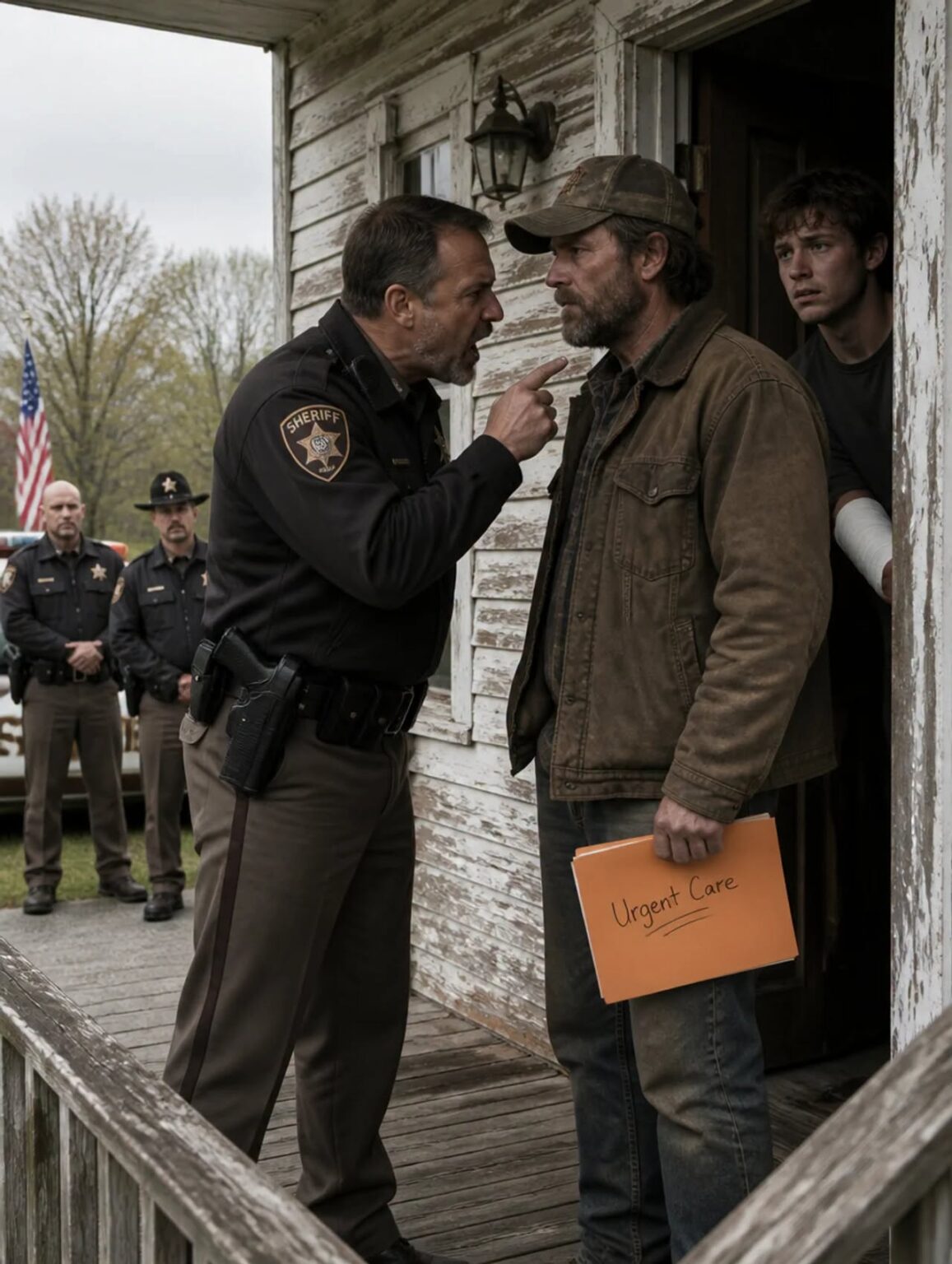
Sheriff Gaines arrived at my house furious, demanding to know what I had done.
Before the conversation could go further, state investigators pulled into the driveway. Deputy Susan Parsons stepped out alongside them carrying a folder filled with statements from families who had finally decided to speak.
For the first time, the sheriff was no longer the only authority in the room.
The confidence he had displayed behind his desk was gone.
Fear loses much of its power the moment people stop facing it alone.
As the investigation unfolded, Drew stood beside me wearing the cast that had started everything.
He quietly thanked me for staying calm that day in the sheriff’s office.
I told him courage is not measured by how loudly we fight back.
Sometimes courage is choosing patience over impulse, truth over intimidation, and lawful action over revenge.
Strength is not the absence of pain.
It is the decision to confront injustice without becoming unjust ourselves.
And if our town learned anything from those days, I hope it was this:
Real authority is never built on fear.
It is built on integrity, and integrity can withstand the truth.