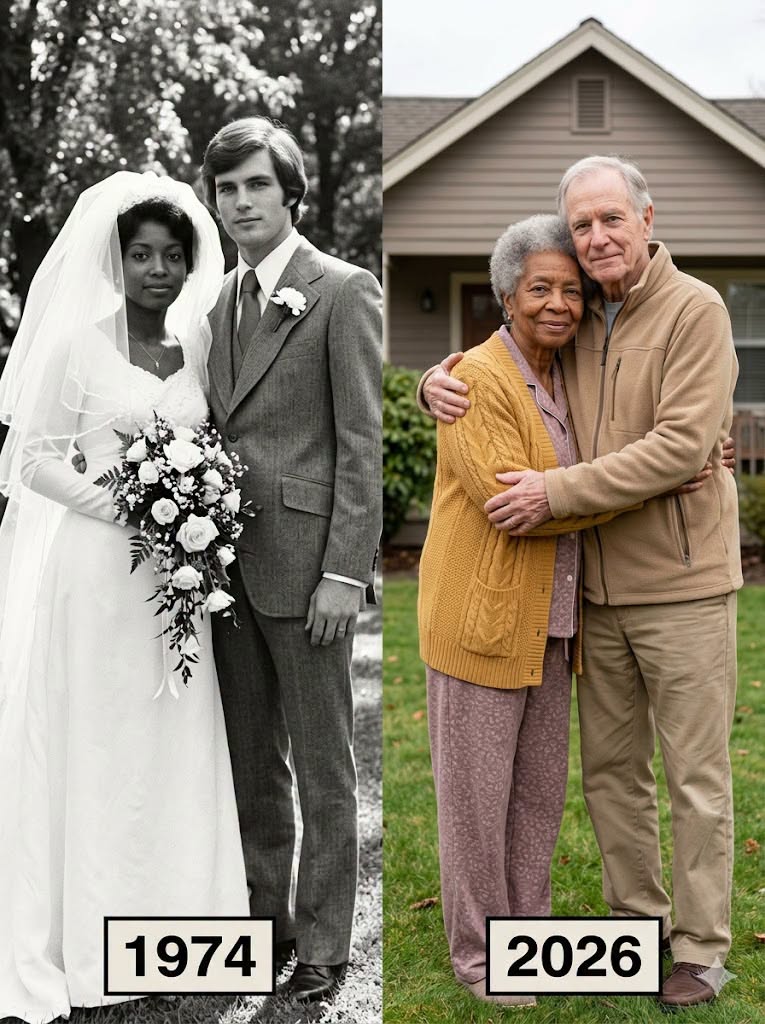
I was wrong.
For as long as I could remember, the attic door had been secured with a heavy padlock. Martha always said it protected old family heirlooms and papers that no longer mattered. I never pressed her. After decades of marriage, some privacy seemed harmless.
Then, two weeks ago, Martha broke her hip and was moved to a rehabilitation center.
The house felt unnaturally quiet without her.
One night, I heard something above me.
A slow scraping sound.
Then a dull dragging noise across the attic floor.
At first, I told myself it was an animal or the settling of an old house. But the sounds came again the next night, deliberate enough that my instincts would not let me ignore them.
I forced the lock open.
The attic was thick with dust and crowded with forgotten furniture. Near the back wall stood an antique oak chest secured by another lock.
When I visited Martha the following morning and mentioned it, the color drained from her face.
“Please, Gerry,” she said. “Leave it alone.”
That answer only deepened my unease.
That evening, I returned with bolt cutters.
Inside the chest were hundreds of letters, carefully arranged and tied with faded ribbons. Every envelope was addressed to Martha, and every one was signed by a man named Daniel.
The earliest letters were dated 1966.
The year Martha and I married.
I read until my hands began to shake.
Daniel wrote about a child he believed was his. He described watching from a distance as a boy named James learned to walk, started school, and grew into a young man.
James was my oldest son.
The next morning, I carried the letters to the rehabilitation center.
Martha looked at the chest key in my hand and understood immediately.
Then, after more than fifty years, she told me the truth.
Before she met me, she had been engaged to Daniel. She was already pregnant when he was sent overseas for military service in 1966. Shortly afterward, his plane went missing, and everyone believed he had died.
I met Martha months later.
When James was born seven months after our wedding, I accepted him as my son without hesitation.
What I never knew was that Daniel had survived.
He had spent years in captivity before returning to the United States in 1972. By then, Martha and I had built a family, and James knew me as his father.
Daniel chose not to disrupt that life.
He remained nearby, quietly watching the son he could not openly claim.
I learned he had lived in our town for decades.
He had died only days before I opened the attic.
The discovery left me angry, heartbroken, and unsure which part of my life had been real. So I went to speak with James.
He listened quietly before admitting that he had known since he was sixteen.
Daniel had approached him after a baseball game thirty-four years earlier and told him the truth. He asked James to keep it secret because he did not want to destroy the family James already had.
I struggled to speak.
Then James looked at me and said, “He gave me life. You gave me everything that came after.”
Those words did not erase the deception.
Martha had hidden something from me that I had a right to know, and love did not make that choice harmless. Daniel’s silence may have been intended as sacrifice, but it also left the burden of truth for others to carry.
Still, fatherhood is not decided by blood alone.
It is built in ordinary years: teaching a boy to ride a bicycle, sitting beside him when he is sick, correcting him when he is wrong, and standing in the crowd when he looks for a familiar face.
Daniel was part of James’s beginning.
I was part of his becoming.
At seventy-six, I have learned that families are often more complicated than the stories they tell about themselves. Truth can wound even when it arrives late, but it can also reveal what was real all along.
James was my son not because I was deceived into raising him.
He was my son because, every day for more than fifty years, I chose to be his father.