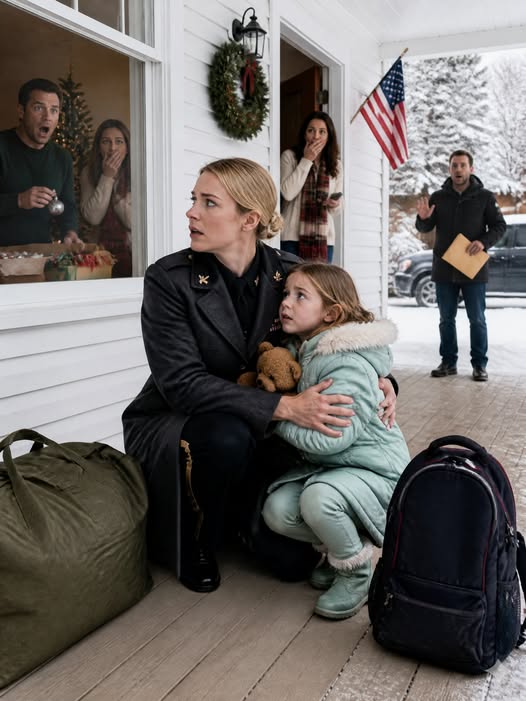
Through the living room window, I saw my husband, Ryan Mercer, laughing beside a woman I had never met, both of them decorating our Christmas tree as if my child were merely a discarded ornament. I did not knock or scream; the soldier in me took over, cold and precise. I wrapped my jacket around Lily, placed her in my SUV, and drove away from the life I thought I had built, knowing I would never return to that house of lies. The drive to the nearest open diner was a blur of adrenaline and mounting, icy clarity. I carried Lily inside, her small frame still shivering against my chest, and the waitress, seeing my uniform and the child’s state, didn’t ask questions. She simply provided a booth and hot chocolate. In that quiet, neon-lit space, I realized that my marriage had been a hollow shell for far longer than I had been willing to admit. I had been funding a life for a man who viewed my service as an inconvenience and my daughter as an obstacle to his new, selfish desires.
The next morning, I went directly to the Fort Carson Legal Assistance Office. I was still in my uniform, my mind focused on the tactical necessity of protecting my daughter. Captain Elena Torres, the legal officer, listened with a professional, steady demeanor that made me feel, for the first time in years, that I was not alone. She guided me through the initial steps of documenting everything. We began with the financial records, and the extent of the betrayal was staggering. Ryan had been using our joint accounts to fund luxury hotel stays, expensive dining, and gifts for his mistress, all while telling me that money was tight and that my military pay was barely covering our basic expenses. He had even forged my signature on credit applications and loans, creating a web of debt that I had been unknowingly tethered to for months. Every document we pulled, every statement we printed, felt like a brick being removed from the wall of lies he had constructed around us.
The divorce process that followed was a grueling test of endurance. Ryan, initially convinced that he could manipulate the situation, tried to paint me as an unstable, career-obsessed mother who had abandoned the family home. He leaned on his mother, Marjorie, to support his narrative, and for a time, she did. However, the legal discovery process was relentless. When we presented the court with the bank statements, the timestamps of the photos showing him with his mistress while Lily was left on the porch, and the evidence of his financial fraud, his position crumbled. The judge saw through the performative, wounded act he put on in the courtroom. I was granted primary custody of Lily, and the court ensured that the financial liabilities he had secretly accrued were assigned to him. Watching him lose his footing as the truth became undeniable was not a moment of triumph, but one of profound relief. I was reclaiming my daughter’s future.
After the divorce was finalized, I moved us into a smaller, more modest home. It was not the grand house we had shared, but it was ours—a place where Lily was safe, warm, and cherished. The process of healing was slow. Lily had to learn that she was secure, and I had to learn how to trust my own judgment again. We established a firm, structured visitation schedule for Ryan. At first, the transitions were difficult, but as the months turned into years, the consistency of the court-ordered arrangements began to foster a different kind of dynamic. Ryan, faced with the reality of his own failures and the collapse of his business, eventually began to change. He started counseling, stopped blaming the military for his own shortcomings, and began to show up consistently for Lily, not because he was forced to, but because he finally understood the weight of his actions.
Marjorie’s transformation was perhaps the most surprising. After she personally reviewed the court records and realized the true extent of the neglect Lily had suffered on that Christmas Eve, her perspective shifted. She reached out to me, not with excuses, but with a genuine, albeit late, apology. She acknowledged that she had contributed to a culture in our home where my service was treated as a burden rather than a contribution. We agreed to a trial period of supervised visits in public spaces, and she proved herself capable of respecting the boundaries I set. She never again criticized my career in front of Lily, and she learned that if she violated the trust we were slowly rebuilding, the access would be revoked. Over time, she became a steady, respectful presence in Lily’s life, one that no longer threatened our peace.
Today, our family life is defined by a hard-won, quiet stability. Lily is now a vibrant, curious child who respects my service and understands that her home is a place where she is always wanted. She has learned that love is an action, not just a word, and that she is safe. When we gather for holidays, there is no pretense, only a shared commitment to the child who taught us that true strength is found in protection and integrity. Ryan and Marjorie have earned their place back in our lives through years of consistent, humble behavior. We co-parent with a focus on Lily’s well-being, keeping the past in its place. I did not just survive; I built a future where my daughter never again has to wonder if she belongs, because she knows she is home. The journey from that freezing porch to this life of peace was not easy, but it was necessary for us both to find our way back to ourselves.