I never married.
I never stopped waiting in the small, quiet part of my heart that still belonged to him.
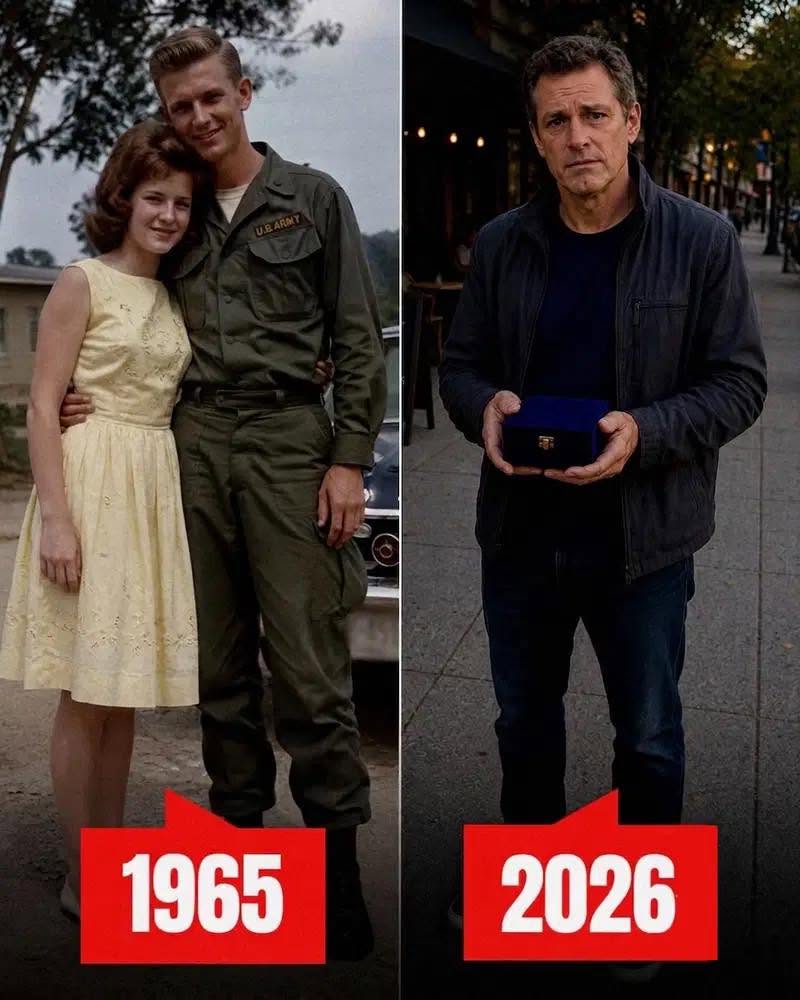
Then, on Benjamin’s eightieth birthday, a stranger walked into a café and placed a blue box beside my bouquet of red carnations.
“I made someone a promise,” he said. “No matter what happened, this had to reach you.”
His hands trembled.
Mine began trembling too.
The man looked to be in his late fifties. His hair was gray at the temples, and grief had settled deeply around his eyes.
But the eyes themselves were blue.
Benjamin’s blue.
He had Benjamin’s crooked smile and the same small dimple in his chin.
For one dizzying moment, it felt as though the boy I had loved had stepped out of my memories, aged more than sixty years, and taken the seat across from me.
“Who are you?” I whispered.
Before he could answer, the café door opened and my niece Wren hurried inside.
She saw the man, the box, and my face.
Then she stopped.
I looked at her.
“You knew about this?”
Wren slowly approached the table.
“Aunt Isobel, I knew someone had found something that might belong to you.”
“Might?”
“I needed to be certain before I put hope back into your hands.”
Anger cut briefly through my shock.
“I have carried my own hope for sixty-two years. I did not need you deciding when I was allowed to hold it.”
Her eyes filled.
“You’re right. I’m sorry.”
The stranger pushed the box gently toward me.
“Please open it.”
The blue cardboard was worn at the corners. A narrow brass clasp held the lid closed.
I placed my fingers against it and hesitated.
Every instinct told me that whatever waited inside would divide my life into two parts: everything I had believed before opening the box and everything I would know afterward.
I lifted the lid.
A silver ring rested on top of an old photograph.
The picture had faded, but I recognized it immediately.
Benjamin and I stood beneath the willow tree near my childhood home.
I was eighteen, wearing the yellow dress he loved. Benjamin stood behind me with his arms around my waist, his chin resting near my shoulder.
We looked certain of the future.
I turned the photograph over.
Seven words had been written across the back in Benjamin’s familiar handwriting.
Isobel, I will come home to you.
The café seemed to tilt.
I gripped the edge of the table, but the strength left my hands.
At a nearby table, a little girl with melting ice cream looked up at me. Without saying anything, she took a clean napkin from the dispenser and slid it in my direction.
“Here,” she whispered.
I pressed it to my mouth.
The stranger leaned closer.
“My name is Edward,” he said. “Benjamin is my father.”
I stared at him.
Then I saw it completely.
Not merely Benjamin’s eyes or dimple.
Benjamin’s son.
“No.”
Edward remained still.
“My Benjamin died in Vietnam.”
“He was listed as missing in action,” Edward said gently. “Later, he was presumed dead.”
“His mother came to my house. She stood on my porch and told me he was gone.”
“I know.”
“Then what are you saying?”
“My father survived.”
The words did not make sense.
I had spent most of my life believing Benjamin had been buried somewhere far from home, or perhaps never recovered at all.
Now a stranger was telling me he had lived.
Edward placed several old documents on the table.
“My father was badly injured during the war. His identification was delayed, and the records were confused for years. By the time everything was corrected, his mother had died. The address he remembered no longer led anywhere useful.”
Benjamin had lived.
While I mourned him, he had been somewhere beneath the same sky.
My hands closed around the silver ring.
“Where has he been?”
Edward glanced at Wren before answering.
“My father suffered a severe head injury. It affected his memory. He remembered fragments, emotions, and occasional images, but not enough to rebuild the life he had before.”
“He forgot me?”
“He forgot most of what came before the injury.”
A short laugh escaped me, though nothing was amusing.
For sixty-two years, I had remembered enough for both of us.
Edward placed another folder beside the box.
“How did you find me?” I asked.
“The photograph was the beginning. Then I found a page from an old school yearbook. Your full name was written beside your picture.”
Wren sat across from me.
“Edward found an article about your volunteer work,” she said. “Once I confirmed his documents, I told him you still visit the willow tree every year.”
I looked at the red carnations on the table.
That day was Benjamin’s birthday.
Every year, I brought those flowers to the tree where we had spent our last night together.
People sometimes asked whether I regretted never marrying or having children.
The answer was never simple.
I had not spent my life sitting beside a window in mourning. I had worked, traveled, volunteered, and surrounded myself with people I loved.
But I had never stopped loving Benjamin.
We met in high school.
He was restless, funny, and incapable of walking past a stray dog without trying to feed it. I was quieter and more cautious.
He made me laugh.
I made him slow down.
Most afternoons, we sat beneath the willow tree and imagined the life we would build.
We spoke about a small house, children, Sunday breakfasts, and growing old enough to forget what we had argued about.
Then the draft notice arrived.
The night before Benjamin left, we stayed beneath the willow until sunrise.
My hands shook the entire time.
He held them between his own.
“No matter how long it takes,” he told me, “I will come home to you.”
One year later, his mother arrived at my front door in tears.
Benjamin had been reported missing.
Months afterward, he was presumed dead.
I waited for years before accepting that no one was coming back.
I never married anyone else.
Instead, I poured the love I still carried into other lives. I volunteered in hospitals, read to sick children, and spent every Thursday sitting beside people who needed kindness more than conversation.
It did not replace Benjamin.
But it gave my grief somewhere meaningful to live.
“Why today?” I asked Edward.
“Because my father asked me to find you.”
My fingers tightened around the little girl’s napkin.
Edward looked at the blue box.
“Last month, I moved him into full-time care. I found this locked inside one of his drawers. When he saw it, he became very emotional.”
“Did he know what was inside?”
“Not everything. His memories return in pieces.”
Edward paused.
“But he had a lucid moment. He touched the box and said, ‘Belle must have it.’”
Only Benjamin had ever called me Belle.
The café disappeared around me.
“Is he safe?”
“Yes.”
“Is he well?”
Edward’s expression changed.
“His health is declining.”
Behind Benjamin’s familiar features, I saw something else.
Edward was not simply bringing hope to an old woman.
He was preparing to lose his father.
Wren reached for my hand.
“We can take you home,” she said. “You do not have to make any decisions now.”
Edward closed the box.
“You don’t have to see him today.”
I looked at them both.
Then I placed the ring carefully back inside.
“I have spent sixty-two years speaking to Benjamin as though he might still hear me.”
My hands continued to shake, but my voice had become steady.
“If he is close enough to answer, I am not waiting another day.”
I looked directly at Edward.
“Take me to him.”
During the drive, I held the blue box against my lap.
“Did he ever speak about me?” I asked.
Edward kept his eyes on the road.
“My father remembers emotions better than names. Sometimes he spoke about a girl in a yellow dress.”
My throat tightened.
“He said her hands shook.”
“Mine did.”
Edward glanced at me.
“The night before he left, I wore yellow because he told me I looked like walking sunshine. He said it made him feel brave.”
“Were you brave?”
I smiled through the ache.
“Benjamin always said courage meant being frightened and moving forward anyway.”
Edward smiled faintly.
“My father said the same thing.”
“He stole it from me.”
For one brief moment, Edward looked so much like Benjamin that I had to turn toward the window.
I found myself imagining the life Benjamin and I might have shared.
The home.
The children.
The son we never had.
Then I asked the question I had been avoiding.
“Did he marry?”
Edward’s hands tightened slightly around the steering wheel.
“Yes.”
The word landed harder than I expected.
“Who was she?”
“My mother helped him after he came home. She worked at a rehabilitation hospital.”
“Did she know about me?”
“She knew there had been someone before the war. She never knew your name.”
“Did he love her?”
Edward did not answer immediately.
“Yes,” he finally said.
Benjamin had survived.
He had built another life.
He had loved another woman.
The realization hurt, but anger did not come.
Instead, I imagined a wounded young soldier with damaged memories, trying to rebuild himself from whatever pieces remained.
“Is your mother still alive?”
“She died five years ago.”
“I’m sorry.”
“She was a good woman.”
The words came with difficulty.
That was how I knew they were true.
When we arrived at the care facility, a nurse met us outside Benjamin’s room.
“He may not recognize you,” she warned. “Please do not pressure him. If he becomes distressed, the visit will need to end.”
I nodded.
For sixty-two years, Benjamin had remained eighteen in my memories.
His hair was dark. His shoulders were broad. His hands were warm around mine beneath the willow.
Behind that door waited an eighty-year-old man I did not know.
I stopped with my hand near the handle.
“What if nothing is left?” I whispered. “What if there is nothing left of us?”
Edward’s expression softened.
“You do not have to go inside.”
Wren squeezed my hand.
I shook my head.
“I did not come this far to be brave in a hallway.”
Benjamin sat beside the window in a wheelchair.
His hair was thin and white. A blanket covered his knees, and one hand rested loosely on the armrest.
A moment later, he turned toward us.
His eyes were still blue.
Before my mind accepted him, my heart already had.
Edward stepped forward.
“Dad, someone came to see you.”
Benjamin looked at me with quiet politeness.
The hope I had carried into the room slowly folded in on itself.
“My name is Isobel,” I said.
“Isobel,” he repeated.
There was no recognition.
I sat beside him and opened the blue box.
Benjamin studied the ring.
“Pretty,” he said.
Edward moved forward, but I raised my hand.
I did not want anyone protecting me from reality.
“Do you remember a willow tree?” I asked.
Benjamin frowned.
“A yellow dress?”
His fingers began tapping lightly against the blanket.
The nurse stepped closer.
“That is enough for today.”
In the hallway, I leaned against the wall because my legs would no longer support me.
Wren wrapped her arms around me.
“Oh, Aunt Isobel.”
“He came back,” I whispered. “But the part of him that remembered me never did.”
Edward wiped his face with the back of his hand.
I looked at him.
“May I come back?”
He stared at me.
“You still want to?”
“I don’t know what I want. But I know I am not ready to leave.”
I returned two days later.
Then I came twice the following week.
Eventually, I stopped bringing out the ring.
I stopped asking Benjamin to remember.
Some days, he listened while I read.
Other days, he slept through most of the visit.
Once, he called me by his late wife’s name.
The mistake stung, but I said nothing.
He looked embarrassed.
“I keep losing people,” he whispered. “In my mind and in real life.”
Another afternoon, I was reading aloud when he interrupted me.
“That fellow talks too much.”
I closed the book.
“You talked all night once.”
“Did I?”
“Under a willow tree.”
Benjamin looked toward the window.
“Was I charming?”
“Occasionally.”
“Did it work?”
“For more than sixty years.”
He smiled.
Later, Edward followed me into the hallway.
“This is hurting you,” he said. “I can see it every time you leave.”
“I know.”
“Perhaps you should come less often.”
I turned toward him.
“You brought me here. Now you want me to disappear?”
“I do not want to watch you break every time he forgets you.”
His voice tightened.
“My mother is gone. My father is dying. I cannot carry your grief too.”
Guilt immediately filled his face.
Then I understood.
Edward was not trying to drive me away.
He was frightened of losing another person he cared about.
“I am not asking you to carry me,” I said gently. “I have carried myself for eighty years.”
“I only want to protect him.”
I placed my hand over his.
“I will not force his memories. I will not ask him to choose between your mother and me. I only want to sit beside him while I still can.”
Edward slowly nodded.
“All right.”
“But you do not have to carry everything alone either.”
Several weeks later, Edward arranged a short trip outside the care home.
He brought Benjamin to the willow tree.
Wren stayed several steps away while Edward pushed the wheelchair beneath the familiar branches. Then they quietly gave us space.
I knelt in the grass and placed a red carnation in Benjamin’s hand.
He rubbed one petal gently between his fingers.
“We sat here until sunrise once,” I told him.
He stared at the flower for a long time.
“You promised you would come home.”
His breathing changed.
Benjamin touched the dimple in his chin and slowly raised his eyes to mine.
“Belle?”
My hand flew to my mouth.
For one impossible moment, the fog disappeared.
“You wore yellow,” he whispered.
I laughed through my tears.
“It was the ugliest dress I owned.”
“You were beautiful.”
Behind us, Edward turned away.
Wren covered her mouth with both hands.
I slipped my hand beneath Benjamin’s.
He studied my face as though he were trying to cross sixty-two years in a single glance.
“You came back,” I whispered.
Benjamin shook his head.
“No. I think you came and found me.”
Only a few minutes later, the clarity disappeared.
He looked toward the lake and asked where he was.
But he had spoken my name.
He had remembered the dress.
That single moment did not return the life we had lost, but it healed something inside me that had remained open for more than six decades.
After that day, I stopped trying to reclaim the past.
I simply sat beside Benjamin.
I read to him.
Sometimes he held my hand without knowing why.
One afternoon, he looked at our joined fingers.
“Were you lonely?” he asked.
“Sometimes.”
“Because of me?”
I told him about the children I had comforted, the families I had helped, and the life I had slowly created.
“Loving you gave me more love than one life knew what to do with,” I said. “So I gave it away.”
Benjamin gently squeezed my fingers.
Several months later, Edward called before sunrise.
“I think it is time, Isobel.”
When I arrived, Benjamin lay peacefully in bed.
Edward sat on one side of him.
A single red carnation stood in a glass beside the window.
I took the chair on Benjamin’s other side and opened the book we had been reading.
My voice trembled too badly to continue.
Edward took the book from me and began reading.
When grief stole his voice, Wren continued.
As dawn approached, Benjamin slowly opened his eyes.
He looked first at Edward.
Edward leaned closer.
“I’m here, Dad.”
Then Benjamin turned toward me.
His hand moved weakly across the blanket.
I reached for it.
“Still shaking,” he whispered.
“Only a little.”
His gaze shifted toward the pale morning light.
“Did I make it home?”
I pressed his hand against my cheek.
“You did, Benjamin.”
His eyes returned to mine.
“Belle.”
A peaceful smile crossed his face.
Then his fingers slowly relaxed inside my hand.
Benjamin left this world as the first rays of sunlight entered the room.
I kissed his hand one final time.
“You kept your promise,” I whispered. “It simply took longer than we expected.”
At the funeral, I stood quietly near the back.
Edward walked toward me.
“Please sit with me,” he said. “You belong with the family.”
I followed him without speaking.
He placed a red carnation beside Benjamin’s photograph.
“My mother gave him a life after the war,” Edward said. “You carried the love he had before it.”
Several weeks later, Edward and Wren met me beneath the willow tree.
Edward handed me the familiar blue box.
Inside rested the silver ring and a new photograph.
It showed Benjamin and me beneath the willow during his final visit.
We were old.
His body was fragile, and my hair was white.
But our hands were joined.
I divided the red carnations into three small bouquets.
One went to Edward.
One went to Wren.
One remained with me.
For the first time in sixty-two years, I did not leave the flowers behind and walk away alone.
I had spent most of my life believing Benjamin had never found his way home.
In the end, he returned just long enough to keep his promise.
And when he left again, he gave me something even more precious than the future we had lost.
He left me a family.