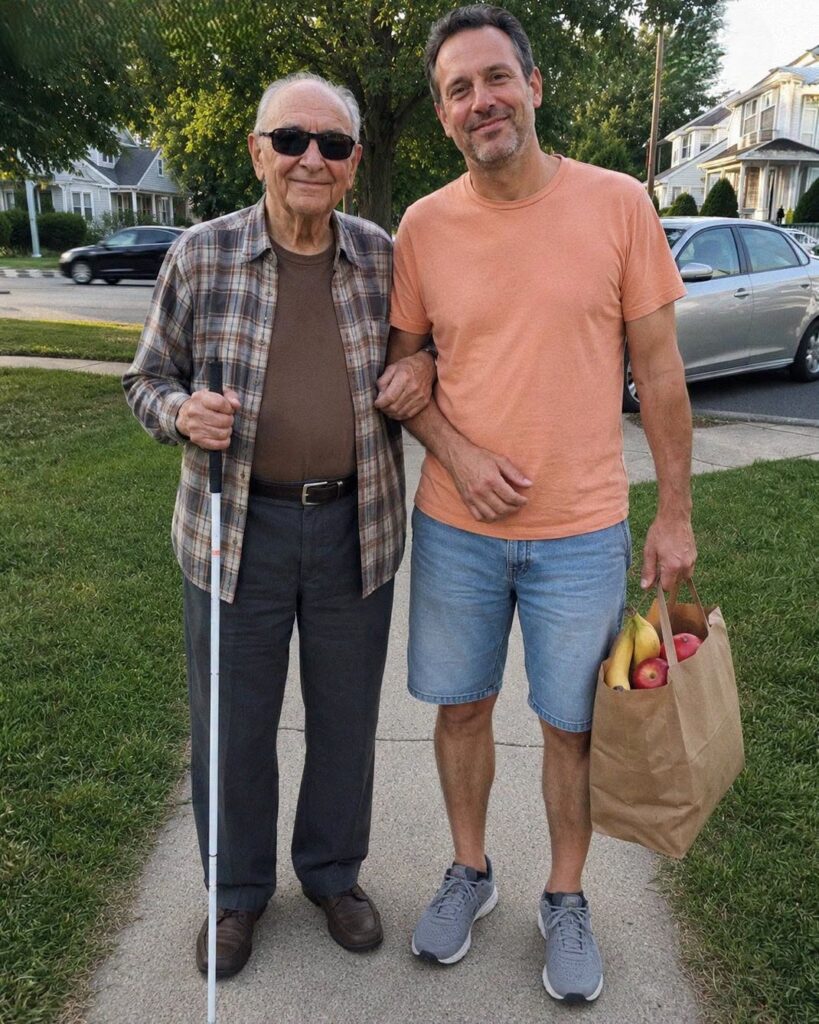
His hands trembled as he said, “Your dad made me promise to tell you where we really went.”
Ten years earlier, my father had been diagnosed with glaucoma.
By the time doctors discovered it, the damage was already severe. Within two years, most of his vision was gone. He could make out light, movement, and vague shadows, but little else.
Still, no one could persuade him to leave the house where he had lived for more than forty years.
“The kitchen still smells like your mother’s cooking,” he would tell me. “The hallway still has the dent from when you tried riding your bicycle indoors.”
“Dad, that happened when I was nine.”
“And the wall has never forgiven you.”
Whenever I suggested moving him closer to my family, his voice became softer.
“Leaving this place would feel like losing forty years with your mother all over again.”
I understood.
But I also lived almost a thousand miles away with two children, a demanding job, and a wife whose schedule was just as relentless as mine.
Dad could still dress himself, prepare simple meals, and move around the house by memory. What he could not safely manage alone were his medical appointments, errands, and transportation.
That was where Ben came in.
Ben had lived next door to my parents for decades. He was a retired roofer with broad shoulders, a stubborn streak, and a voice that seemed permanently set one level above normal conversation.
He had repaired our roof after storms, changed my mother’s flat tire, and once walked outside in his pajamas carrying a shovel because he heard a noise between the houses.
He was more family than neighbor.
So we made an arrangement.
Every Thursday, I paid Ben to drive Dad wherever he needed to go. Sometimes it was the glaucoma clinic. Other weeks, they visited the pharmacy, grocery store, bank, or a nearby diner.
“Your father spent his life helping everybody else,” Ben told me. “Let someone return the favor without making him feel helpless.”
The arrangement gave me peace.
I visited when work allowed, and Dad and I spoke on the phone every day.
He told me about meals he had cooked by touch, audiobooks he disliked, and checkers games Ben supposedly lost on purpose.
From the background, Ben would shout, “He’s lying!”
Dad never complained that I did not visit often enough.
He always asked about my children, my wife, and whether I had eaten a proper meal.
Some afternoons, I heard Ben arrive before our call ended.
A door would open. Keys would jingle.
Then Ben would announce, “Your royal carriage awaits.”
Dad would reply, “It smells like old coffee and questionable decisions.”
Their laughter made the distance between us feel smaller.
For eight years, I believed those Thursdays were ordinary.
Then Dad died peacefully in his sleep.
Ben found him on Friday morning, still wearing the blue sweater my daughter had given him the previous Christmas.
The funeral passed in a blur.
People brought casseroles, shook my hand, and told me how proud my father had been of me.
I thanked them, but my mind kept returning to our final phone call.
The previous evening, Dad had said, “Thursday was productive.”
“What does that mean?”
He laughed.
“Don’t interrogate an old man.”
My daughter needed help with homework, so I promised to call him the following day.
There was no following day.
After the burial, everyone slowly drifted toward the parking lot.
I stayed beside the grave, staring at the fresh earth and trying to understand how the world could keep moving when my father no longer existed inside it.
A light rain began to fall.
Then Ben approached me.
He wore the same brown coat he had worn to my mother’s funeral.
He stopped beside me and held out a sealed envelope.
My name was written across it in Dad’s uneven handwriting.
When I reached for it, Ben did not immediately let go.
His hands were trembling.
I had seen that man climb roofs during storms. I had watched him carry heavy timber alone and confront strangers twice his size.
I had never seen him afraid.
“He made me promise to tell you where we really went,” Ben said.
I thought he meant casinos, secret lunches, or some harmless adventure Dad had hidden because I worried too much.
A weak smile almost reached my face.
Then Ben looked toward the grave.
“I wasn’t only driving him.”
The rain grew heavier.
I tucked the envelope beneath my coat.
“What are you talking about?”
“The places mattered,” he said. “But what we were doing there mattered more.”
For several seconds, he said nothing.
Then he told me about Claire.
Claire was Ben’s only daughter.
I remembered her as a sharp, funny teenager who painted her bedroom walls black and blamed them whenever her father complained.
She had moved away after college.
I knew she and Ben rarely spoke, but I had never asked why.
“Claire and I stopped speaking years ago,” he said. “Whenever we did speak, we argued.”
He wiped rain from his face, though I suspected it was not only rain.
“Your father noticed something.”
“What?”
“Every time you mentioned your children, I went quiet.”
That sounded like Dad.
He had lost most of his sight, but he noticed what other people tried hardest to hide.
One Thursday, he asked Ben directly, “What did you do?”
Ben had bristled.
“Why assume I did something? Claire is stubborn as an ox.”
Dad replied, “You’re defending yourself rather strongly for an innocent man.”
Ben hated that response.
For three Thursdays, Dad kept asking questions.
Eventually, Ben gave in.
He admitted he had spent years making cutting remarks about Claire’s career, her marriage, and the way she was raising her children.
He believed he was offering advice.
Claire heard criticism.
When she stopped visiting, Ben convinced himself that she was ungrateful.
“I told your father I only said those things because I missed her,” Ben said. “She never came around the way you did.”
Dad’s answer had been immediate.
“You miss a great deal. You miss your daughter. You missed your chance to apologize. Goodness, man.”
Ben nearly turned the car around.
Instead, Dad instructed him to drive to the downtown library.
A patient librarian taught Ben how to send photographs, record video messages, and use emojis without making them look sarcastic.
Dad sat nearby and listened.
Whenever Ben complained that technology was ridiculous, Dad said, “Claire learned plenty of things to impress you. You can learn this.”
The following Thursday, Dad directed him to a bakery.
They bought flour, yeast, cinnamon, sugar, and enough butter to concern any reasonable doctor.
Ben had baked cinnamon rolls when Claire was young.
He had not made them since she left home.
They practiced in Dad’s kitchen.
The first batch burned.
The second did not rise.
The third became so dense that Ben claimed it could be used to repair the porch.
“It’s that useless oven,” Ben complained.
“The oven didn’t forget the timer,” Dad replied.
Then came the apologies.
Ben recorded one in the car.
Dad listened and shook his head.
“Too much defending yourself.”
He deleted it.
Ben tried another over lunch.
Dad deleted that one too.
By the end of the day, Ben was furious.
“What exactly do you want from me?” he demanded.
Dad gave him the same answer he would repeat for months.
“Do not tell her why you were right. Tell her why she matters.”
Ben wrote letters as well.
He read each one aloud because Dad could no longer see well enough to read them himself.
Dad told him which sentences sounded dishonest, which parts were excuses, and which words finally sounded true.
The final letter needed no corrections.
Dad told him it was ready.
Ben still could not send it.
I looked down at the envelope beneath my coat.
“That’s what this is?”
“Part of it.”
He explained that the envelope contained Ben’s final letter to Claire, along with instructions from Dad.
“After he died,” Ben said, “you were supposed to make sure I finished what we started.”
Anger surged through me.
I had buried my father less than an hour earlier, and Ben was handing me a task involving another family.
I pushed the envelope back toward him.
“No. I can’t do this for you today.”
Ben nodded.
He did not argue.
“There’s another letter inside,” he said. “That one is for you.”
I stared at the envelope.
Despite my anger, I could not refuse one final message from Dad.
I opened it.
His letter was short and typed, except for his signature at the bottom.
My boy,
Ben gave me freedom every Thursday without ever making me feel helpless.
He described curbs, doors, food, and faces so I always knew what was around me. He drove me to appointments and waited while I answered the doctors’ questions myself. He offered help without making me feel small.
Helping Ben was my way of returning that dignity.
And in a way, he was helping you too.
You may think I hid something from you.
I did.
I hid how useful I still felt.
I read the final line twice.
Then a third time.
For years, I had believed Ben was simply helping my father.
I had never considered how much my father was helping Ben.
Dad had lost his sight, but he had not lost his purpose.
Those Thursday trips gave him something I could not provide from a thousand miles away.
They made him feel needed.
I looked at Ben.
“For Dad’s sake, I’ll help you.”
Ben’s shoulders lowered slightly.
“But I won’t apologize for you,” I continued. “I won’t defend you or pressure Claire to forgive you. I’ll only be there, the way you were there for Dad.”
“That’s fair.”
We left the next morning.
Claire lived three hours away.
Ben began rehearsing before we reached the highway.
Every version opened with an apology and ended with a long explanation of why he had been misunderstood.
“That last part is an excuse,” I told him.
He tried again.
“So is that.”
By the fourth attempt, his hands tightened around the steering wheel.
“You enjoy correcting me almost as much as your father did.”
“We both like being right.”
Ben snorted.
“Your father would have enjoyed today.”
“It would have been Christmas for him.”
I laughed despite myself.
We stopped for coffee halfway there.
Ben considered throwing the letter into a river.
I locked it inside the glove compartment.
“You’re not legally entitled to confiscate my mail,” he said.
“Isn’t that why you brought me?”
He did not answer.
When we reached Claire’s house, Ben remained behind the wheel for several minutes.
The home was modest and warm, with flower beds along the walkway and children’s bicycles leaning against the garage.
Finally, we walked to the door.
Claire answered wearing gardening gloves.
She had Ben’s eyes and the same stubborn set to her jaw.
The moment she saw him, her face hardened.
“You should have called.”
Ben took one step backward.
I moved beside him and whispered, “Tell her why she matters.”
He looked at Claire.
Then he handed her the letter and a box of cinnamon rolls.
“I spent years protecting my pride,” he said. “I expected you to return because admitting that I hurt you would mean admitting I was wrong.”
His voice shook.
“I was wrong.”
Claire said nothing.
“More importantly, I made you feel as though nothing you did was ever good enough for me. I made you feel insignificant.”
She blinked rapidly.
Ben held out the box.
“These might be terrible. Your neighbor’s father refused to finish one, but he had very questionable taste.”
Claire looked toward me.
“Your father helped with this?”
I nodded.
“Every Thursday.”
Something in her expression shifted.
She did not hug Ben.
She did not forgive him.
For a moment, I thought she might close the door.
Instead, she opened the porch gate.
“Come in.”
We spoke for nearly two hours.
Ben told her about the library, the bakery, the letters, and the endless recordings Dad had forced him to redo.
I described my daily phone calls with Dad, his terrible jokes, and the empty chair waiting at his house.
Talking about him loosened something inside me.
Until then, my grief had felt like a knot tightening around every memory.
On Claire’s porch, it slowly began to untangle.
Claire listened quietly.
Then she went inside and returned carrying a small wooden box.
Inside were unsigned postcards she had received during the previous months.
Each held only one or two sentences.
Your father remembers more than he knows how to say.
He still makes cinnamon rolls badly.
Pride charges interest. I think he is finally tired of paying it.
Ben covered his face with both hands.
“I didn’t send these,” he whispered.
“I know,” Claire said.
Dad had prepared both sides.
He had not pressured Claire to forgive. He had simply reminded her that her father was trying.
Claire held Ben’s letter against her chest.
“I cannot pretend we’re fixed,” she said. “I don’t trust you yet.”
Ben nodded.
“You don’t have to.”
“One phone call every Thursday,” she said. “We start there.”
“I’ll call.”
On the drive home, Ben apologized for continuing to accept my payments after the Thursday trips became personal.
“I had forgotten about that,” I said. “Why did you keep taking the money?”
“Your father said you would become suspicious if our arrangement changed.”
He was right.
Dad had managed both of us until the end.
“You’re not receiving another payment,” I said.
Ben immediately began explaining that he had never wanted the money.
I raised one hand.
“You didn’t do anything wrong. You still cared for Dad. But Thursday drives are not work anymore.”
“Your father would argue with you.”
“My father is no longer in charge.”
Ben glanced at me.
“Do you actually believe that?”
I looked out the window.
“No.”
The following Thursday, I was still at Dad’s house sorting his tools and folding shirts that continued to smell like him.
At nine in the morning, tires crunched outside.
Ben arrived out of habit.
He froze when he saw me sitting on the porch with two cups of coffee.
“I assume the royal carriage still operates on Thursdays,” I said.
He looked toward Dad’s empty window.
“The carriage feels rather empty now.”
I handed him a cup.
“We could go for a drive.”
“What would be the point? You’ll become irritated when I describe every tree and building we pass.”
“I have a high tolerance for stubborn old men.”
He smiled.
We drove without choosing a destination.
Ben passed the library, the bakery, and Dad’s clinic.
At every turn, he looked as though he wanted to say something.
Then his phone rang through the car’s speakers.
Claire’s name appeared on the dashboard.
Thursday.
Exactly as promised.
Ben reached toward the answer button, then stopped.
He began rehearsing under his breath.
I touched his wrist.
“No rehearsals.”
His eyes filled.
He nodded and pressed the button.
“Hello, Claire.”
His voice trembled, but he said the words.
For a second, the car felt painfully empty.
Then Claire answered.
“Hi, Dad.”
Ben exhaled as though he had been holding his breath for years.
I turned toward the passenger seat where my father should have been.
As Ben and Claire began to speak, I unfolded Dad’s letter one more time.
For eight years, I believed those Thursday drives were simply a way to help my blind father live independently.
Only after he died did I understand the truth.
My father had not spent his final years waiting to be cared for.
He had spent them teaching another man how to find his way home.