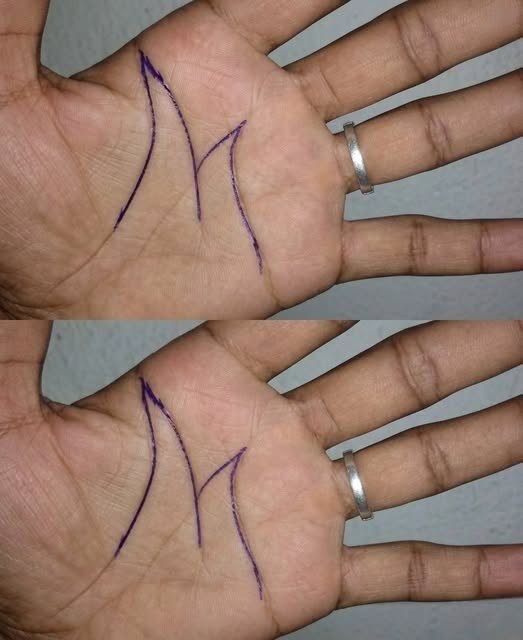
Traditional palmistry focuses on four primary lines:
- Life Line: Often associated with vitality, physical energy, and major life changes. Contrary to a common misconception, palmists do not believe it predicts how long a person will live.
- Heart Line: Believed to reflect emotional tendencies, relationships, and how a person expresses affection.
- Head Line: Traditionally linked to thinking style, learning, reasoning, and decision-making.
- Fate Line: Said to represent career direction, life path, and the influence of outside circumstances. Not everyone has a prominent Fate Line.
The Meaning of the “M” Shape
One of the most talked-about palm markings is the letter M, which some people believe is formed when several major palm lines intersect.
According to traditional palmistry, this marking is associated with qualities such as:
- Leadership.
- Determination.
- Self-confidence.
- Strong intuition.
- Resilience when facing challenges.
Some palmistry traditions also suggest that people with an “M” are good judges of character and may have a heightened ability to recognize honesty or deception.
It’s important to remember that these interpretations are symbolic beliefs rather than scientifically established facts.
The Crescent Moon Symbol
Another marking sometimes discussed in palmistry is a crescent moon shape, usually described as appearing near the lower portion of the palm.
Traditional interpretations associate this symbol with:
- Imagination.
- Creativity.
- Emotional sensitivity.
- Intuition.
- Personal growth and transformation.
People who believe in palmistry often view the crescent moon as representing a rich inner life and an openness to new experiences.
When Both Symbols Appear Together
Some palmistry traditions suggest that having both an “M” shape and a crescent moon is especially significant.
In symbolic interpretations:
- The M represents determination, confidence, and practical action.
- The crescent moon symbolizes intuition, creativity, and emotional insight.
Together, they are said to represent a balance between logic and instinct, encouraging both thoughtful decision-making and personal growth.
Palmistry Looks at the Whole Hand
Experienced palm readers typically do not base interpretations on a single marking alone. Traditional palmistry also considers:
- Finger length and shape.
- Thumb flexibility.
- Palm shape.
- Skin texture.
- Mounts (the raised areas of the palm).
- Other minor lines and markings.
Different palmistry traditions may interpret the same hand in different ways, and there is no universally accepted system.
A Symbolic Tradition
While palmistry remains popular across many cultures, there is no scientific evidence that palm lines can predict personality, future events, or destiny. Most people who practice or explore palmistry view it as a cultural tradition, spiritual practice, or form of personal reflection rather than a proven method of forecasting life.
Whether viewed as folklore, entertainment, or a source of personal inspiration, the enduring appeal of palmistry lies in its invitation to reflect on one’s strengths, aspirations, and unique journey. For many, the markings on the hand serve less as predictions and more as reminders to pursue growth, resilience, and self-understanding.