…only the scarred, barren earth where the prefabricated cabins had stood just ninety minutes prior. The skid marks were deep, gouged into the pine-needle-strewn soil like the tracks of a retreating army. My brain stuttered, refusing to process the visual evidence of the missing vehicles, the vanished coolers, and the complete absence of the people who had brought us here under the guise of a family reset. It was a calculated, surgical extraction of our existence from their lives.
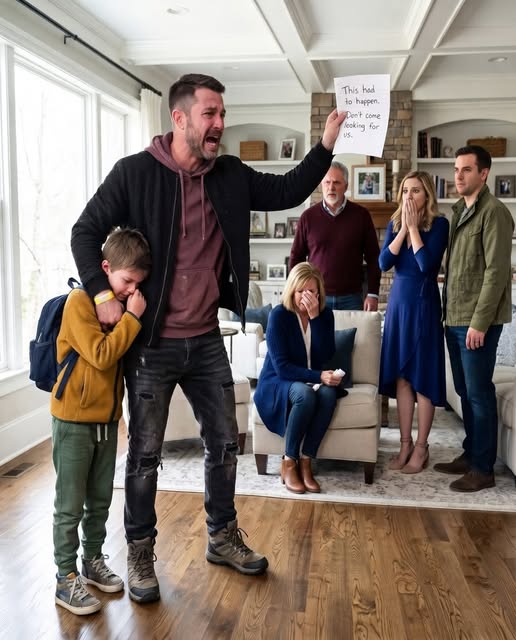
I moved toward the pine tree where a white envelope was pinned, the paper stark against the rough, dark bark. My mother’s handwriting, elegant and precise, felt like a physical blow to my chest. The note was a manifesto of cold detachment, framing our abandonment as a necessary correction for my perceived failures. They had viewed my grief over Claire—my inability to simply move on from her death—as a burden they were no longer willing to subsidize. They had left us with nothing.
Noah’s eyes were wide, reflecting a terror that no child should ever have to harbor. He did not scream; he simply stood there, his small frame vibrating with the effort to remain brave for my sake. That silent stoicism was the sharpest blade of all. I realized then that my family had not just left us; they had attempted to erase us, assuming the wilderness would finish the task they had started with their departure. They had underestimated my resolve.
The first night was a descent into a frigid, star-dusted hell. I fashioned a lean-to from deadfall and pine boughs, wrapping Noah in my only jacket while I shivered in the biting mountain air. My mind cycled through the years of resentment I had endured—the way Melissa had rolled her eyes at my tears, the way my father had demanded I perform a masculinity that felt like a cage. They had always treated my grief as a flaw, a crack in their polished family facade.
Days blurred into a singular, agonizing struggle for survival. We scoured the perimeter, finding only scraps of refuse—a crushed bottle, a discarded wrapper—remnants of the life they had enjoyed while planning our demise. I taught Noah how to find water in the mossy crevices of rocks and how to conserve heat. We spoke little, our energy reserved for the grueling task of staying upright. Each morning, I woke with a singular, burning focus that eclipsed the hunger gnawing at my stomach.
By the fourth day, the fever began to set in, a byproduct of exposure and the sheer physical toll of the altitude. I hallucinated Claire’s voice in the wind, whispering encouragement, telling me to keep walking, to keep Noah safe. I used those moments to fuel my anger, turning it into a protective barrier against the despair that threatened to swallow us. I was no longer the man they had mocked; I was a creature forged in the crucible of their cruelty.
On the ninth day, the rhythmic thrum of rotors broke the mountain silence. When the rescue crew finally descended, they found us huddled together, skeletal and feverish, but alive. I watched the helicopter approach with a detached, predatory calm. As the medics swarmed us, wrapping us in thermal blankets and checking our vitals, I didn’t cry. I didn’t thank them for the miracle of our discovery. I only asked for a phone, my voice raspy and hollow, to prepare for the aftermath.
The recovery process in the hospital was a blur of IV drips and concerned faces, but my mind was elsewhere. I had kept a meticulous mental log of the route Troy had taken, the landmarks we passed, and the specific rental company that provided the cabins on skids. I knew where they were. I knew the rhythm of their lives, the way they would be settling back into their comfortable, suburban existence, believing they had successfully severed the tether of my grief.
When I was finally discharged, I did not go home. I went to the authorities, not as a victim, but as a witness to a crime. The investigation was swift once the evidence of the abandoned site was corroborated by the rental company’s records. My family’s attempt to hide their tracks had been sloppy, born of an arrogance that assumed I would never survive long enough to speak. They had left a trail of financial records and rental agreements that led directly to their front doors.
The final confrontation happened in the sterile, fluorescent-lit halls of the local precinct. When Richard and Elaine saw me, their faces didn’t register remorse; they registered shock, then a frantic, defensive indignation. Melissa tried to speak, to frame their actions as a desperate measure, but I simply stared at them, my presence a living, breathing indictment of their morality. The law would handle the charges of endangerment and abandonment, but the true resolution was already complete.
I looked at Noah, who stood beside me, his hand firmly in mine. He was safe. He was strong. And as I turned my back on the people who had once been my world, I felt the final weight of their expectations dissolve. They had tried to break me, to leave me in the dirt of the San Juans to wither away, but they had only succeeded in stripping away the last of my illusions. I walked out of the station into the cool, clear air, finally free of the family that had never truly known me, leaving them to face the consequences of a coldness that had finally, inevitably, returned to claim them.