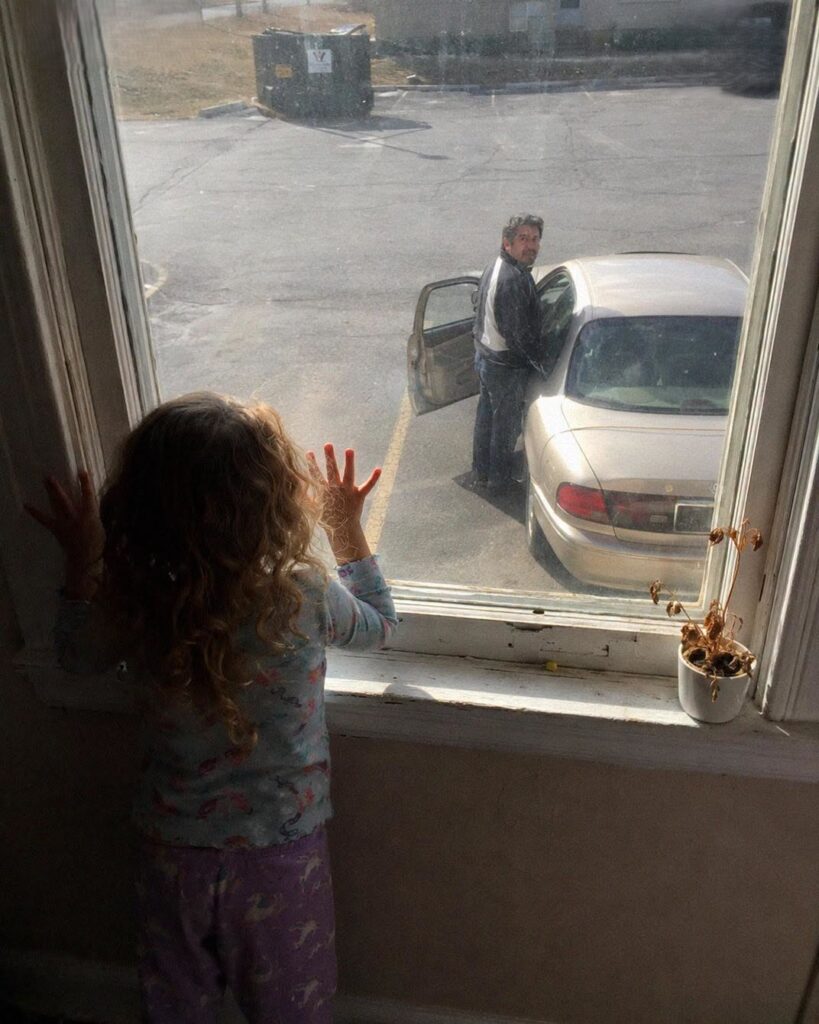
“It’s handled.”
Then one afternoon, I finally marched to his door and demanded an explanation.
Without saying a word, he handed me an old shoebox.
What I found inside changed everything I believed about him—and about the little home my daughter and I had fought so hard to keep.
My name is Poppy. I was 31 when my marriage ended, leaving me with a four-year-old daughter, $1,100, and a car that only started if I turned the key twice and whispered a prayer.
That was nearly everything I could still call mine.
For years, I had believed my life was stable. My husband and I had plans, routines, bills divided between us, and a future that seemed predictable.
Then, in less than a month, he moved out.
The bills stayed.
The plans disappeared.
And suddenly, every ordinary expense felt like a threat.
My daughter, Trixie, was too young to understand why her father no longer slept in our house. She only knew we were packing her clothes into cardboard boxes.
One afternoon, she held up a purple sweater.
“Are we going somewhere fun?”
I forced myself to smile.
“We’re going somewhere new.”
“Will Daddy come?”
The question hit me harder than I expected.
“Not today, sweetheart.”
She accepted the answer with the simple trust children sometimes have. Then she folded the sweater badly and placed it in the box.
I turned away before she could see me cry.
I had no savings, a part-time job at a dental office, and barely enough money to cover groceries.
Every night after Trixie fell asleep, I searched apartment listings.
Most landlords wanted the first month’s rent, a security deposit, proof of income, references, and a credit score I did not have.
Some stopped responding when I mentioned my daughter.
Others wanted more in rent than I earned in an entire month.
By the end of that week, fear had settled into my body like something permanent.
It lived in my stomach.
It tightened my chest whenever my phone rang.
It followed me into every conversation and made me ashamed of needing help.
Then I saw a handwritten notice taped inside the window of a neighborhood grocery store.
“GARAGE APARTMENT FOR RENT. PALMER STREET. $800. ASK FOR ALVAREZ.”
I stared at the paper for so long that the cashier finally looked up.
“Do you need something?”
“Is this apartment still available?”
She glanced toward the sign.
“You’ll have to ask him.”
“Do you know Mr. Alvarez?”
“Everybody around here knows Mr. Alvarez.”
The way she said it made me nervous, but I copied down the address anyway.
The apartment was a converted garage behind an old blue house on Palmer Street.
It had one bedroom, a kitchen barely large enough for two people, and a window above the sink that faced a row of tomato plants.
The paint was faded.
The bathroom floor tilted slightly.
The refrigerator buzzed constantly.
There was no dishwasher, no laundry room, and no place for a dining table.
To me, it looked like safety.
Trixie ran from one side of the bedroom to the other.
“Can I put stars on the ceiling?”
“We’ll see.”
“That means no.”
“It means we’ll see.”
She opened the closet and frowned.
“It’s small.”
“So are your clothes.”
She laughed.
Mr. Alvarez met us in the driveway.
He looked to be in his seventies and wore a gray work shirt buttoned neatly to the collar. His hair was white and cut close to his head. His hands were rough, and a pale scar ran beside his left thumb.
His face revealed absolutely nothing.
He looked at me.
Then at Trixie.
Then at my car, which had stalled twice on the way there.
He asked only three questions.
“Do you smoke?”
“No.”
“Do you have a dog?”
“No.”
“Is the little girl yours?”
“Yes.”
Trixie moved closer and slipped her hand into mine.
Mr. Alvarez looked at her for another moment.
“Eight hundred dollars a month,” he said. “First day of the month. No lease. I don’t like paperwork.”
I almost cried in the driveway.
Eight hundred dollars was less than half the price of nearly every apartment I had found.
“Is there a deposit?”
“No.”
“Application fee?”
“No.”
“Do you need proof of income?”
He stared at me.
“Can you pay $800?”
“Yes.”
“Then move in Saturday.”
That was the entire conversation.
No background check.
No interrogation about my marriage.
No judgment about my finances.
I thanked him so many times that his expression finally shifted.
“Stop thanking me,” he said. “Pay on time.”
“I will.”
And I did.
We moved in with six cardboard boxes, two suitcases, and a mattress my sister had given us.
Trixie slept in the bedroom.
I slept on a narrow sofa in the living room.
On our first night, rain drummed against the roof.
Trixie came out holding her blanket.
“I can’t sleep.”
“Is the rain too loud?”
She nodded.
I lifted the blanket.
“Come here.”
She curled beside me and rested her head against my shoulder.
“Do you like our new house?”
I looked around the tiny room.
“I think I will.”
“I like the