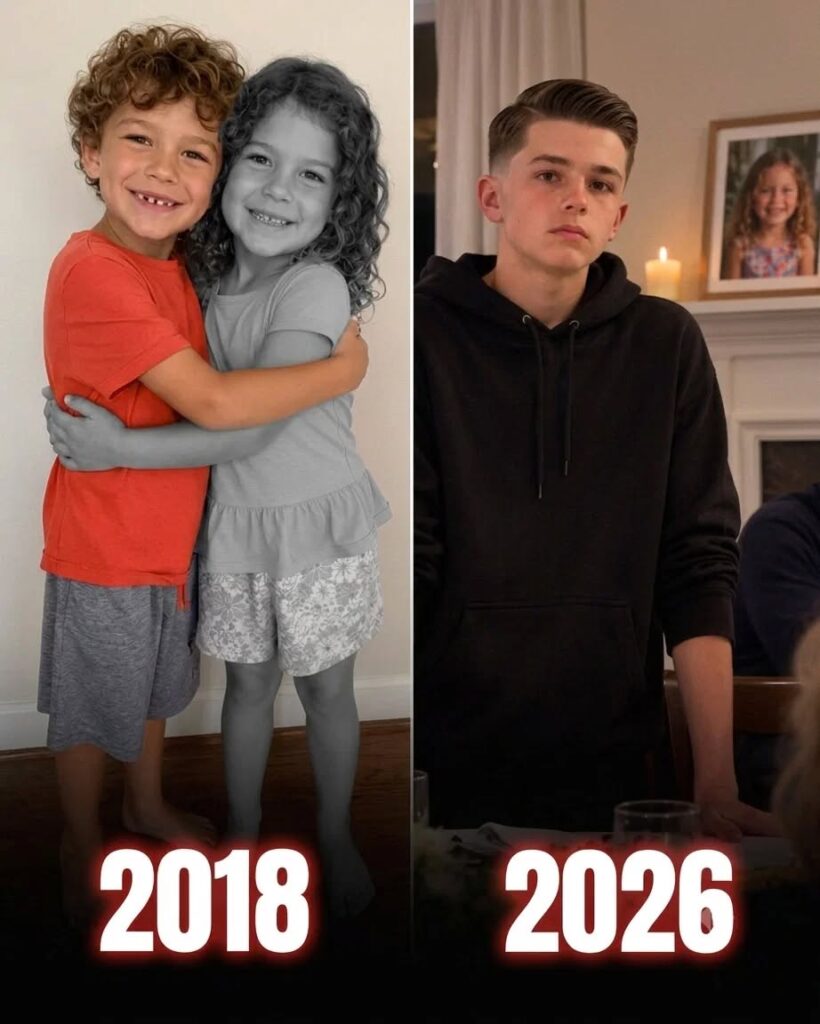
Jeremy and Janice were born eleven minutes apart.
From the beginning, they seemed to move through life as one person divided into two bodies.
They slept better in the same room.
They invented games no one else understood.
They could communicate with a glance, a laugh, or a private gesture that left the rest of us guessing.
If one woke from a nightmare, the other woke too.
If Jeremy fell and scraped his knee, Janice cried before he did.
For five years, they were almost never apart.
Then my husband, Zane, took them to the lake.
Only Jeremy came home.
Zane told me Janice had slipped while climbing over the rocks near the water.
The current caught her before he could reach her.
He said he jumped in.
He said he swam until his arms gave out and searched until rescuers forced him back to shore.
Her body was never recovered.
The police called it a tragic accident.
Jeremy stopped speaking on the day of her funeral.
It did not happen gradually.
He did not begin using fewer words or become quieter over time.
He simply stopped.
He stood beside me in a tiny black suit, one hand locked around mine, while an empty white coffin was lowered into the ground.
After that, he never spoke again.
I took him to doctors.
Therapists.
Trauma specialists.
We tried music therapy, art therapy, play therapy, and eventually medication for the anxiety that kept him awake at night.
I read to him every evening, hoping one day he would interrupt me or ask for another chapter.
He never did.
He communicated through gestures, short notes, and expressions I learned to understand.
For years, I convinced myself that silence was the only way his young mind knew how to survive.
Zane and I did not survive in the same way.
Our marriage unraveled slowly after Janice died.
There was no single explosive argument.
We simply became two grieving people living beneath the same roof, each unable to reach the other.
Zane worked longer hours.
I spent nearly every moment focused on Jeremy.
Eventually, we separated.
He still attended birthdays, holidays, and school events, but he never stayed long.
Every year on the anniversary of Janice’s death, I hosted a small family dinner.
I made blueberry pie because Janice had once called it “birthday pie.” She believed anything sweet deserved candles, regardless of the occasion.
Zane always came.
He sat at the far end of the table.
He rarely looked directly at Jeremy.
And he always left before dessert.
That year, Jeremy was thirteen.
He had grown tall and thin, with Zane’s dark hair and Janice’s serious eyes.
His teachers described him as brilliant.
He completed assignments far above his grade level and communicated through a tablet in class, but he had not spoken a single word in eight years.
From the moment Zane entered the dining room, Jeremy watched him.
Not casually.
Not with curiosity.
He studied him.
Zane noticed.
I saw the way his eyes kept shifting toward our son before moving quickly away.
We were halfway through dinner when Jeremy placed his fork on the table.
The sound was small.
Still, every person in the room seemed to hear it.
Jeremy looked at me first.
Then at my parents.
Finally, he lifted his arm and pointed at Zane.
His breathing became quick and shallow.
His lips trembled.
Then, in a voice that sounded rusty from years of disuse, he said:
“You knew why I stopped talking.”
No one moved.
For one impossible moment, the sound of his voice mattered more than the words.
“Jeremy?” I whispered.
His eyes widened, as if he had not meant to let the sentence escape.
Then he pushed back his chair, ran upstairs, and slammed his bedroom door.
I started after him.
Zane caught my wrist.
“Let him calm down.”
I looked down at his hand.
Then at his face.
For eight years, I had seen grief there.
Guilt.
Exhaustion.
But that night, I saw something else.
Fear.
I pulled my arm free.
“What did he mean?”
“He’s upset,” Zane said. “This date always brings everything back.”
“Do not do that.”
“Claire—”
“Do not dismiss what he said.”
My parents sat frozen at the table.
No one touched their food.
“What did you know?” I demanded.
Zane looked toward the stairs.
Then he shook his head.
“It is not what you think.”
I laughed bitterly.
“I don’t know what to think.”
He stayed another twenty minutes.
He barely spoke.
Then, as always, he left before dessert.
Jeremy refused to open his bedroom door.
I sat outside it for hours, telling him he was safe and that he did not have to explain anything before he was ready.
Around midnight, a folded sheet of paper appeared beneath the door.
My hands shook as I opened it.
**I heard Dad and Uncle Dean fighting before the lake.**
I read the sentence twice.
Then I saw more writing beneath it.
**Dad said, “If Nora goes to the board, we lose the house.”**
**Uncle Dean said, “Then keep her quiet until this is done.”**
My heart began pounding.
At the bottom of the page was one final line.
**Janice heard it too.**
I sat on the hallway floor until sunrise.
Memories I had never questioned began rearranging themselves.
The lake trip had been sudden.
Zane had announced it the night before, claiming the twins needed fresh air and that I deserved a quiet day alone.
At the time, I had considered it thoughtful.
Now I wondered whether he had been trying to remove them from something.
Or someone.
At breakfast, Jeremy came downstairs but would not look at me.
He sat at the table and pushed another note across the surface.
**I found Nora in Dad’s old file box.**
An address was written beneath the words.
I did not ask how long he had known.
I did not ask why he had searched Zane’s things.
I took my coat and drove.
Nora lived forty minutes away in a brick duplex on a quiet street.
She opened the door cautiously.
She was around my age, perhaps slightly older, with gray beginning at her temples.
“Can I help you?”
I held out Jeremy’s note.
“My son spoke for the first time in eight years last night.”
Her expression changed instantly.
“Jeremy?”
The fact that she knew his name made my stomach turn.
“How do you know my son?”
She stepped aside.
“You should come in.”
We sat at her kitchen table.
I told her everything.
Jeremy’s words at dinner.
The notes.
The argument he and Janice had overheard.
When I finished, Nora did not begin with the financial records.
She opened an old folder and removed a faded child’s drawing.
Two stick figures stood beside a wide strip of blue water.
In one corner, written in shaky block letters, were the words:
**NORA BAD MAN MAD**
I stared until the letters blurred.
“Janice drew this?” I asked.
Nora nodded.
“She gave it to me the day before the lake trip.”
My throat tightened.
“You knew her?”
“Only briefly.”
She placed both hands around a cup of untouched tea.
“Zane and Dean were arguing at the office. Jeremy and Janice were nearby with coloring books. Janice wandered into the hallway.”
“She heard them.”
“Enough to know someone was angry with me.”
I looked down at the drawing.
“What does any of this have to do with Jeremy not speaking?”
Nora was quiet for several seconds.
“He was five years old,” she finally said. “He heard two adults arguing about keeping someone quiet. Janice heard it too. Then she died the next day.”
My stomach twisted.
“A frightened child can build a terrible explanation from those pieces.”
I already knew what she meant.
Jeremy must have believed Janice died because she had overheard the argument.
Perhaps he believed talking was dangerous.
Perhaps silence had been his way of ensuring no one else disappeared.
“Tell me what they were fighting about.”
Nora opened another folder.
“Did Zane ever tell you the truth about your first house?”
Twenty-two years earlier, when I was pregnant, we had nearly lost that house during a financial crisis.
Zane told me an anonymous investor had provided a temporary loan while he reorganized the family business.
I had always believed my husband had saved us.
“I was the investor,” Nora said.
She slid an old loan statement across the table.
Our address appeared at the top.
“You?”
“I was a junior accountant at the company.”
She added another document.
It showed a series of internal transfers routed through Zane’s division.
Dean’s initials appeared beside several entries.
“Dean was shifting losses into Zane’s accounts,” Nora explained. “He wanted the division to appear unstable.”
“Why?”
“If it failed, he could force Zane out, buy his shares at a lower price, and gain control of the company.”
I stared at the pages.
“And the house?”
“It was tied to the business loan. Dean used it as leverage.”
Nora had discovered the transfers and copied the records.
She warned Zane.
Then she used part of her inheritance to cover the overdue loan temporarily, giving him time to challenge the accounting.
“Why would you risk your own money?”
“Because what Dean was doing was wrong.”
“What happened to you?”
Her expression hardened.
“Dean blamed the irregularities on me.”
She was dismissed.
Rumors spread that she had manipulated company accounts.
Other employers refused to hire her.
She lost her career while Zane remained silent.
“Why didn’t he defend you?”
“At first, he said he needed time to gather proof.”
“And later?”
“He said exposing Dean would destroy the family company and risk your home.”
I pushed the papers away.
“What does this have to do with the lake?”
“Nothing directly.”
I looked up sharply.
“So Zane told the truth about Janice?”
“Yes.”
Nora answered without hesitation.
“Her death was an accident.”
I closed my eyes.
For years, I had imagined every possible version of what could have happened near that water.
Hearing it had truly been an accident should have brought relief.
Instead, I felt sick.
Because now I understood what Jeremy had carried.
He heard his father and uncle discuss keeping Nora quiet.
Janice overheard them too.
The next day, she disappeared into the lake.
To a five-year-old, those events must have seemed connected.
“Zane knew they heard the argument,” I said.
“Yes.”
“And he never explained it.”
“No.”
“Why?”
Nora let out a slow breath.
“After Janice died, everything became wrapped in grief. Jeremy stopped speaking. Your marriage began falling apart.”
She looked down.
“Zane convinced himself that telling you about the fraud would make the accident look suspicious. Then more time passed.”
“And shame became easier than honesty.”
Nora nodded.
She handed me one last envelope.
My name was written across the front.
Inside was a letter from Zane dated six weeks earlier.
**If Claire ever comes to you, give her this.**
In the letter, he admitted everything.
Dean had manipulated the company records.
Nora had saved our home.
Zane had remained silent while she lost her career and reputation.
He also admitted knowing that both children had overheard part of the argument.
He wrote that after Janice died, he had become terrified that revealing the truth would make Jeremy believe his sister’s death had been connected to the company dispute.
But Jeremy already believed that.
Zane’s silence had not protected him.
It had confirmed his worst fear.
“When did Zane send this?” I asked.
“Six weeks ago.”
“Why then?”
“The company announced that Dean would be honored at the founders’ dinner.”
Nora folded her hands.
“Zane said he was finally ready to stop protecting him.”
“And yet he still said nothing.”
“No.”
When I returned home, Zane was sitting on my front porch.
He stood as soon as he saw me.
“Claire.”
I did not invite him inside.
“Did Janice and Jeremy hear you arguing with Dean before the lake trip?”
His face changed.
Behind me, the screen door shifted.
Jeremy stood just inside the house.
Zane saw him.
There was nowhere left to hide.
“Yes,” he said.
“You knew they heard?”
“I knew they had heard something. I did not know how much.”
“And after Janice died, you allowed Jeremy to believe that argument had something to do with it.”
“I didn’t know what he believed.”
“He stopped speaking the day of her funeral.”
Zane sat heavily on the porch step.
“I thought if I told him the truth, he would believe I had caused her death.”
“He already believed that.”
He covered his face.
“I know.”
“No. You know now because he finally told us.”
My anger rose with every word.
“What you hid was not the accident. You hid the pressure surrounding it. The fraud. Nora. Dean’s threat.”
“I was trying to protect the family.”
“You protected Dean.”
Zane looked up.
His eyes were red.
“I was afraid of losing the house. Then I was afraid of losing the company. After Janice died, I was afraid of losing you and Jeremy.”
“You lost us anyway.”
He flinched.
I stepped closer.
“Nora lost her career because you stayed silent.”
“I know.”
“Jeremy lost eight years of his voice.”
His shoulders collapsed.
“I know.”
“And Janice died believing something terrible was happening around her.”
“Claire, please.”
I was finished with pleas.
During our separation, Zane had transferred his voting shares in the family company to me.
At the time, he said grief and guilt had made him incapable of dealing rationally with Dean.
A week later, the company held its annual founders’ dinner.
Dean was expected to be named honorary chairman.
He arrived smiling, shaking hands, and accepting congratulations before the announcement had even been made.
When the master of ceremonies approached the podium, I stood.
“I need to speak first.”
The room grew quiet.
At first, people smiled politely.
Then I said Nora’s name.
Dean’s expression changed.
I told them everything.
The false transfers.
The loan attached to our house.
The evidence Nora had copied.
The way she had been blamed and removed.
Then I told them about what followed.
“Nora paid for this company’s comfort with her career,” I said.
“My son paid for it with eight years of silence.”
Dean attempted to laugh.
“This is an old grievance being dressed up as a scandal.”
I held up the proxy documents.
“Zane transferred his voting authority to me during our separation.”
The laughter disappeared.
“I will not approve your appointment. I am also requesting an independent review of the company’s historical records.”
Nora stepped forward with the documents.
A retired accountant who had trained her confirmed the transfer patterns and signatures.
Two former employees provided statements explaining that Dean had previously blamed them for irregular entries they had not created.
Before the evening ended, the framed citation prepared for Dean’s appointment had been removed from the stage.
The investigation uncovered enough falsified reporting and financial manipulation to remove him permanently from leadership.
Nora’s professional record was formally corrected.
The company issued a public apology and reached a financial settlement with her.
She accepted enough to recover what she had lost.
She refused the rest.
“I don’t want to be paid to disappear again,” she told the board.
The old house looked smaller when I returned to it afterward.
For years, I had treated it as proof that Zane had protected our family.
Now it reminded me that someone else had paid for our security.
I sold it that spring.
Part of the proceeds established the Nora Grant, which helped women return to careers after being unfairly pushed out of their professions.
That was the public ending.
The real ending happened quietly.
One Saturday morning, I was making blueberry pancakes when Jeremy entered the kitchen.
He had started attending therapy again.
Since the dinner, he had spoken only a few words at a time.
Each sentence seemed to cost him something.
He sat at the table and watched me flip a pancake.
Then he asked, quietly but clearly:
“Did Janice like these more than the pie?”
I nearly dropped the spatula.
I turned toward him.
“Yes,” I whispered. “She did.”
He nodded.
“I remember.”
I set the spatula down and sat beside him.
For eight years, remembering Janice had sounded like danger in our house.
It had sounded like blame.
Like guilt.
Like a question no one knew how to answer.
That morning, for the first time, it sounded like love.
Jeremy began speaking more after that.
Not quickly.
Some days he said only one sentence.
Other days he returned to writing notes.
We never forced him.
His voice belonged to him, and he would decide how and when to use it.
One evening, he asked Zane to visit.
They sat across from each other in the living room for nearly an hour before Jeremy spoke.
“Did you try to save her?”
Zane’s face crumpled.
“Yes.”
“Did you stop because of the argument?”
“No.”
“Did Uncle Dean hurt her?”
“No.”
Jeremy stared at his hands.
“Then why didn’t you tell me?”
Zane cried before he answered.
“Because I was a coward.”
Jeremy nodded slowly.
“That hurt me more.”
“I know.”
“No,” Jeremy said. “You’re learning.”
It was more mercy than Zane deserved.
But it did not mean everything was repaired.
Jeremy did not immediately forgive his father.
Neither did I.
Forgiveness was not a reward for finally admitting the truth.
It was something that might come after years of honesty, accountability, and change.
Zane began testifying in the investigation.
He publicly admitted his role in protecting Dean.
He apologized to Nora without asking her to reassure him.
Most importantly, he stopped hiding from Jeremy’s questions.
On the next anniversary of Janice’s death, we held our family dinner again.
Zane came.
This time, he did not sit at the far end of the table.
He sat beside Jeremy.
He stayed through dessert.
I placed candles in the blueberry pie because Janice would have insisted.
Before we blew them out, Jeremy looked at all of us.
“I want to tell a story about her.”
His voice trembled, but he continued.
He told us how Janice used to cheat at board games.
How she hated socks.
How she believed clouds followed the car during road trips.
We laughed.
Then we cried.
For years, silence had been the only memorial Jeremy knew how to give his sister.
That night, he gave her his voice.
After dinner, he stood beside me at the kitchen sink.
“Mom?”
“Yes?”
“I thought if I talked, something bad would happen.”
I turned off the water.
“You were five.”
“I thought Janice talked too much. I thought that was why she disappeared.”
I pulled him into my arms.
“Nothing she said caused her death.”
“I know that now.”
He rested his head against my shoulder.
“And nothing you said caused it either,” I whispered.
His arms tightened around me.
The truth did not bring Janice back.
It did not restore the eight years Jeremy spent in silence.
It did not erase Zane’s cowardice or Nora’s losses.
But truth finally separated the accident from the secrets surrounding it.
It gave Jeremy something fear had stolen from him.
The right to remember his sister without believing her death was a punishment.
And when my son spoke her name again, it no longer sounded like guilt.
It sounded like Janice was finally allowed to come home.