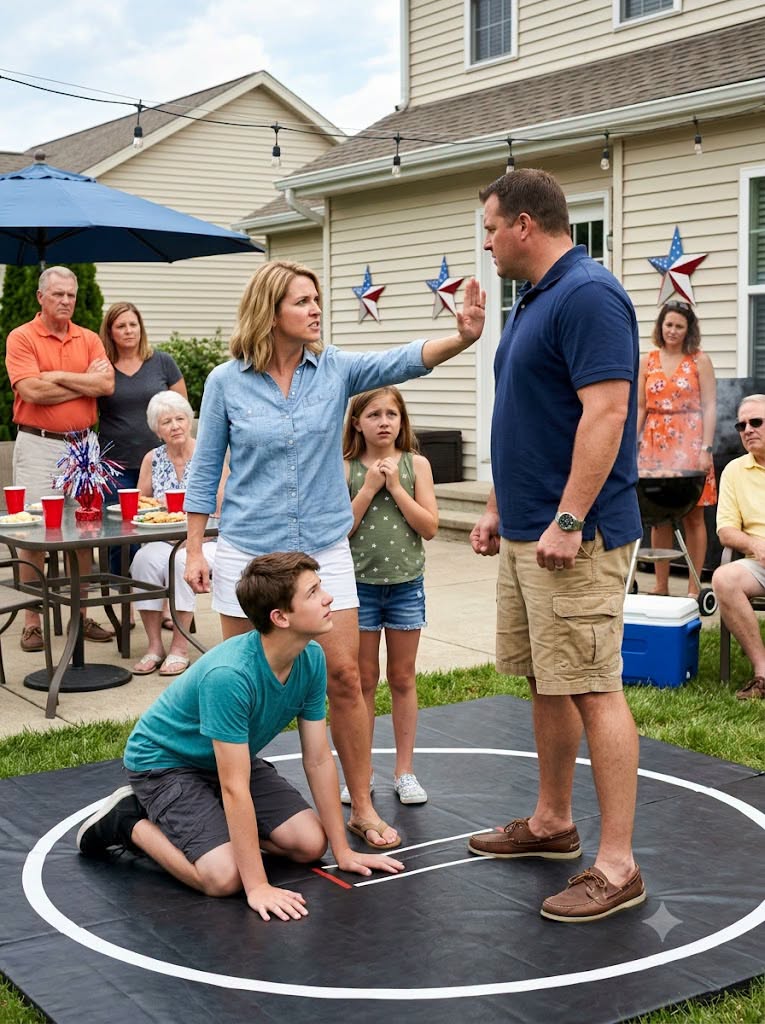
Then Derek decided Caleb would become the entertainment.
My brother-in-law had always been skilled at disguising cruelty as humor.
He mocked my work.
He belittled people he considered weak.
Whenever someone objected, he laughed and claimed they could not take a joke.
For years, I had ignored him.
I told myself I was protecting my sister Mallory.
Protecting my mother.
Protecting the fragile peace of family gatherings.
That afternoon, Derek grabbed Caleb by the shoulder and pushed him onto the mat spread across the lawn.
Caleb stumbled and looked toward me.
Derek laughed.
“Maybe your mother should teach you how to toughen up.”
My daughter Emma stood nearby, frozen with fear.
That was the moment I understood what my silence had been teaching them.
Not patience.
Not humility.
Permission.
By refusing to confront disrespect, I had shown my children that keeping other people comfortable mattered more than protecting their dignity.
Derek turned toward me and spread his arms.
“Come on, Laurel. Show him how it’s done.”
He expected embarrassment.
What he did not know was that I had spent years in the United States Marine Corps.
I was forty-four years old and a retired lieutenant colonel.
My family knew almost nothing about my service because I had learned long ago that my accomplishments made them uneasy.
So I kept the details small.
I allowed them to believe my career had been ordinary.
Derek stepped toward me carelessly.
I entered the mat.
When he lunged, I redirected his weight, brought him down safely, and secured his arm behind his back without injuring him.
The movement was over before he understood it had begun.
I did not tighten the hold.
I did not humiliate him.
I simply removed his control.
“Enough,” I said.
An older voice answered from behind us.
“She said enough.”
Our neighbor, Silas Mercer, had been watching from the edge of the yard.
He walked forward slowly with the aid of a cane.
Then he looked directly at Derek.
“You should step back.”
Silas turned toward my family and told them something I had never intended to reveal that afternoon.
In 2011, his convoy had been disabled during an attack.
My unit had responded.
I had carried him away from the damaged vehicle and helped bring his team to safety.
He spoke of deployments.
Of the Bronze Star.
Of the Purple Heart.
Of operations I had never discussed at family dinners.
The backyard grew silent.
Caleb pulled out his phone and searched my name.
Within moments, he found an old veterans article confirming what Silas had said.
My relatives stared at me as though I had suddenly become someone else.
I had not.
They were simply seeing the part of me they had never cared enough to know.
My mother asked why I had hidden everything.
I answered honestly.
“Because whenever I spoke about something I achieved, everyone became uncomfortable.”
No one replied.
I gathered Caleb and Emma and left before the fireworks began.
During the drive home, Caleb sat quietly for several miles.
Then he asked the question I had been avoiding for years.
“If you’re that strong, why did you let Uncle Derek treat you like that?”
I kept my eyes on the road.
“Because I thought staying quiet proved I was stronger than him.”
I paused.
“I was wrong.”
Strength does not always require confrontation.
But neither does it require endless tolerance.
“I taught you that disrespect should be accepted for the sake of peace,” I told him. “I won’t teach you that anymore.”
The next morning, I called my friend Tasha Reed.
She had known me long enough to recognize the difference between patience and self-erasure.
With her support, I began changing the role I had accepted within my family.
For years, I had quietly paid expenses for my mother.
I helped cover Mallory’s mortgage.
Whenever someone needed money, I became the solution.
Whenever I needed respect, I was told not to create tension.
I canceled every automatic payment.
Then I sent a simple email.
I would no longer provide financial support while being treated as a joke, a backup account, or a person whose boundaries could be ignored.
Mallory called in tears.
For once, she did not defend Derek.
She admitted she had ignored his behavior because challenging him would have disrupted the peace inside her own home.
But peace built on someone else’s silence is not peace.
It is avoidance.
She agreed to begin counseling.
Two months later, I invited the family to a recognition ceremony at Quantico.
There, they heard my service record in full.
Not to impress them.
Not to shame them.
Because I was no longer willing to hide my life to make others feel larger.
Afterward, Derek approached me alone.
His apology was quiet.
He admitted that he had belittled me because diminishing others helped him feel important.
I accepted the apology.
But I also told him the truth.
“Trust will not return because of one conversation.”
“It will return only if your behavior changes.”
By Thanksgiving, the changes were visible.
I hosted dinner, but I no longer paid for and prepared everything myself.
Everyone was expected to contribute.
They arrived carrying dishes.
They helped set the table.
No one complained.
Derek spoke more carefully.
When he began telling a story that crossed a line, he stopped himself and corrected it.
It was not perfection.
It was effort.
Later, my mother stood beside me at the sink and helped wash dishes.
She admitted she had avoided asking about my military life because my independence made her feel ashamed of how much she depended on me.
Her honesty did not erase the past.
But it gave us somewhere more truthful to begin.
In time, I started mentoring younger veterans.
Many of them carried the same confusion I once had.
They believed humility meant hiding.
They believed kindness required tolerating disrespect.
I told them what I had finally learned.
Humility does not mean pretending your strength does not exist.
Kindness does not require surrendering your dignity.
Boundaries are not punishment.
They are the structure that allows respect to survive.
Our family gatherings eventually became simpler.
We began celebrating holidays at a public park.
Everyone brought something.
Everyone helped.
No one person carried the entire weight.
The greatest change was not that my family finally learned about my medals.
It was that I stopped measuring peace by how much of myself I was willing to erase.
Real strength is not loud.
It does not need to dominate.
But it does know when to stand.
And sometimes the most important lesson a parent can teach is that love should never require a person to disappear.