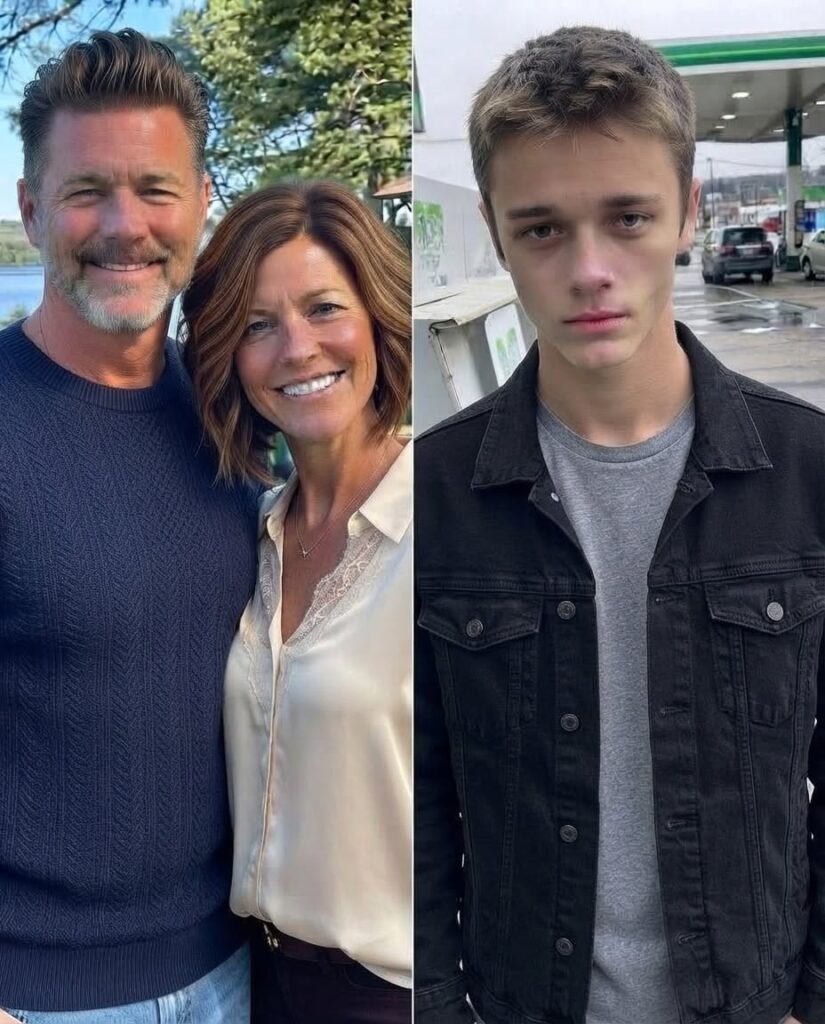
I stopped with my hand on the door handle.
His face had changed.
A moment earlier, he had been polite and slightly embarrassed, asking if he could borrow my phone to call his aunt. Now his eyes kept darting toward the road as though he expected someone to appear.
“What’s wrong?” I asked.
He swallowed.
“Your husband has been paying me to follow you.”
At first, I laughed.
It was not because the words were funny.
They were simply too absurd to fit inside the life I believed I had.
“My husband?”
The boy nodded.
“Dr. David Bennett.”
The laughter died in my throat.
“How do you know my husband’s name?”
“He’s been paying me for almost two months.”
My fingers tightened around the phone.
Until that Tuesday evening, I had believed my life was stable.
My name is Rachel Bennett.
I had been married to David for twenty-two years. Our children, Emma and Ben, were both away at college. David was a respected physician whose patients frequently stopped us in public to praise his patience and kindness.
Our friends described our marriage as dependable.
Solid.
Unbreakable.
We were the couple people called when their own relationships were falling apart.
I had never considered the possibility that mine had already been quietly dismantled.
There had been small things.
Nothing dramatic enough to justify suspicion.
David installed a new lock on his home office while I was away visiting Emma.
When I asked why, he said he had begun bringing home confidential patient files.
A few weeks later, I found a business card in his coat pocket belonging to an attorney who specialized in guardianship and estate law.
David told me the attorney was advising the family of an elderly patient.
I believed him.
Why wouldn’t I?
There was also the lake cabin my father had left me.
It stood two hours outside town, surrounded by pine trees and a narrow strip of rocky shoreline.
My father had built most of it himself.
Every uneven floorboard and stubborn window latch carried a memory.
A developer had recently offered a substantial amount of money for the property, but I refused.
David brought up the offer repeatedly.
He called the cabin impractical.
He said the taxes would rise.
He reminded me that neither Emma nor Ben visited often anymore.
I told him the cabin was not merely real estate.
It was the last place where I could still hear my father’s voice.
David stopped arguing.
Or so I thought.
That evening, I had stopped at my usual gas station on the way home.
While the tank filled, I noticed a thin teenage boy sitting beside the ice machine with a faded backpack between his knees.
His jacket was too light for the weather.
He approached carefully.
“Ma’am, could I borrow your phone? I need to call my aunt.”
I hesitated only briefly.
He looked close to my son’s age.
I handed it to him.
He stepped a few feet away, made a short call, and returned the phone.
“Thank you,” he said. “She’s coming to get me.”
Then he looked toward the entrance of the parking lot.
“Please don’t get into your car yet.”
Now I stared at him.
“What exactly has my husband been paying you to do?”
The boy lowered his voice.
“My name is Marcus. He found me at a church meal program about two months ago.”
David had told him that his wife suffered from memory problems.
He said I sometimes wandered around town without remembering where I had been.
He claimed he was frightened I might get hurt.
“He offered me three hundred dollars a week,” Marcus said. “He wanted me to write down where you went, who you talked to, and whether you drove toward the lake.”
I felt the air leave my lungs.
“At first, I thought he was worried about you,” Marcus continued. “He sounded like he cared.”
“What changed?”
“The questions.”
Marcus looked down at the pavement.
“He started asking whether you met other men. Whether you bought alcohol. Whether you forgot where you parked or looked confused.”
“Have you ever seen me confused?”
“No.”
The answer came immediately.
“I kept telling him you seemed normal. You went to the grocery store, the pharmacy, the library. Sometimes you stopped for coffee. That was it.”
“What did he say?”
“He got angry.”
Marcus shifted the backpack strap over his shoulder.
“He told me I wasn’t paying enough attention. He said I needed to look harder.”
A cold heaviness settled inside my chest.
Marcus explained that David reminded him of his own father.
His father had spent years describing Marcus’s mother as unstable until relatives, teachers, and even doctors began repeating the same language.
“She wasn’t broken,” he said quietly. “He just needed everyone to think she was.”
That sentence frightened me more than anything else he had said.
Marcus gave me the phone number David used and showed me several payment notifications.
Some were cash-app transfers from an account with initials I recognized.
Others had been paid in cash.
“Does he know you spoke to me?” I asked.
“No.”
“Good.”
Marcus looked surprised.
I asked him to continue sending David ordinary reports.
Nothing false.
Nothing dramatic.
Just enough to prevent David from realizing we had spoken.
Then I gave Marcus the name of my attorney and arranged for him to meet her the next morning.
I drove home without confronting my husband.
Every traffic light felt too bright.
Every familiar street looked staged.
When I entered the house, David was in the kitchen preparing dinner.
He kissed my cheek and asked how my day had been.
“Ordinary,” I replied.
He smiled.
During dinner, he casually mentioned the lake cabin.
“The developer increased the offer,” he said. “Have you reconsidered?”
“No.”
“You should at least hear them out.”
“I’m not selling it.”
He studied me for a moment.
“You seem unusually quiet.”
“I’m tired.”
He reached across the table and touched my wrist.
The gesture would once have comforted me.
Now it felt like an examination.
The next morning, I waited until David left for the hospital.
Then I reviewed our bank statements.
Every Friday, for almost two months, he had withdrawn between three hundred and four hundred dollars in cash.
The amounts were small enough to appear ordinary.
Together, they formed a salary.
Marcus’s salary.
I spent nearly an hour searching for the spare key to David’s office.
I eventually found it hidden beneath a stack of takeout menus in the kitchen drawer.
The moment the lock turned, I knew there would be no returning to the life I had believed in.
His office was immaculate.
Medical journals lined one wall.
Patient files sat inside a locked cabinet.
A photograph of our family stood beside his computer.
I opened the top drawer of his desk.
Inside was a black notebook.
The first page contained my name.
Rachel Bennett.
Below it were dates, locations, and descriptions of my behavior.
Some entries recorded places I had actually visited.
Grocery store.
Pharmacy.
Library.
Lake road.
Others were complete inventions.
One claimed I had purchased two bottles of wine before stumbling outside the store.
I had never bought the wine.
Another said I became disoriented in a parking lot and tried to enter the wrong vehicle.
That had never happened.
Marcus had refused to provide the evidence David wanted.
So David had begun writing it himself.
Beneath the notebook was a folder containing photographs.
There I was outside the pharmacy.
Sitting at a traffic light.
Loading groceries into my trunk.
Walking into the public library.
The photographs looked ordinary.
Placed beside the fabricated notes, they became something else.
Evidence of a woman being watched.
At the bottom of the folder, I found a draft petition requesting legal guardianship over me due to “progressive cognitive impairment and diminished capacity.”
My hands began trembling.
The petition claimed I had forgotten appointments, become confused while driving, made irrational financial decisions, and shown increasing paranoia.
Behind it was an appraisal of the lake cabin.
Then I found a revised purchase offer from the developer.
The amount was far higher than the figure David had mentioned to me.
An email from the guardianship attorney explained that if David were appointed my legal guardian, he could request court permission to manage or sell property held solely in my name.
Another email from the developer referred to a “private consulting arrangement” that would compensate David after the sale closed.
That was the plan.
He intended to manufacture evidence that I was mentally incapable.
Then he would gain control of my finances and sell the inheritance my father had left me.
He would portray himself as a devoted husband protecting an ill wife.
And he would profit from it.
I photographed every document.
Then I returned each page, folder, and drawer exactly as I had found it.
My hands were still shaking when I called my friend Karen.
She had handled estate disputes and guardianship cases for nearly twenty years.
When she answered, I said, “I need you to be my attorney today. Not my friend.”
She listened without interrupting.
When I finished, there was a long silence.
“Do not confront him,” she said.
“I want to.”
“I know. Don’t.”
“He has been following me.”
“He has also spent months preparing evidence and constructing a legal narrative. If you confront him too early, he will destroy records and claim your reaction proves his allegations.”
I closed my eyes.
“What do I do?”
“We become smarter than him for one more week.”
Two days later, I met Marcus at a roadside diner.
He sat across from Karen and me with both hands wrapped around a cup of coffee.
David had contacted him again.
This time, he offered extra money for photographs showing me confused, drinking, or behaving erratically in public.
“When?” Karen asked.
“Saturday,” Marcus replied. “He said he would send the location.”
That evening, David poured himself a drink and announced that he had made a dinner reservation for us on Saturday.
The restaurant was near the lake cabin.
Everything became clear.
He intended to take me somewhere public, encourage me to drink, and have Marcus photograph me.
Because the restaurant was close to the cabin, he could claim I had driven there in a confused state.
I smiled at him across the room.
“That sounds perfect.”
After David went upstairs, I sent Karen a single word.
Saturday.
By the time the evening arrived, we were ready.
Marcus had signed a sworn statement detailing every payment and instruction.
His financial records showed transfers linked to David.
More importantly, David had already filed the guardianship petition.
That meant Karen could obtain an official copy from the court without relying on anything I had found inside his office.
We arrived at the restaurant shortly after seven.
David behaved like the loving husband he wanted everyone to see.
He opened the door for me.
Pulled out my chair.
Placed his hand lightly against my back.
Then he ordered wine without asking.
I did not touch it.
“You’ve seemed tired lately,” he said. “I’m worried about you.”
“I’ve been worried too.”
He leaned forward.
“About what?”
I placed a folder on the table and slid it toward him.
“About this.”
David opened it.
The color drained from his face.
Inside were copies of Marcus’s payment records, the filed guardianship petition, sworn testimony, correspondence regarding the cabin, and the revised purchase offer.
He stared at the first page for several seconds.
Then he recovered.
“Rachel, you’re misunderstanding what you found.”
“Am I?”
“Yes. I was trying to protect you.”
“From what?”
“You’ve been forgetful.”
I almost smiled.
“Am I forgetting things again?”
His eyes hardened.
“You entered my office.”
“I didn’t need anything from your office.”
He looked up sharply.
“Marcus gave a sworn statement. His payment records came from his account. Your guardianship petition was already filed with the court.”
For the first time in twenty-two years, David had no immediate answer.
“Karen has secured the evidence,” I continued. “Our children are receiving copies tonight.”
His expression changed.
“You involved Emma and Ben?”
“You tried to convince them I was losing my mind.”
“I never said that.”
“You wrote it in a legal petition.”
He lowered his voice.
“You are making a serious mistake.”
“No.”
I placed another envelope on top of the folder.
“These are divorce papers.”
David stared at them.
“You don’t have to sign them here,” I said. “But this marriage is over.”
“Rachel, sit down.”
“I am sitting.”
“You are emotional.”
“I am informed.”
Several diners nearby had begun watching us.
David noticed.
His public face returned immediately.
He softened his voice.
“Let’s go home and talk privately.”
“You planned to turn this restaurant into evidence that I was unstable.”
I stood.
“Instead, it is where your plan ended.”
I left enough cash to cover my half of dinner and walked out.
David did not surrender.
Before I reached my car, he called both of our children.
He told them I had suffered a severe emotional episode.
He claimed I had become paranoid, accused him of stealing, and abandoned him during dinner.
Fortunately, I had already warned Emma and Ben not to react until they saw the evidence.
Karen filed an emergency response opposing the guardianship petition that same night.
She also requested an independent neurological and psychological evaluation.
The following morning, I underwent hours of testing.
Memory assessments.
Cognitive screening.
Psychological evaluation.
Financial-capacity review.
The results showed no cognitive impairment.
No diminished capacity.
No medical basis for guardianship.
Meanwhile, Marcus met with investigators.
He explained that David had not hired him because he genuinely believed I was ill.
David repeatedly instructed him to find or create evidence supporting that conclusion.
When Marcus reported that I seemed healthy and behaved normally, David became angry.
The financial motive was equally clear.
The developer’s latest offer for the cabin was substantially higher than the amount David had disclosed to me.
The emails also suggested David expected a private consulting payment once the transaction was approved.
He was not merely trying to control my property.
He intended to profit personally while convincing our children, friends, and a judge that he was protecting me.
Once the guardianship case reached court, David’s polished image began to crack.
His attorney argued that he had acted out of concern.
They presented the notebook entries, photographs, and statements describing my supposed confusion.
Then Karen called Marcus to testify.
He entered the courtroom wearing a clean shirt Karen’s assistant had helped him buy.
He looked nervous, but when he spoke, his voice remained steady.
“Dr. Bennett told me his wife had memory problems,” he said. “He paid me to report where she went.”
“What happened when your observations did not support that claim?” Karen asked.
“I told him she seemed fine.”
“And what did he say?”
Marcus looked toward David.
“He told me to find something wrong.”
The payment records supported his testimony.
Messages from David instructed Marcus to document alcohol purchases, confusion, unusual behavior, or trips toward the cabin.
None existed.
My independent medical evaluation confirmed that I was fully capable of managing my health, finances, and property.
Karen then presented David’s communications with the developer and guardianship attorney.
The judge read them in silence.
When she finally looked up, her expression had changed.
The guardianship petition was dismissed.
The matter was referred for investigation.
Outside the courtroom, David claimed he had only been trying to protect our future.
But protecting our future would not have required inventing an illness.
It would not have required surveillance.
It would not have required secret negotiations involving property he did not own.
Our children were devastated.
Emma initially struggled to believe that her father could have planned something so calculated.
She had spent her entire life believing he was the calm, reasonable parent.
Ben said almost nothing for several days.
Then he asked David one question.
“If Mom was really sick, why did you need someone to lie about her?”
David had no answer.
The divorce was finalized several months later.
The lake cabin remained mine.
David received no control over it and no portion of the inheritance my father had left solely to me.
His medical employer also opened an internal investigation after learning that he had used his professional status to support false claims about my mental health.
For years, his reputation had protected him.
Now it became part of the evidence against him.
Marcus entered a housing and employment program with help from Karen’s office.
I made sure he received a phone, work clothes, and reliable transportation.
But I never treated him as though he owed me anything.
He had already given me something money could never repay.
He had told the truth when everyone involved expected him to remain silent.
Several months after the divorce, I returned to the lake cabin alone.
For years, David had treated it like an asset waiting to become cash.
But when I stood on the dock and watched the afternoon light move across the water, I remembered why my father had left it to me.
It was never merely property.
It was proof that I had existed before my marriage.
Proof that I had a history, a voice, and a life that did not belong to David.
I replaced the locks.
I repaired the porch.
Then I emptied the small room David once planned to turn into an office and made it a reading room.
Above the desk, I framed a handwritten note Marcus had given me after the hearing.
It read:
You weren’t confused. He just needed you to believe you were.
My marriage ended because of five whispered seconds at a gas station.
But the truth was that David had been destroying it long before Marcus spoke.
The warning did not ruin my life.
It stopped someone else from taking it away.
David had spent months trying to convince the world that I could no longer be trusted with my own decisions.
In the end, the only person whose judgment had truly failed was him.
The cabin remained mine.
My mind remained mine.
My future remained mine.
And for the first time in twenty-two years, so did my life.