Those two words stayed with me.
She had spent hours scrubbing someone else’s house until she was exhausted, all to earn a little money.
I asked why.
At first, she hesitated.
Then she finally admitted she was trying to save one hundred dollars.
“For Sophie’s birthday,” she said.
I didn’t understand.
She explained that my mother had told her every member of the family had to contribute toward an expensive birthday gift for her cousin.
If she failed to pay, Grandma had warned, perhaps she wasn’t really part of the family after all.
Those words had frightened her far more than the work itself.
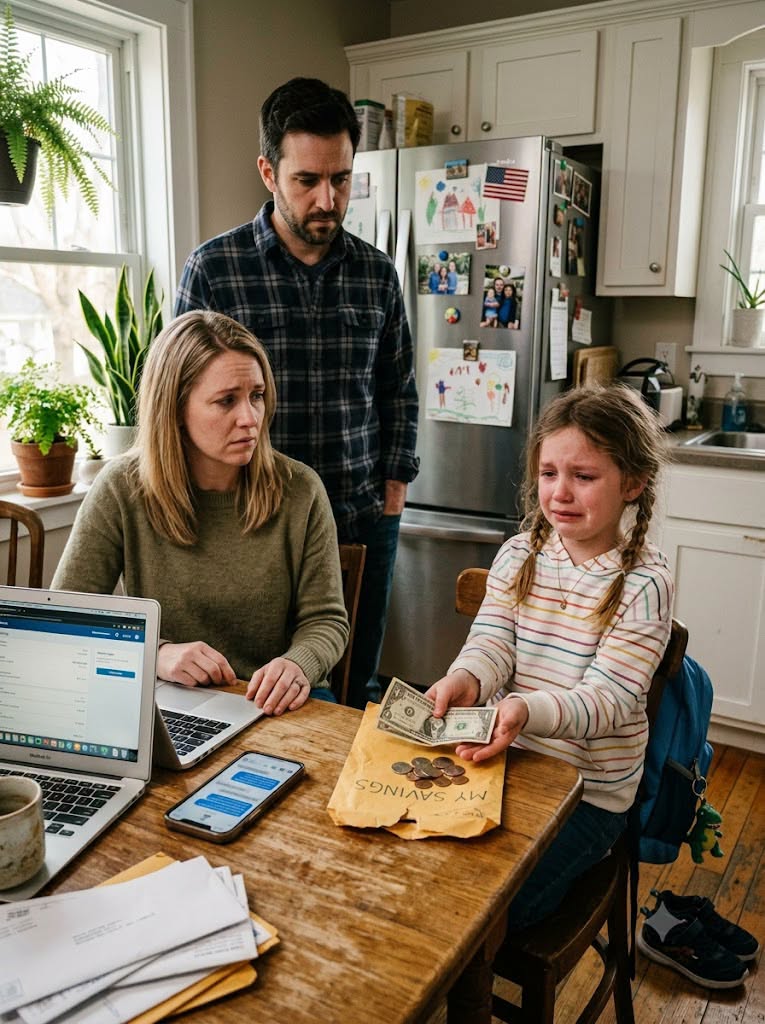
She had emptied her piggy bank.
Taken odd jobs.
Scrubbed floors.
Not because she wanted a new bicycle or a toy.
Because she believed love had been given a price.
I held her while she cried.
No child should ever believe belonging can be purchased.
That evening, I called my mother.
I expected embarrassment.
Perhaps even regret.
Instead, she confirmed everything without hesitation.
She insisted the lesson was valuable.
Children, she said, should learn responsibility.
I listened quietly.
Then something inside me finally connected.
This was not about a birthday.
It never had been.
It was the same story I had been living since childhood.
As the oldest sibling, I had always been the dependable one.
While Heather and Leo were allowed to enjoy their youth, I worked.
When college opportunities appeared, I gave them up because the family needed another income.
One sacrifice became another.
Mortgage payments.
Utility bills.
Emergency expenses.
Each request arrived wrapped in words like “family,” “duty,” and “gratitude.”
Each one slowly convinced me that saying no meant I loved them less.
Looking back, I realized I had not been treated as a daughter.
I had been treated as a resource.
Now they had begun teaching my daughter the same lesson.
The gift they expected everyone to fund was for an expensive horse camp costing hundreds of dollars.
The amount mattered less than the principle.
A child had been made to believe she must earn acceptance through labor.
That was the moment everything changed.
I opened my laptop.
With my husband Thomas sitting beside me, I logged into every account.
One by one, I canceled the recurring monthly transfers that had quietly supported my parents and siblings for years.
Automatic payments disappeared.
Shared access was revoked.
Every financial connection ended.
When I finished, I sent one final message.
We would no longer provide financial support.
We would not attend the birthday celebration.
And our daughter would never again be pressured into buying her place within the family.
The response came immediately.
By the following afternoon, I had fifty-three missed calls.
Voicemails.
Text messages.
Accusations.
Some pleaded.
Others demanded.
Not one asked how Mia was feeling.
Then my parents crossed a line I had never imagined.
Unable to persuade me, they approached Mia at school.
They blamed her.
They told her the family was falling apart because of what she had said.
By the time I arrived, she was standing outside in tears.
I wrapped my arms around her before anyone else could speak.
Then I looked at my parents.
Quietly, but firmly, I said something I wish someone had once said to me.
“Children are never responsible for the choices adults make.”
We left together.
No argument.
No shouting.
Just a child finally walking away from a burden she had never deserved to carry.
Several weeks later, there was another knock at our door.
My parents stood outside with Heather.
Their voices were softer now.
They called everything a misunderstanding.
They spoke about forgiveness.
About family.
About moving forward.
What they never mentioned was accountability.
Not once did they apologize to Mia.
Not once did they acknowledge the fear they had placed in a twelve-year-old’s heart.
They wanted access restored.
Not trust rebuilt.
I listened until they finished.
Then I answered as calmly as I could.
“The day you used emotional blackmail against my daughter was the day you stopped acting like grandparents.”
There was nothing more to discuss.
I closed the door.
Not in anger.
In protection.
Six months have passed since then.
The silence has remained.
Without my financial support, my parents have been forced to make difficult decisions, including selling the home they could no longer afford.
My siblings now carry responsibilities that I had quietly carried for years.
Those consequences belong to the choices they made, not to the boundary I finally established.
Inside our own home, something unexpected has grown.
Peace.
Mia laughs more easily now.
She no longer worries about earning someone’s approval.
She knows that birthdays are celebrations, not obligations.
She knows that love is never measured by a receipt.
Looking back, I understand that breaking unhealthy patterns often feels like breaking a family.
But they are not the same thing.
A family built on fear, guilt, and financial obligation cannot flourish for long.
Real love does not demand payment before offering belonging.
It protects the vulnerable.
It honors dignity.
And sometimes the most loving thing a parent can do is close one door, so that a child never again mistakes manipulation for love.