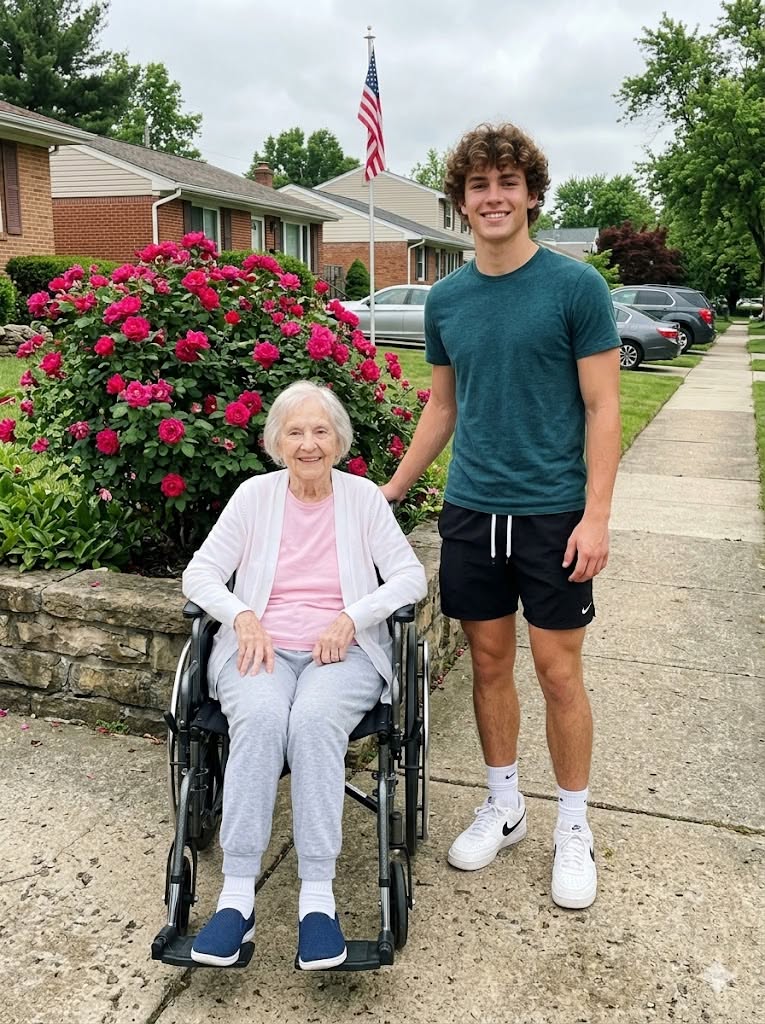
That was where I met Mrs. Rhode.
She was eighty-five years old and visited every Tuesday and Thursday without fail.
She always complained about the coffee.
She criticized the toast.
She insisted the pie had been better twenty years earlier.
Yet she tipped fairly, remembered everyone’s names, and somehow made every complaint sound more like conversation than criticism.
One afternoon, she asked whether I could help her carry groceries home.
Then came prescriptions.
A leaky faucet.
Changing light bulbs.
Fixing a loose porch railing.
One day, after I finished replacing a broken kitchen cabinet hinge, she looked at me over her glasses and said something completely unexpected.
“If you look after me until I’m gone,” she said, “I’ll leave you everything.”
I laughed at first.
She didn’t.
She extended her hand.
I was struggling to pay bills. The offer sounded impossible, but desperation has a way of making unlikely promises feel believable.
So I shook her hand.
At the beginning, I won’t pretend my motives were pure.
I needed the money I hoped would one day come.
But something changed over the months that followed.
I stopped visiting because I expected an inheritance.
I visited because she had become part of my life.
We watched old game shows together.
She made dry meatloaf that somehow tasted better simply because someone wanted me at the table.
I fixed dripping faucets, cleaned gutters, and listened to stories about the husband she still missed decades after losing him.
Eventually, she began asking about my childhood.
No one had asked me that in a long time.
Not politely.
Not patiently.
For the first time in years, I stopped feeling like someone passing through another person’s life.
I began feeling like family.
Then one morning, I let myself into the house with the spare key she had given me.
Her tea sat untouched.
She was sitting quietly in her favorite chair.
She had passed away.
The silence in that room felt different from every silence I had known before.
This one did not come from abandonment.
It came from a life that had simply reached its end.
After the funeral, I sat inside a lawyer’s office across from Mrs. Rhode’s niece.
She barely looked at me.
When the attorney began reading the will, I waited with quiet hope.
Then everything I expected disappeared.
The house was being donated to charity.
The savings would support several community organizations.
I was left nothing.
Not a dollar.
Not a keepsake.
Nothing.
I thanked the attorney, walked out, and drove home without remembering the roads I had taken.
That night, I sat alone in my tiny apartment wondering how I had been foolish enough to believe someone had finally chosen me.
The old lesson returned.
Never trust promises.
The next morning, loud knocking shook my front door.
When I opened it, the attorney stood there holding a dented metal lunchbox.
He apologized.
Mrs. Rhode had left additional instructions.
They were meant only for me.
Inside the lunchbox rested a plain metal key and an envelope addressed in her unsteady handwriting.
I opened the letter carefully.
She began with honesty.
She knew I had first agreed to help because I hoped for an inheritance.
She said that had never offended her.
“Most relationships begin because someone needs something,” she wrote. “The important question is what they become afterward.”
She thanked me for becoming her family during the final year of her life.
Then she explained why the will had looked the way it did.
She had chosen not to leave me a large sum of money.
Not because she doubted me.
Because she wanted to leave me something that could continue growing long after the money was spent.
Months earlier, she had quietly approached Joe, the owner of the diner where I worked.
Using her own savings, she had purchased a significant ownership share in the business.
She had transferred that ownership to me.
The key in the lunchbox belonged to the office at the diner.
For a long moment, I simply stared at the letter.
Then I dropped to my knees.
Not because I had become wealthy.
Because someone had believed I deserved a future.
I ran all the way to the diner with the key clenched tightly in my hand.
Joe was waiting behind the register.
On the counter rested a thick folder of legal documents.
He smiled before saying anything.
“She was proud of you,” he said quietly.
Not because I repaired her house.
Not because I kept my promise.
Because somewhere along the way, I had stopped treating our arrangement like a transaction and started treating her like family.
Joe invited me behind the counter.
Not as an employee.
As his business partner.
That morning, I unlocked the office with the small metal key Mrs. Rhode had left behind.
The room itself was ordinary.
A desk.
Old filing cabinets.
Coffee stains on the floor.
Yet it felt more like home than any place I had lived before.
Growing up in foster care, I believed roots were something other people inherited.
Mrs. Rhode taught me otherwise.
Sometimes roots are not found.
They are given.
Not through money alone.
But through trust, responsibility, and the quiet confidence that someone sees who you are becoming before you see it yourself.
She could have left me a fortune that might one day disappear.
Instead, she left me a place to build.
A reason to stay.
A future connected to people rather than possessions.
That little metal key unlocked far more than an office door.
It unlocked the first life I never felt I had to leave behind.