Sorrow was allowed to sit quietly in the room.
That was where I met Nathan Cole.
He was fifty-nine, terminally ill, and irritated by nearly everything.
He complained that the coffee was weak, the television was too loud, and the nurses called him brave when he did not feel brave at all.
While other patients had flowers on their windowsills and family photographs taped beside their beds, Nathan had one worn leather bag and no emergency contact listed on his chart.
During my second shift, I brought him coffee from the café across the street.
He took one sip and looked at me.
“You remembered the cream.”
“You complained about it for twenty minutes yesterday.”
One corner of his mouth lifted.
“Complaining does not guarantee anyone listens.”
“It does when you are impossible to ignore.”
After that, Nathan began asking for me.
I stopped at his room before every shift ended.
At first, our conversations remained small.
Weather.
Bad television.
The declining quality of crossword clues.
Then, little by little, he began offering pieces of his life.
He had washed dishes as a teenager, driven delivery trucks through three states, and eventually managed a diner called Millie’s.
He spoke warmly about the diner.
He remembered which waitress had worked there longest, which customer always ordered eggs over hard, and which booth caught the morning light.
But whenever I asked whether he had children, he changed the subject.
One evening, I entered his room and found a man in a dark suit standing beside the bed.
He carried a leather folder and spoke in a low, careful voice.
Nathan looked irritated.
“This is Eric,” he said. “He handles my paperwork.”
Eric glanced at me briefly.
“Hello.”
There was something restrained in his expression.
Not dislike exactly.
Something closer to suspicion.
Nathan signed several documents without reading them.
When he finished, he handed back the pen.
“That will be all.”
Eric’s jaw tightened.
He collected the papers and left without another word.
I watched him go.
“Friendly man.”
Nathan closed his eyes.
“He is efficient.”
“That was not what I said.”
“No,” Nathan murmured. “It rarely is.”
A few days later, Nathan reached for my hand.
His fingers felt cool and thin.
“I have one final request.”
“That sounds dangerous.”
“Pretend you are my daughter until I’m gone.”
I stared at him.
“What?”
“I had a daughter once.”
His eyes moved toward the window.
“Or I nearly did. I lost her before she was born. I never got to know her.”
The request should have unsettled me.
Instead, it pressed against the oldest wound inside me.
My mother had raised me alone.
She never told me my father’s name.
Whenever I asked, she gave me the same answer.
“He chose fear instead of us.”
That was all.
No photograph.
No hometown.
No explanation.
Only absence.
Nathan watched me carefully.
“You can say no.”
I forced a smile.
“Well then, hello, Dad.”
He laughed so hard he began coughing.
For the next six weeks, we built a temporary family.
I brought him coffee with cream.
We argued over crossword puzzles.
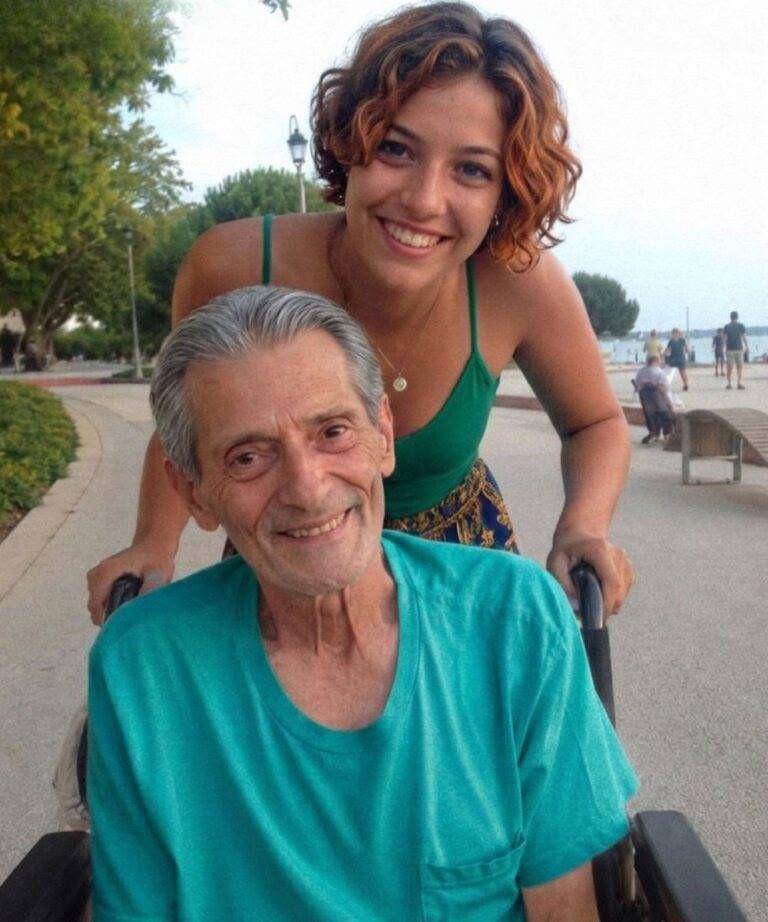
I pushed his wheelchair through the hospice garden while he criticized every flower.
“That one is leaning.”
“It is growing toward the sun.”
“It lacks discipline.”
“You are criticizing a daisy.”
“It knows what it did.”
The hospice approved two outings.
The first was to Millie’s Diner.
The moment we entered, several employees called Nathan’s name.
A silver-haired waitress hurried over and kissed his cheek.
“You look terrible.”
“You look older,” he replied.
She laughed and brought his coffee without asking.
Nathan ordered two slices of apple pie.
“One for each of us,” he said.
“I gathered that.”
“No. One for me and another in case the first disappoints me.”
The second outing was to the ocean.
I helped him across the sand.
He removed his shoes and stood barefoot near the water, his eyes closed as the wind moved through his coat.
For several minutes, he said nothing.
Neither did I.
People often assumed I was his real daughter.
Nathan always answered before I could correct them.
“She is.”
Every time, warmth moved through me.
Then guilt followed.
I knew we were pretending.
But after years of caring for my mother and always being the person someone needed, I liked being chosen.
Nathan became weaker quickly.
During my final visit, he drifted in and out of sleep.
I sat beside him, holding his hand.
“Was I convincing?” he asked.
“As a father?”
“As someone worth remembering.”
I swallowed.
“You were difficult.”
“That sounds honest.”
“You complained constantly.”
“I was consistent.”
“You manipulated me into drinking terrible hospice coffee with you.”
“That was companionship.”
I smiled despite myself.
“But I will remember you.”
His fingers tightened faintly around mine.
He died the following morning.
At the funeral, I recognized nurses, hospice volunteers, and several people from the diner.
Eric stood alone near the back.
He watched me place a flower on Nathan’s casket.
He did not approach.
The next afternoon, he called.
“I need to tell you something Nathan should have told you himself.”
We met in Eric’s office.
A wooden box sat on the desk between us.
Eric closed the door, returned to his chair, and folded his hands.
“Nathan was your biological father.”
For several seconds, the words meant nothing.
They reached me as sounds without meaning.
Then my body understood before my mind did.
My heart began pounding.
“No.”
Eric pushed a folder across the desk.
Inside was a signed acknowledgement of paternity dated before my birth.
There were letters addressed to my mother.
Every one had been returned unopened.
Beneath them were genealogy records and confirmation of a DNA match.
Years earlier, I had submitted my DNA while searching for relatives on my mother’s side.
Nathan had used that database to find me.
He learned where I volunteered.
Then he chose that hospice deliberately.
“He arranged everything?” I asked.
“Yes.”
“You knew?”
“Yes.”
“For all six weeks?”
Eric’s face tightened.
“Yes.”
I stood so quickly that my chair struck the wall.
Nathan had known exactly who I was.
He had watched me bring him coffee.
Listened while I spoke about my mother.
Asked me to pretend to be the daughter he already knew I was.
Eric had known too.
Together, they had taken away my right to decide whether I wanted a relationship with the man who had abandoned us.
“He was afraid you would refuse to see him,” Eric said.
“That was my choice.”
“I know.”
“No, you do not.”
My voice shook.
“You decided his comfort mattered more than my consent.”
Eric lowered his eyes.
“Yes.”
The directness stopped me.
“I told myself he was dying,” he continued. “I believed six weeks of comfort would hurt less than the truth.”
“You were wrong.”
“Yes.”
Inside the wooden box were two bundles of letters.
One was addressed to me.
The other carried Eric’s name.
Beneath them were legal documents leaving us joint ownership of Millie’s Diner.
I stared at the papers.
“Who are you to Nathan?”
Eric’s jaw tightened.
“His son.”
Nathan had married several years after leaving my mother.
Eric had grown up in his home.
For one confused moment, jealousy cut through me.
He had received everything I had been denied.
A father at breakfast.
A father at school events.
A father whose name appeared on forms.
Then Eric spoke.
“He paid every bill. Attended every parent meeting. Signed every report card.”
His voice remained calm, but his hands had tightened into fists.
“He never asked how I felt unless the answer affected my grades.”
I looked at him.
“And you still protected him.”
Eric looked toward the window.
“When he told me about you, I thought he was finally trusting me like a son.”
He laughed once, without humor.
“Then you arrived carrying coffee, and he became the father I had wanted my entire life.”
“You resented me.”
“Yes.”
The honesty hurt more than denial would have.
That night, I sat at my kitchen table and opened Nathan’s letter.
His handwriting weakened as the pages continued.
He admitted he had failed both of us differently.
He abandoned me completely.
He remained physically present for Eric but withheld affection so thoroughly that his son grew up starving beside a full table.
Nathan wrote that he had arranged our meeting because he wanted to know whether I could care about him before learning what he had done.
The admission made me feel sick.
He had staged his redemption.
He wanted love first and truth afterward.
When Nathan asked whether he had been convincing, he had not been pretending to be my father.
He had been pretending not to be.
His regret had become one final demand.
He wanted forgiveness without giving me the opportunity to question him.
To reject him.
To tell him how his absence had shaped my life.
His final hope, written across the last page, was that Eric and I might give each other the family he had denied us.
I called Eric the next morning.
“We are not required to become family because Nathan wanted a clean ending.”
“I agree.”
“And I am not forgiving you.”
“I understand.”
For the next month, we communicated only through separate attorneys.
Millie’s Diner could not be sold without both signatures.
The building was valuable.
The business was not.
Eric wanted to sell the property, pay the outstanding debts, and divide whatever remained.
At first, I agreed.
The diner felt like another trap Nathan had left behind.
Then Eric and I visited it together.
The silver-haired waitress from my first visit recognized me immediately.
“You came with Nathan.”
Her name was Rosa.
She led us to the corner booth where Nathan and I had eaten apple pie.
“He started here as a dishwasher,” she explained. “Worked his way up. Bought the building years later.”
Then she told me something I had never known.
Every year on my birthday, Nathan came to that same booth and ordered two slices of pie.
For one dangerous moment, something inside me softened.
Then I reminded myself of the truth.
Missing someone was not the same as finding them.
Loving an idea of a daughter was not the same as raising one.
Six employees depended on the diner.
Selling the building would clear the debt.
It would also erase their livelihoods.
Eric remained practical.
“We cannot preserve every failing business because we feel guilty.”
“And selling it solves everything?”
“It pays what is owed.”
“It also costs six people their jobs.”
The manager, Paul, overheard us.
“Nathan was trying to make things right before he got sick.”
I almost laughed.
“Was he?”
Paul looked confused.
Before I could answer, Eric spoke.
“He lied to her.”
The entire diner became quiet.
Eric faced the employees.
“She did not know Nathan was her father.”
Rosa’s hand rose to her mouth.
“I knew,” Eric continued. “I helped him hide it from her until he died.”
No one moved.
“I chose his wishes over her right to know.”
His voice tightened.
“Whatever happens to this diner, do not blame her.”
It was the first time Eric stopped protecting Nathan’s reputation.
Three days later, he sent me a written apology.
It contained no excuses.
He offered to resign as estate representative and pay for an independent attorney to review every document connected to the inheritance.
His apology finally cost him something.
That mattered.
I agreed to examine the diner’s finances before making a decision.
For four months, Eric and I met twice a week.
We argued about staffing.
Debt.
Opening hours.
Inventory.
Whether saving Millie’s was loyalty, guilt, or simple financial stupidity.
Trust did not appear suddenly.
It arrived in small, unimpressive pieces.
Eric disclosed mistakes before I discovered them.
He admitted when he did not understand something.
He stopped speaking for me.
I learned that he had spent much of his own savings on Nathan’s medical care.
He learned that I had worked two jobs while caring for my mother.
Neither truth erased what had happened.
But it changed the shape of our anger.
Eventually, we found a solution.
An unused piece of land behind the diner was sold.
Operating hours were reduced.
Several suppliers agreed to renegotiate contracts.
The remaining debt became manageable.
Millie’s survived.
Later, the diner formed a partnership with the hospice.
Once a month, it served free breakfasts to patients’ families.
We did not rename the restaurant after Nathan.
We did not hang a large portrait of him on the wall.
The corner booth remained unchanged.
On my next birthday, I arrived before opening and found Eric sitting there.
Two slices of apple pie rested on the table.
“I suppose he finally got his table for two,” Eric said.
I looked at the empty seat across from him.
Nathan had manipulated me.
He had denied me the chance to confront him while he was alive.
Missing me for years did not undo his first choice.
Regret did not become courage simply because death was near.
But the six weeks we had shared were also real.
The laughter had been real.
The coffee had been real.
The ocean had been real.
Love did not erase anger.
Anger did not make love false.
I pulled a third chair toward the table.
“No,” I said. “He does not get to decide who belongs here.”
Eric studied the chair.
Then he moved from the opposite side of the table and sat beside me.
Before the diner opened, he removed Nathan’s letter from inside his coat.
The envelope was still sealed.
“I have not read it.”
“Why?”
“Because I know what he will ask me to forgive.”
I looked at the letter.
“You do not have to read it today.”
For once, neither of us allowed Nathan to control the timing.
We sat quietly until Rosa entered and switched on the lights.
In the window, three chairs appeared side by side.
Families from the hospice began arriving.
A tired woman guided an elderly man through the door.
Two children entered with their mother, whispering because their father was receiving care nearby.
Nathan’s untouched slice of pie remained in the center of the table.
Rosa noticed the three chairs.
She disappeared into the kitchen.
A moment later, she returned carrying another fork.
She placed it between Eric and me without saying anything.
Nathan had spent his life choosing fear over honesty.
He had left behind apologies, property, letters, and one final attempt to arrange the people he had hurt into a family.
But family could not be assigned in a will.
It could not be manufactured through guilt.
It had to be chosen freely.
Eric and I were not brother and sister because Nathan had asked us to be.
We became family slowly, through uncomfortable truths, earned apologies, shared responsibility, and the decision to remain when walking away would have been easier.
Nathan had wanted forgiveness.
What he left us instead was a choice.
And for the first time, that choice belonged entirely to us.