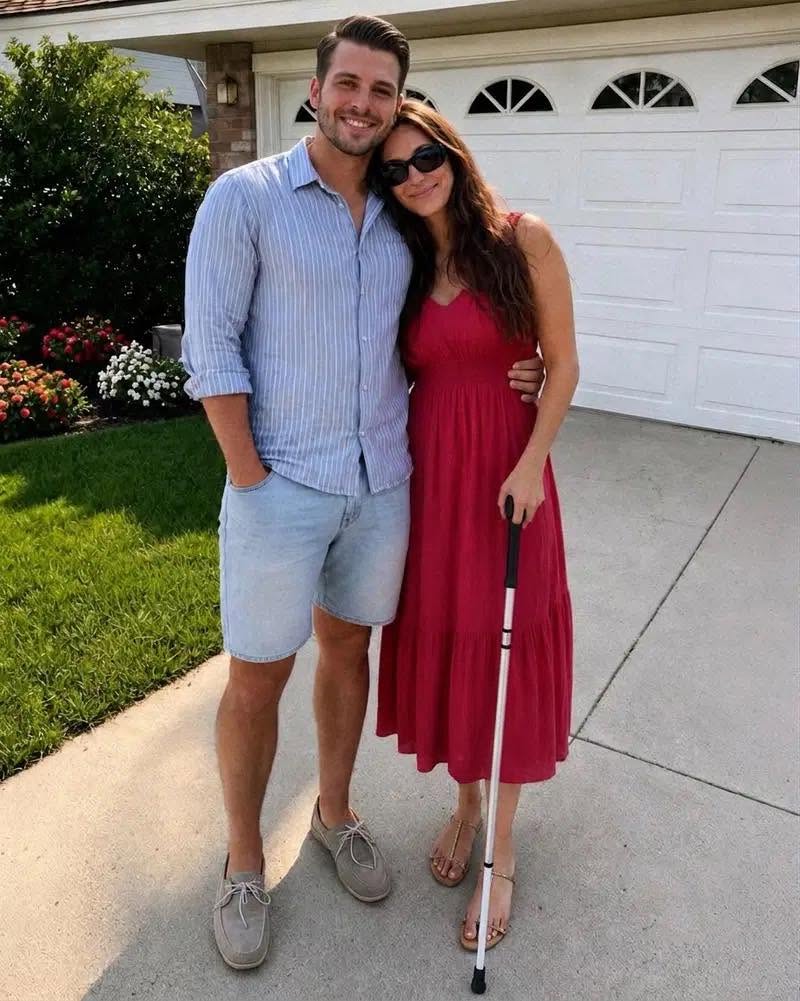
It had to do with the man I trusted to guide me.
Warm afternoon sunlight rested against the kitchen window while I sat with both hands wrapped around a mug of tea I could barely make out.
By then, I recognized my home mostly through sound.
The low hum of the refrigerator.
The steady ticking of the hallway clock.
The creak in the floor near the pantry.
And every evening, the familiar growl of Brian’s car pulling into the driveway.
I was thirty-five years old and had not clearly seen my own face in almost a decade.
When Brian and I married, my eyesight had been completely normal.
One year later, doctors diagnosed me with a rare degenerative eye disease.
At first, distant signs became difficult to read.
Then faces lost their detail.
Colors faded.
Edges softened.
Eventually, the world became a collection of pale shapes, shadows, and light.
By the fourth year, I used a white cane.
By the sixth, I stopped pretending I could manage unfamiliar places alone.
A few years later, nearly all my functional vision was gone.
Brian took over everything.
He drove me to appointments.
Read the mail aloud.
Handled bills.
Selected groceries.
Managed repairs.
He even chose my clothes most mornings, telling me which colors matched.
At first, I was grateful.
Then dependence slowly became routine.
And routine became my identity.
There was one part of the house Brian never allowed me to enter.
The garage.
“Don’t worry about it, honey,” he told me once when I asked if I could help organize it. “There are tools everywhere. Boxes. Car parts. It’s dangerous.”
“I could at least sit and help you sort things.”
His hand closed around my elbow, gently but firmly steering me back toward the kitchen.
“Gina, please. There’s nothing in there for you.”
Something in his voice tightened whenever I mentioned that room.
I told myself it was concern.
I told myself he was protecting me.
That was what love looked like, I believed.
That was what devotion sounded like.
My best friend, Marissa, was less convinced.
“You’ve been shrinking,” she said one afternoon as we sat at the kitchen table.
“What does that mean?”
“You used to argue with me about everything. Now you wait for Brian to decide whether you should try something.”
“That’s not fair.”
“Isn’t it?”
I lifted my mug.
“He’s helped me through all of this.”
“I know he has. But did you look into the clinical trial I sent you?”
“Brian says it’s a long shot.”
“What do you say?”
I hesitated.
“He doesn’t want me to get my hopes up.”
Marissa went quiet.
Then she asked, “What do you want, Gina?”
I had no answer.
At some point, I had stopped asking myself that question.
For years, specialists had told me there was nothing more they could do.
Then Marissa found an experimental laser procedure being offered through a clinical program.
The doctors were careful not to promise anything.
Success was uncertain.
There were risks.
Brian focused on every one of them.
I brought it up over dinner one evening.
He placed his fork down.
“Sweetheart, we already discussed this.”
“I know. I just think I should at least speak to the doctor.”
“You’ll break your own heart.”
His voice was gentle, but that familiar tension was underneath it.
“I don’t want to watch you fall apart when it fails.”
“I might regret not trying.”
“You’re vulnerable right now. These clinics know how to sell hope.”
“Marissa researched it.”
“Marissa.”
He repeated her name flatly.
“Of course she did.”
For once, I did not let the conversation end there.
“I’ve thought about it carefully,” I said. “I want to apply.”
Brian was silent for several seconds.
Then he changed the subject to the leftovers.
A few days later, he left for a week-long business trip.
He kissed my forehead before leaving and promised to call every evening.
The house became silent around me.
With Marissa’s help, I applied to the trial.
The next afternoon, she arrived at my door carrying coffee and a letter from the clinic.
I had been accepted.
That night, I lay awake remembering who I had been before the diagnosis.
I had been the woman who argued with a contractor until he rebuilt an entire porch correctly.
The woman who chose her own paint colors.
The woman who once drove alone to Asheville simply because she wanted to see the autumn leaves.
Little by little, I had handed those pieces of myself to Brian.
Not all at once.
That would have frightened me.
Instead, I surrendered them slowly enough that I barely noticed.
For the first time in years, I was making my own decision.
The following morning, Marissa arrived with a packed bag.
“Are you sure?” she asked.
“No.”
She smiled.
“That wasn’t the question.”
I took a breath.
“Yes. I’m doing it.”
Dr. Halim was patient, careful, and brutally honest about every risk.
The procedure itself took less time than I expected.
The recovery was stranger.
For two days, everything resembled a blurred watercolor painting.
Then, on the third morning, I opened my eyes and saw the ceiling fan.
Not a shadow.
Not a shape.
The actual fan.
I saw the blades.
The pull chain.
Even the dust gathered along the edges.
I cried for nearly an hour.
Over the next several days, the world returned in fragments.
The lines in Marissa’s face.
The blue of the nurse’s uniform.
The printed letters on a medication bottle.
My own hands.
When Dr. Halim finally approved my discharge, Marissa drove me home.
I stood in the hallway staring at details I had forgotten existed.
“The curtains are blue,” I whispered.
Marissa looked toward them.
“Yes.”
“Brian always said they were green.”
Her expression changed slightly.
“They’ve always been blue.”
I moved from room to room like a stranger touring someone else’s house.
The framed photographs on the mantel.
A chip in the coffee table.
Dust beneath a chair.
My own reflection in the bathroom mirror.
I looked older than I remembered.
There were fine lines beside my eyes and a streak of gray near one temple.
But the woman in the mirror was still me.
“I don’t want to tell him yet,” I said.
Marissa watched me carefully.
“I want Brian to walk through the door and see me seeing him.”
“Whatever you want.”
She left that afternoon after promising to check on me the following morning.
Alone in the quiet house, I thought about Christmas lights.
Brian had mentioned them countless times over the years.
Boxes of tangled lights in the garage.
I had not seen Christmas lights glow in almost a decade.
I decided to find them and surprise him.
I walked toward the door at the back of the kitchen.
The garage door.
The one I had not opened in years.
My hand rested on the knob.
The metal was cool and slightly loose, exactly as I had imagined.
I turned it.
The door opened with a creak.
I expected clutter.
Dust.
Motor oil.
Instead, I smelled lavender.
My hand found the light switch through old muscle memory.
The bulbs flickered on.
And the world I had imagined for more than a decade disappeared.
There were no tools scattered across the floor.
No machines.
No car parts.
No towers of storage boxes.
The garage had been transformed into a small apartment.
A gray couch stood beside a polished coffee table.
A neatly made bed occupied one corner.
There was a small bathroom.
A woman’s coat hung from a hook near a side entrance.
Framed photographs covered several shelves.
I stepped closer.
My legs began trembling.
Brian appeared in every photograph.
His arm was wrapped around a dark-haired woman.
They smiled together on a beach.
At a restaurant.
Beside a Christmas tree I had never seen.
In one picture, she kissed his cheek while he held up a champagne glass.
My hands started shaking.
“This can’t be real.”
A stack of mail rested on a small table.
The top envelope was addressed to Penelope Shaw.
I reached for my phone and called Marissa.
“Gina? What’s wrong?”
“Come back.”
“What happened?”
“Please. Just come back.”
She arrived within twenty minutes.
I heard her car before I saw it through the open side door.
She rushed into the garage and stopped.
“Oh my God.”
I stood beside the bed.
“This is what Brian has been doing.”
Marissa looked slowly around the room.
“For how long?”
“I don’t know.”
“Then we find out.”
We searched carefully.
Inside a drawer, Marissa discovered permits and contractor invoices.
The garage had been converted into livable space six years earlier.
Six years.
But the furniture receipts, utility records, and address-change documents connected to Penelope were only four months old.
Before that, a framed certificate identified the space as:
B. WHITFIELD — PRIVATE OFFICE
Brian had created the room years before moving her into it.
Near the side entrance, I found another set of car keys.
There was a woman’s toothbrush in the bathroom.
Shoes beneath the bed.
Clothes in the drawers.
Then Marissa found a handwritten note.
“You need to read this.”
The handwriting curled across the page.
Brian,
I know this is difficult with your estranged wife dying, but once she is moved into the care facility, we can stop hiding. I hate living out of sight like this, but you are right—the less she senses, the smoother it will be.
I’ll be back from Portland Sunday night. Mom’s surgery is Thursday, so don’t call before then.
Just a few more months.
Love, Penelope.
The paper shook in my hands.
“He told her I was dying.”
Marissa put one arm around my shoulders.
“He told her I was being moved into a care facility.”
“Gina, breathe.”
I lowered myself onto the edge of the bed.
For one long minute, I allowed myself to feel all eleven years of our marriage.
The cane Brian had guided me with.
The meals he cut into smaller pieces.
The soft voice saying, “Let me get that for you.”
The gentle instructions.
The warnings.
The constant reminder that the world was too difficult for me to manage without him.
Every act of care rearranged itself in my memory.
Some of it may have been real.
But somewhere along the way, protection had become control.
And control had given him the freedom to build another life only a few feet from mine.
Then something inside me shifted.
I stood.
“Marissa, photograph everything.”
She blinked.
“The pictures. The paperwork. The note. Every drawer and every wall.”
“Are you sure?”
“I spent years believing I could not survive without him.”
I looked around the hidden apartment.
“I can see now. I’m going to use that.”
We spent the next two hours documenting everything.
Marissa gave me the name of a family attorney she trusted.
I called immediately and scheduled the earliest appointment.
Inside the drawer containing the permits, we also found a small leather notebook filled with passwords in Brian’s cramped handwriting.
Marissa read one aloud while I logged into our joint bank account.
There it was.
Years of slow, careful withdrawals.
Small transfers to accounts I had never known existed.
Payments for furniture.
Rent-like deposits.
Travel charges.
Brian had not simply betrayed me.
He had been preparing an escape while I remained in darkness.
I barely slept that night.
By nine the next morning, I was sitting inside an attorney’s office with photographs, bank records, screenshots, permits, and copies of Penelope’s note spread across the desk.
The attorney listened carefully.
She asked precise questions and took notes.
Then she prepared an initial separation filing, a preservation letter, and a request for full financial disclosure.
“Do not confront him until we have copies of everything,” she warned.
By evening, the legal folder rested on my kitchen counter.
Then I heard the front door open.
Brian’s voice floated through the house.
“Gina? I’m home.”
Relaxed.
Cheerful.
Completely unaware.
I stood in the living room.
A strand of Christmas lights I had found in the hallway closet—not the garage—glowed softly across the window.
Brian entered carrying his suitcase.
The color vanished from his face when he saw me standing without my cane.
“Gina?”
“I had the surgery.”
His mouth opened.
I watched every emotion cross his face.
Shock.
Fear.
Calculation.
Then his eyes moved toward the back of the house.
“I opened the garage,” I said. “I know about Penelope.”
A nervous laugh escaped him.
Then his expression hardened.
“You don’t understand.”
“I understand the photographs.”
“It isn’t that simple.”
“I understand the apartment.”
“Gina—”
“I understand that you told another woman I was dying.”
His face tightened.
“You don’t know what these years did to me.”
I stared at him.
“I took care of everything,” he continued. “I gave up my freedom. I needed someone who could actually see me.”
The cruelty of it nearly took my breath away.
But I did not look away.
“Then look at me now, Brian.”
I stepped closer.
“I see you completely.”
I handed him the folder my attorney had prepared.
Separation papers.
Financial disclosure requests.
Copies of the photographs.
The permits.
The bank statements.
Penelope’s note.
His hands began shaking.
“You spoke to a lawyer?”
“Yes.”
“We can fix this.”
“No.”
“I made mistakes, but you needed me.”
“I needed support.”
My voice remained steady.
“You made sure I confused support with permission.”
He reached for my hand.
I stepped away.
“The woman you thought would never see you again is standing right here.”
I looked directly into his face.
“And I see everything.”
Before leaving, I placed a copy of Penelope’s note on the table.
Beneath it, I left her phone number.
I had found it written under a return address on one of the envelopes.
That night, from Marissa’s guest room, I called her.
Penelope answered cautiously.
“Who is this?”
“My name is Gina Whitfield.”
Silence followed.
“I’m Brian’s wife.”
More silence.
“His wife is dying,” she finally whispered.
“No. I’m not.”
Her breathing changed.
“He told you I was estranged and being moved into a care facility.”
“Yes.”
“He lied to both of us.”
I did not insult her.
I did not threaten her.
I simply told her where she could find copies of the truth.
Several weeks later, I sat beside the window in my own small apartment.
Christmas lights shimmered across the glass in the evening darkness.
I had chosen every piece of furniture myself.
My cane rested folded inside a closet.
I still used it on difficult days, but now it was a tool, not a symbol of helplessness.
Marissa knocked and entered carrying takeout containers and a bottle of wine.
“You look different,” she said.
“I can see my own clothes now.”
“That is not what I meant.”
A brief note from Penelope rested on the counter.
It contained only one sentence.
Thank you for telling me the truth.
Brian’s hidden life collapsed quickly after that.
Penelope left.
The financial investigation uncovered more money than I expected.
My attorney secured my share before Brian could move anything else.
He tried apologizing.
Then blaming loneliness.
Then blaming my illness.
Eventually, when none of those explanations brought me back, he blamed me for exposing him.
I stopped listening.
Months later, I stood in front of a mirror and applied lipstick badly.
I laughed at the uneven line and wiped it away.
Then I tried again.
The woman looking back at me was older than the one I remembered.
She had scars.
She had wasted years trusting someone who benefited from her dependence.
But she was not broken.
Losing my vision taught me how to rely on other people.
Getting it back taught me something harder.
Trust should never require surrendering your voice.
Love should never make your world smaller.
And sometimes the person guiding you through the darkness is the same person hoping you never find the light.