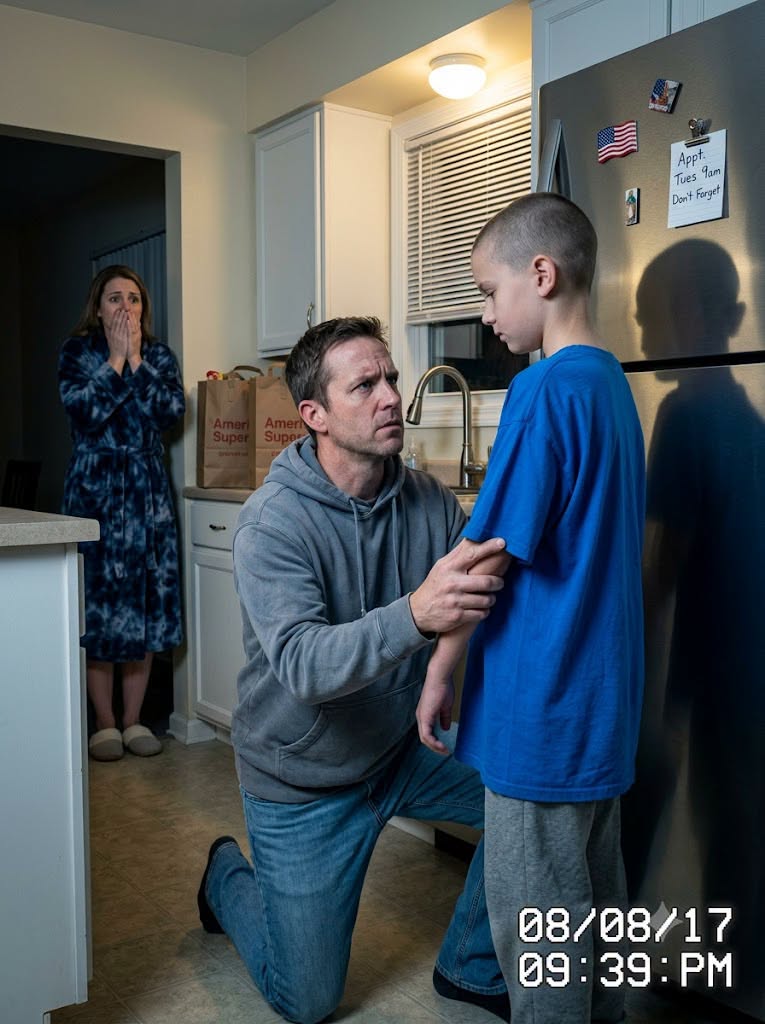
Nothing about the day suggested it would become the longest day of my life.
As I poured coffee, my wife Sarah mentioned that her mother, Gertrude, had offered to take Ethan to the clinic.
I stopped what I was doing.
Gertrude had always presented her interference as generosity. Every favor came with expectations. Every act of help quietly shifted into influence. Over the years, she had repeatedly ignored boundaries, convinced that experience entitled her to make decisions for our family.
“I’d rather take him myself,” I said.
Sarah sighed.
She told me I was overreacting, that her mother was only trying to help, and that refusing would create unnecessary conflict.
I did not want another argument.
But neither did I feel peace.
At ten o’clock that morning, Gertrude arrived in her silver car.
She hugged Ethan, promised him ice cream afterward, and drove away smiling.
I watched the car disappear down the street with a feeling I could not explain.
The afternoon dragged more slowly than it should have.
Around the time the appointment was scheduled, the uneasiness became impossible to ignore.
I called the orthopedic clinic.
The receptionist placed me on hold while she checked the schedule.
When she returned, her voice had changed.
“I’m sorry,” she said gently. “Ethan never arrived.”
For a moment, I thought I had heard her incorrectly.
I called Gertrude.
Voicemail.
Again.
Voicemail.
I called Sarah.
The same result.
By four o’clock, the clinic officially confirmed that the appointment had been missed entirely.
The living room suddenly felt too small.
Every ordinary sound became overwhelming.
The ticking clock.
The refrigerator humming.
The silence between unanswered phone calls.
I began saving everything.
Call logs.
Appointment reminders.
Voicemails.
Text messages.
Not because I expected the worst.
Because experience had taught me that fear is often questioned unless it leaves a record behind.
When Sarah came home that evening, I told her what had happened.
I expected alarm.
Instead, she tried to calm me.
“Maybe Mom took him somewhere afterward.”
“Maybe she got lost.”
“Maybe her phone died.”
Each explanation sounded possible in isolation.
Together, they became a way of postponing the question neither of us wanted to ask.
Where was our son?
When another hour passed without contact, I stopped debating possibilities.
I called the authorities.
I explained that my six-year-old son had been taken to a medical appointment by his grandmother, never arrived, and neither she nor anyone else could be reached.
I described Ethan.
His clothes.
His height.
His smile.
I described Gertrude’s silver car.
The dispatcher listened carefully, asking measured questions while recording every detail.
The conversation remained calm.
My heart did not.
By evening, our home no longer felt like home.
It became a waiting room.
The lights stayed off except for the soft blue glow of the kitchen clock.
Every passing car made us look toward the driveway.
Every set of headlights raised hope before disappearing into the darkness.
Eventually, even Sarah stopped defending her mother’s silence.
With trembling hands, she left a voicemail unlike any she had left before.
Not a casual message.
Not a reminder.
A plea.
“Please call us. Just tell us Ethan is okay.”
The hours stretched.
An officer called back to complete the formal report.
He asked about family relationships, recent disagreements, and whether Gertrude had ever ignored parental decisions before.
I answered each question as carefully as I could.
Not to assign blame.
But because every truthful detail mattered when a child was missing.
After the call ended, Sarah and I sat together without speaking.
There are moments when words no longer make fear smaller.
They simply fill the room.
So we waited.
Listening.
Watching the empty driveway.
Praying that the next sound would be tires slowing outside the house.
That the front door would open.
That Ethan would run inside smiling, unaware of the hours that had passed or the weight they had carried.
Sometimes the deepest test of a family is not found in dramatic arguments or loud accusations.
Sometimes it is found in the long silence between unanswered calls, where love is measured not by what people promise, but by how fiercely they refuse to stop searching.