At the time, keeping the inheritance private felt less like strategy and more like instinct. Grief had taught me that not every truth needed to be placed immediately into other people’s hands.
That quiet decision eventually protected my home, my independence, and the future my husband had worked his entire life to leave me.
From the beginning, my relationship with Allison felt strained.
I tried to welcome her.
I prepared Andrew’s favorite meals when they visited. Years earlier, I had sold pieces of my jewelry to help pay off his student loans. When the wedding approached, I offered to bake their cake, hoping it might become one small way to contribute something personal.
Allison refused.
At the ceremony, I was seated in the fifth row.
During the reception, when I stood to speak about Andrew’s childhood and the man his father had hoped he would become, Allison began applauding loudly before I had finished. Others joined in, believing my speech was over.
My memories disappeared beneath the noise.
I told myself not to make too much of it.
A wedding can bring stress. Families misunderstand one another. Small humiliations can grow larger when grief and pride are already present.
But after the wedding, the pressure began.
Andrew and Allison called repeatedly.
They said my Seattle home was too large.
They said I was getting older.
They said I should sell while property values were strong and move into assisted living before an emergency forced the decision.
Their words were framed as concern, but they never asked what I wanted.
Each conversation arrived with the same conclusion already prepared for me.
Sell the house.
Give up the responsibility.
Let them manage the rest.
I refused.
Calmly at first.
Then more firmly.
The calls continued.
Allison’s father joined the effort, speaking to me as though my independence were a temporary obstacle rather than a right. They repeated words like safety, burden, practicality, and family responsibility.
But concern that refuses to listen often becomes control.
I began to understand that they were not simply offering advice.
They were testing how much resistance I still had.
A close friend, Nancy Collins, urged me to speak with an elder law attorney named Laura Chen.
I met Laura in her office and told her everything.
The calls.
The pressure.
The repeated insistence that I sell my home.
The way Allison spoke as though decisions about my life had already been made.
Laura listened without interrupting.
Then she told me these could be early signs of financial exploitation.
The phrase felt severe.
I wanted to believe Andrew was merely being influenced by a forceful spouse. I wanted to believe the situation would settle if everyone had time to calm down.
Laura did not ask me to stop loving my son.
She asked me to protect myself while the truth became clear.
Together, we created a protective trust.
I gave power of attorney to Nancy, someone whose loyalty had never depended on access to my money.
Laura also prepared a plan for what to do if anyone arrived with documents and tried to force my signature.
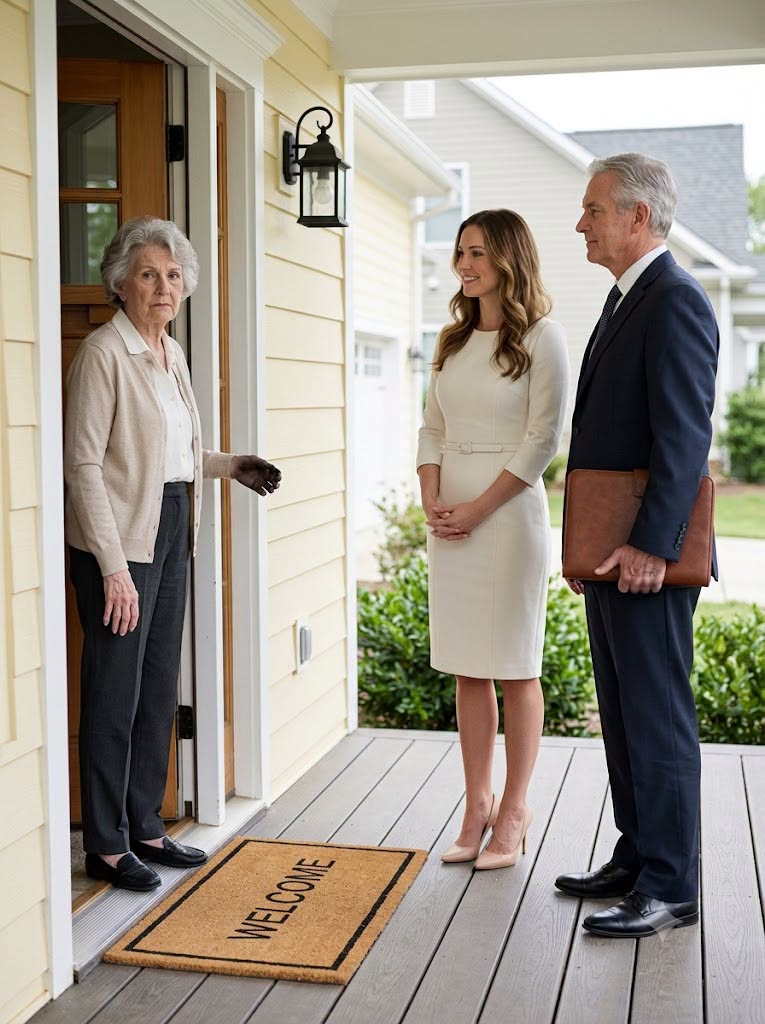
One week after the wedding, Allison came to my front door.
Beside her stood a sharply dressed notary named Peter Lang.
She carried a thick folder.
Once inside, Allison spread the papers across my table and began explaining my future to me.
She had found a buyer for my home.
The proposed sale price was $850,000.
She had also selected an assisted living facility.
The documents would authorize the sale, transfer control of my finances, and give her authority over my medical decisions.
She spoke with the confidence of someone who believed the only remaining step was my signature.
I did not argue.
I did not raise my voice.
I let her continue.
Then the doorbell rang.
Allison told me to ignore it.
I opened the door.
Laura stood there with two police officers.
She entered calmly and explained that they were there to review the documents as part of an active report involving suspected elder financial exploitation.
The atmosphere in the room changed immediately.
Peter Lang gathered his belongings and tried to leave. One of the officers stopped him long enough to record his information and ask whether he understood the documents he had agreed to notarize.
Allison began speaking quickly.
She said she was only helping.
She said I was confused.
She said the family was worried about my safety.
Laura reviewed the paperwork one section at a time.
She explained the coercive provisions, the unauthorized decisions, the transfer of financial authority, and the attempt to commit a competent adult to a facility without her informed consent.
Every excuse Allison offered became weaker when placed beside the actual documents.
Andrew arrived shortly afterward.
At first, he seemed irritated.
Then Laura showed him the paperwork.
I watched his expression change as he realized this was not a conversation about helping his aging mother.
It was a plan to remove me from my home and place my life under his wife’s control.
He claimed he had not understood the full extent of it.
I believed he had allowed himself not to understand.
That was painful enough.
I chose not to press formal criminal charges.
Perhaps some people will believe that was too merciful.
Others may believe it was not merciful at all, because I still required them to leave and told them they were no longer welcome on my property.
Mercy does not always mean removing consequences.
Sometimes it means refusing revenge while still closing the door.
The following day, I invited Andrew back alone.
I placed the deed to the eastern Washington ranch in front of him.
For several moments, he said nothing.
Then I told him its value.
Approximately $4.2 million.
Five hundred acres.
The inheritance his father had intended to provide security for me and, one day, perhaps something meaningful for the next generation.
Andrew stared at the deed and understood what had nearly happened.
Had I revealed the ranch earlier, it would likely have become the center of every conversation. Concern for my safety would have expanded into concern for the land, the trust, and the timing of inheritance.
The silence he may once have viewed as secrecy had protected us from learning the truth too late.
His marriage to Allison ended soon afterward.
But I did not celebrate its collapse.
A broken marriage is still a wound, even when it was built around dishonesty.
Andrew filed for divorce three weeks later.
Rebuilding our relationship took much longer.
He apologized, but apologies could not immediately restore the trust he had allowed to be damaged. We began again slowly.
He visited without asking about property.
He helped with small repairs.
He listened when I spoke.
Sometimes we worked beside one another for hours without discussing the past.
That silence felt different.
It no longer concealed danger.
It made room for humility.
I eventually placed the ranch into a strict trust.
Andrew may inherit it after my death, but only under clear protections that prevent anyone from using pressure, marriage, debt, or urgency to seize control of it.
Today, we spend time together on the land.
The ranch is wide and quiet, with long fences, open fields, and a horizon that makes most human schemes appear very small.
I often think about the morning Allison arrived with those documents.
I did not protect myself through anger.
I protected myself through preparation.
Through wise counsel.
Through refusing to surrender my dignity merely because someone called control concern.
Age did not make me incapable.
Love did not make me obligated to obey.
And forgiveness did not require me to leave my future unguarded.
My husband left me land.
Life taught me boundaries.
Both became part of the inheritance I intend to preserve.
Not only for Andrew.
For myself.