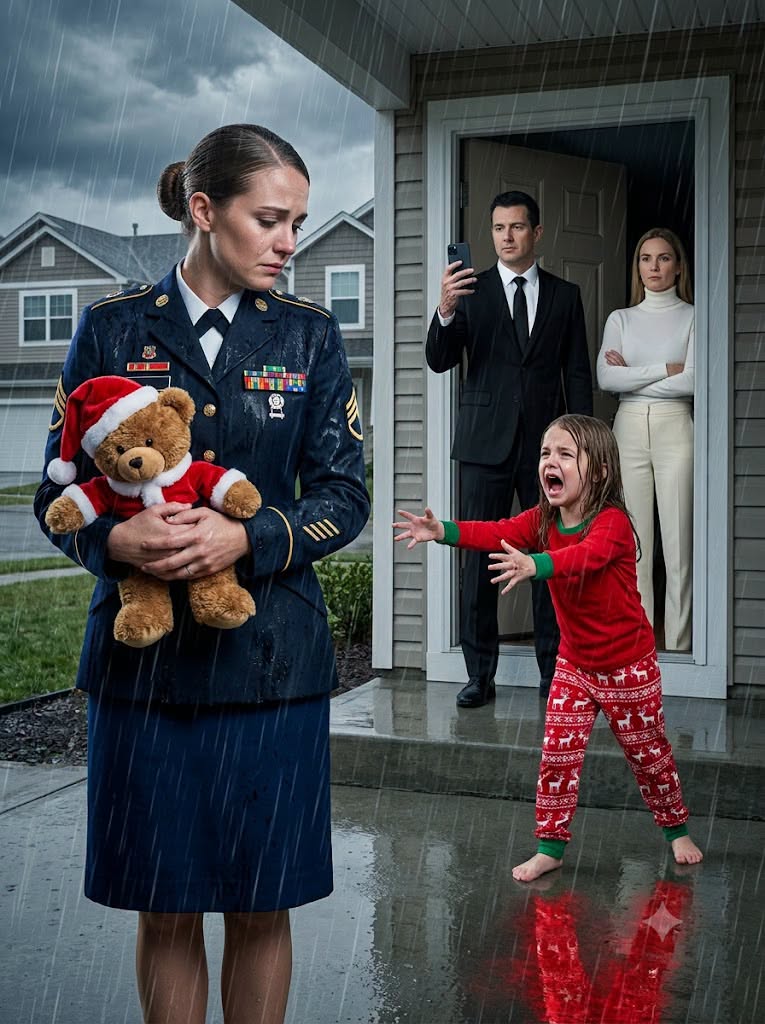
Then Corinne noticed the mark on her daughter’s wrist.
Before she could ask what had happened, her half-sister, Gwendolyn, stepped forward with an easy explanation.
“Playground accident,” she said quickly.
The answer came too fast.
Inside the house, her husband Ross stood holding his phone, recording everything.
The warmth Corinne had carried home disappeared.
When she walked through the front door, she realized the house no longer looked like hers.
Her belongings had been removed.
Photographs were gone.
Closets had been emptied.
Furniture had been rearranged.
The rooms now reflected Gwendolyn’s life instead of her own.
Ross calmly handed Corinne a folder containing legal separation papers. He wanted primary custody of Casey and proposed only limited visitation for her.
It felt less like a conversation and more like the final step of a plan that had been unfolding while she was serving overseas.
Corinne asked for a welfare check, believing the truth would become obvious once professionals looked closely.
Instead, she learned Ross had already contacted local authorities.
He had prepared edited messages and carefully selected recordings portraying her as unstable and unpredictable.
With conflicting accounts and a frightened child caught between adults, emergency workers made the difficult decision to let Casey spend the night with her aunt Miriam until the situation could be properly investigated.
For Corinne, that decision was painful.
But she understood that protecting Casey—not winning an argument—had to remain the priority.
The following morning, she met family attorney Rachel Norman in downtown Kansas City.
Rachel listened carefully before offering advice that changed the direction of the case.
“This cannot become about proving Ross betrayed you,” she said. “It must become about proving what environment is safest for Casey.”
That distinction mattered.
Personal betrayal could cloud judgment.
The child’s wellbeing had to remain at the center.
Their investigation soon led them to seventy-two-year-old Mrs. Odom, the quiet neighbor who had spent years tending her garden across the street.
Mrs. Odom had noticed more than anyone realized.
She kept careful notes.
August 18.
September 2.
October 11.
Dates when Gwendolyn began staying at the house for long periods.
Days Casey cried alone outside.
School absences that seemed increasingly unusual.
She had never intended to become part of a legal case.
She had simply paid attention.
Then she shared something even more important.
Security footage from her own cameras.
The recordings showed Casey being treated harshly outside the house and documented people removing boxes of personal papers from Corinne’s property while she remained overseas.
The investigation widened.
Financial records revealed that Ross and Gwendolyn had quietly redirected a significant portion of Corinne’s savings into a fictitious support organization before refinancing the family home without proper authorization.
The money funded an increasingly luxurious lifestyle.
It also helped secure Ross a prestigious community award scheduled to be presented during a Christmas Eve charity gala.
While the financial investigation continued, Corinne was granted supervised visitation with Casey.
Children often communicate differently when words feel unsafe.
That day, Casey handed her mother a drawing.
At first glance, it looked ordinary.
Then Corinne noticed a small object sketched high in the corner of the living room.
A camera.
Carefully drawn.
Casey quietly explained that she had been told to cry whenever her mother visited.
She had been coached to appear frightened.
The child was not trying to manipulate anyone.
She was trying to survive adults who had placed impossible expectations on her.
That drawing became an important piece of the larger investigation.
The legal team obtained an emergency court order allowing specialists to recover deleted files connected to the home’s recording system.
The restored footage spoke for itself.
It captured Ross and Gwendolyn deliberately upsetting Casey before recording her distress.
It preserved conversations discussing their plans to obtain full custody and gain access to Corinne’s military pension and financial assets.
The recordings required no dramatic interpretation.
Truth often carries enough weight on its own.
On Christmas Eve, Corinne attended the community gala with Rachel and Mrs. Odom.
Ross accepted his award confidently before community leaders, local officials, and banking executives.
He believed the story he had created was complete.
During his remarks, he invited Corinne onto the stage, hoping her presence would reinforce his carefully crafted image as a devoted father protecting a troubled family.
She accepted the invitation.
Not to embarrass him.
But to tell the truth.
With permission already arranged through the event organizers and investigators, the scheduled presentation was replaced with authenticated evidence.
The ballroom watched in silence as unedited recordings appeared on the screen.
They saw Casey’s distress.
They heard conversations about manipulating evidence.
They watched financial records connect private deception with public recognition.
No speech could have explained the situation more clearly than the facts themselves.
Authorities and banking compliance officers, who had already reviewed the evidence beforehand, stepped forward.
Ross was escorted away for questioning.
His professional responsibilities were immediately suspended pending investigation.
The room remained silent.
Then Casey ran across the stage into her mother’s arms.
It was the first moment all evening that truly mattered.
The months that followed were devoted less to courtroom victories than to rebuilding a child’s sense of safety.
Corinne was granted primary physical and legal custody.
Ross faced legal and professional consequences for his misconduct.
Gwendolyn entered mandatory psychological treatment and was ordered to maintain permanent legal distance from both Corinne and Casey.
Corinne made one more important decision.
She accepted a permanent administrative position within her department, allowing her to remain closer to home instead of continuing extended overseas assignments.
Together, she and Casey moved into a quiet neighborhood where ordinary routines slowly became possible again.
School mornings.
Bedtime stories.
Gardening together.
Drawing pictures that no longer carried hidden messages.
Healing arrived quietly.
Not through revenge.
Not through public victories.
But through consistency, truth, and the steady work of helping one little girl believe that home could once again be a place where she never had to be afraid.
Sometimes courage looks like serving your country.
Sometimes it looks like standing in a courtroom.
And sometimes it looks like listening carefully when a child cannot yet find the words.
Corinne learned that protecting her daughter required all three.
And in the end, the safest home Casey ever knew was not the one her mother fought to reclaim.
It was the one she built afterward—with honesty, peace, and love strong enough to leave fear behind.