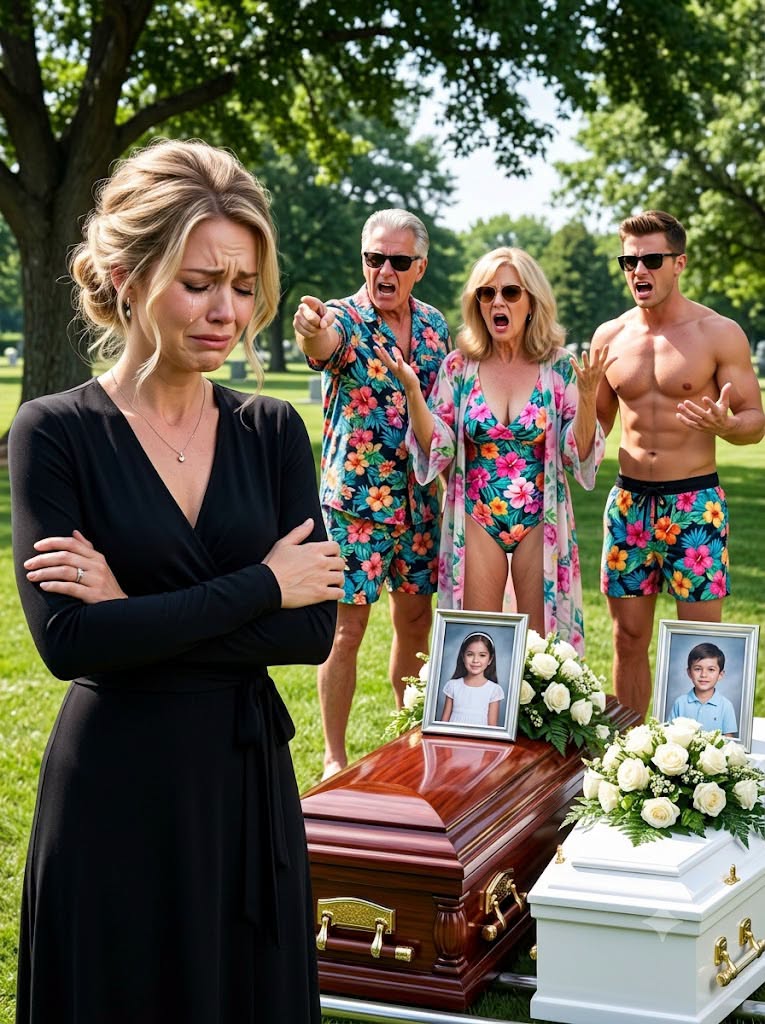
In the days after the funeral, it was my community — not my own family — that showed up for me. Johnny’s coworkers grieved him deeply, my neighbor Mrs. Forbes kept bringing me home-cooked meals, and my pastor gently reminded me I didn’t have to carry this alone. But being “the strong one” was a role I’d been stuck with since I was a kid — I’d always been the one holding my family together and cleaning up their financial messes.
My brother Jared had spent his whole adult life failing his way upward — one bankrupt business and unpaid loan after another. Johnny used to warn me that my parents didn’t love me so much as they saw me as something to use. Then, just three days after I buried my whole world, my parents and Jared showed up on my porch, still smelling like sunscreen. They didn’t ask how I was doing — they demanded forty thousand dollars on the spot to bail Jared and his restaurant out of a tax problem.
They insisted I owed them, after “everything they’d sacrificed” for me. But instead of breaking down under the pressure, I felt an eerie calm settle over me as I looked down at my black mourning dress and my daughter’s sparkly backpack sitting by the door. I picked up a thick navy folder from the entryway table and invited them in. For the first time in thirty-two years, my family had picked the wrong door to knock on.
That folder held something Johnny had been quietly building for months before the accident that took him and Gemma from me. It started with a rejection letter for a huge business loan — one I never applied for. Johnny figured out fast that my parents and brother had used my stolen identity to fund the restaurant. As a senior corporate insurance attorney, he had the resources to dig deep — pulling unredacted bank records and forensic proof of forged signatures.
My parents had basically built an entire secret life off my identity — maxing out cards in my name, hiding Jared’s losses. Worse, Johnny’s forensic accountant found they’d forged his signature too, making him a guarantor on yet another loan headed for default. And just two days before the funeral, my mother impersonated me in an email to Johnny’s law firm, trying to get her hands on his life insurance payout by claiming I was too “unstable” to manage my own finances.
I sat them down in my living room and told them notarized copies of everything had already gone to investigators and the fraud division. I laid out the handwriting analysis and security footage showing Jared depositing the stolen money. When my father lunged for the folder, I calmly told him there was a sheriff parked outside. Right on cue, Johnny’s probate attorney, Mr. Fletcher, walked in with a uniformed deputy to serve them all with felony fraud charges.
The charges also covered something even worse — they’d secretly drained an educational trust my Grandmother Rosemary had set up ten years earlier. That money was meant for my college tuition and Gemma’s future, but my mother had spent it all on vacations and bailing out Jared. Their whole fraudulent world collapsed fast — they lost their house, their jobs, and eventually their freedom. I took no pleasure in it, but I testified anyway, because they needed to face what they’d done.
Months later, the court recovered a good chunk of the stolen trust money, and I used it to start a memorial foundation in my daughter’s name — one that gives scholarships to local kids who’ve lost a parent or guardian. After the foundation launched, I brought a batch of blueberry pancakes to the cemetery and sat between their two headstones for a while. In that quiet spring air, I finally felt like I could start over — and that my life, for the first time in a long time, truly belonged to me.