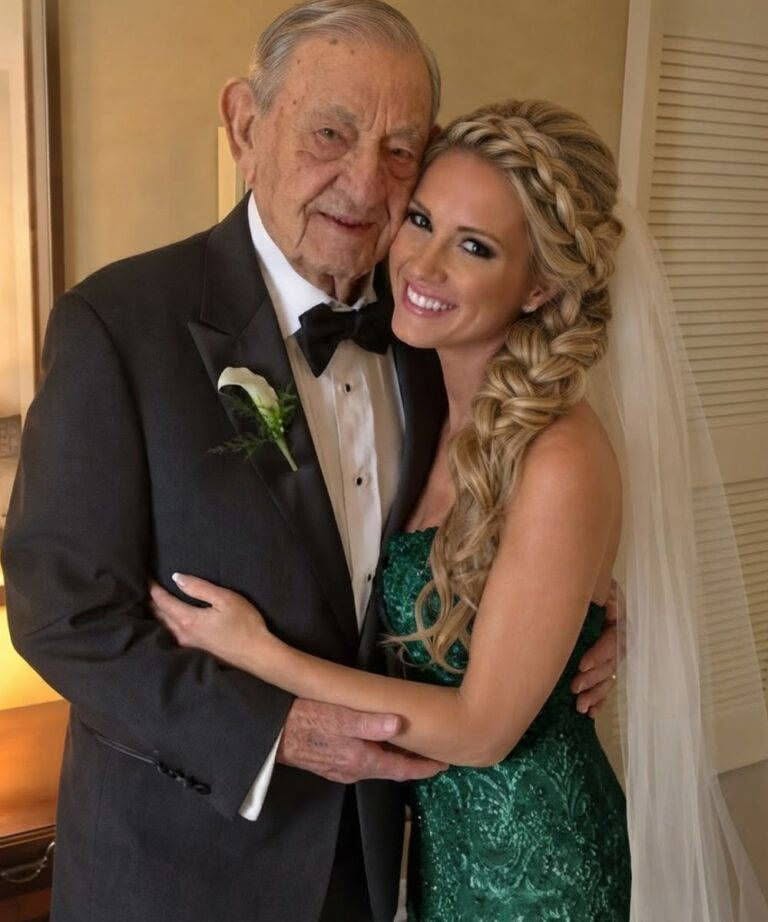
To me, that sounded like destiny.
I had already left more jobs than most people had applied for.
I quit a dental office because the chair at reception hurt my back.
I lasted eleven days at a clothing boutique because the lighting made everyone look exhausted.
My brief career in real estate ended when I discovered that open houses involved hours of standing and answering questions about drainage, roofing, and plumbing.
My parents kept encouraging me to build a career.
I preferred collecting photographs of luxury homes.
“I’m not meant for office life,” I told them one evening over dinner. “I’ll marry someone successful.”
My father slowly lowered his fork.
“Marriage is not a retirement plan, Sally.”
“It can be if you choose wisely.”
My mother closed her eyes.
Then I met Walter.
He was sitting alone in an elegant restaurant when his hand trembled and his wineglass slipped.
I reached the table before the waiter, caught the glass, and moved his phone away from the spill.
Walter looked up at me with amused blue eyes.
“That was either kindness or impressive reflexes.”
“Both,” I said.
He laughed and asked my name.
Within five minutes, I had given him my address, my phone number, and the most flattering possible version of my life story.
I described myself as “between careers.”
I did not mention that my most recent career had lasted nine days.
A week later, an enormous arrangement of roses arrived at my apartment.
The card read:
Dinner, without the wine accident?
Walter listened carefully when I spoke.
That was unusual enough to make him interesting.
He asked about my childhood, my parents, and why every job on my résumé seemed to end abruptly.
“I haven’t discovered my true calling,” I explained.
“Have you looked for it?”
“Briefly.”
He smiled into his tea.
Over the next two months, Walter took me to concerts, private dinners, charity auctions, and galleries where people bought decorative objects for more money than my father earned in a year.
Walter never bragged about his wealth.
He did not need to.
His tailored coats, private driver, expensive watch, and casual references to summers near Lake Como did the work for him.
I began imagining my future almost immediately.
Silk robes.
Household staff.
Breakfast on a terrace.
A dressing room larger than my apartment.
When Walter proposed, the ring arrived inside a blue velvet box.
The diamond was so large that I accepted before he had finished asking.
My parents were horrified.
At our first dinner after the engagement, Dad looked directly at Walter.
“You’re almost eighty.”
“Seventy-eight,” Walter corrected. “I still have two excellent years before ‘almost eighty.’”
My mother turned to me.
“Do you love him?”
“He treats me well.”
“That is not what I asked.”
I glanced toward Walter.
He was calmly buttering a dinner roll.
“I know enough,” I said.
Walter raised one eyebrow.
For the first time, I wondered whether he understood exactly why I had agreed to marry him.
The wedding was scheduled for six months later.
Walter promised that afterward we would move into his family mansion.
He showed me photographs of a grand stone estate with terraces, twelve bedrooms, enormous windows, and a library with a rolling ladder.
I immediately pictured myself walking down the staircase in a silk robe while someone else prepared breakfast.
Then strange things began happening.
First, Walter’s Bentley disappeared.
“What happened to the car?” I asked.
“It became unreliable.”
“It was nearly new.”
“Appearances can be deceptive.”
A few weeks later, he told me his investment accounts had been temporarily frozen because of trust paperwork.
Then he asked me to pay for dinner.
The following month, he borrowed eight hundred dollars for his wedding suit.
I stared at him.
“You’re a millionaire. Why can’t you afford your own pants?”
“The explanation would ruin the surprise.”
I transferred the money.
Not because I trusted him completely.
I had simply spent too many weeks choosing imaginary curtains for the mansion to turn back.
My parents became increasingly suspicious.
“Have you actually seen this estate?” Mom asked.
“Only photographs.”
“Have you visited his company?”
“I’ve seen the website.”
“What about the Bentley?”
“It’s being repaired.”
Dad stared at me across the table.
“If Walter lost every dollar tomorrow, would you still marry him?”
I opened my mouth.
Nothing came out.
The question bothered me for days.
Strangely, as Walter’s visible wealth disappeared, our relationship became better.
Without the Bentley, we walked.
Without expensive restaurants, we cooked together.
Walter made terrible omelets but excellent soup.
We visited farmers’ markets, watched old films in his modest rented apartment, and argued about crossword clues.
One rainy afternoon, I realized I had spent four hours with him without checking my phone once.
For the first time, Walter himself had become more interesting than his fortune.
I did not tell him.
Three days before the wedding, a courier delivered a cream-colored envelope.
Inside was a simple brass key tied with a blue ribbon.
I immediately called Walter.
“What does it open?”
“You’ll find out.”
“The mansion?”
“No.”
“A safe?”
“Keep it with you.”
That was all he would say.
I carried the key in my purse during the rehearsal.
On the wedding day, I tucked it beneath my bouquet.
Something about that scratched, ordinary key unsettled me more than Walter’s missing car, frozen accounts, or mysterious financial problems.
Halfway through our vows, Walter reached for the microphone.
The ballroom fell silent.
“My bride does not know one important detail about my fortune,” he announced.
My hands tightened around the bouquet.
Finally, I thought.
The estate.
The trust.
Perhaps a secret yacht.
Walter looked directly at me.
“Sally believes she is marrying my fortune.”
A few guests laughed.
“But the truth is, I do not own it.”
I stared at him.
“You what?”
“I take care of it.”
A serious-looking man seated near the front stood and approached us.
I had assumed he was one of Walter’s elderly relatives.
He was actually the family attorney.
He handed me a leather portfolio.
Hope immediately returned.
Perhaps it contained property deeds.
Trust documents.
Maps showing private islands.
I opened it.
The first page read:
THE WALTER FAMILY STEWARDSHIP CHARTER
Beneath the title was a list of responsibilities.
Visit employees experiencing hardship.
Interview scholarship applicants.
Attend retirement dinners.
Serve in community kitchens.
Mentor apprentices.
Read customer letters.
Visit the original family bakery every month.
I looked up at Walter.
“When do I receive the mansion?”
“After you understand why it was built.”
The guests laughed.
Even my father.
I flipped through the pages.
“What about the yacht?”
Walter pointed toward the final appendix.
One sentence appeared in bold type:
There is no yacht.
The laughter grew louder.
Walter explained that his grandfather had built the family business from a rented bakery kitchen.
The fortune no longer belonged to one person.
It belonged to a trust.
Each generation could manage it only while following the charter.
“Money can construct buildings,” Walter said. “Only people can build a family.”
I stared at him.
“So this was a test?”
“No.”
He paused.
“Mostly.”
The Bentley had been donated to a technical school, where students were learning to restore it.
The investment accounts had been transferred into the family trust.
The mansion’s west wing was being converted into housing for retired employees.
Then I remembered the suit.
“What about the eight hundred dollars?”
Walter leaned closer.
“That was the only test I could not resist.”
“The suit cost eight hundred?”
“Six hundred.”
He handed me the remaining two hundred dollars.
The minister coughed to hide his laughter.
I should have walked away.
Perhaps the version of me from six months earlier would have.
But I looked at the man who had cooked soup with me, listened to every ridiculous dream I had ever shared, and allowed me to discover who he was after the expensive things disappeared.
“Do I still get to marry you?” I asked.
Walter smiled.
“Only if you promise to read the first page.”
I looked down at the charter.
The first instruction read:
Learn every name you can.
“Fine,” I said.
The guests applauded, and the ceremony continued.
The morning after the wedding, Walter handed me a clipboard.
“Retired employee breakfast,” he announced.
I stared at him.
“I thought honeymoons involved beaches.”
“Ours involves cinnamon rolls and forty-seven former machinists.”
At first, I treated the family charter like homework.
I checked boxes.
Timed visits.
Recorded names.
I wore fashionable shoes to factory floors until a mechanic named Rosa handed me steel-toed boots.
“They’re ugly,” I complained.
“They’ll protect your feet.”
“What about my dignity?”
“That disappeared when you wore heels near a forklift.”
Rosa became one of my favorite people.
At a retirement breakfast, an elderly man named Arthur showed me photograph after photograph of his grandchildren.
At first, I smiled politely.
Then I noticed how carefully he held each picture.
As Walter and I prepared to leave, Arthur took my hand.
“My wife died last winter,” he said. “No one asks about the photographs anymore.”
The clipboard suddenly felt lighter.
I sat back down.
“Show me the one from the graduation again.”
Arthur smiled.
I stayed another forty minutes.
Slowly, I began understanding what the charter was trying to teach me.
People rarely remembered expensive gifts.
They remembered who called when they were ill.
Who stayed ten extra minutes.
Who noticed an empty chair.
A scholarship applicant named Luis told me his grandmother had cleaned Walter’s offices for forty years.
“Every winter, Mr. Walter checked her furnace himself,” Luis said.
Walter shook his head.
“I sent someone.”
Luis smiled.
“You stayed until it worked.”
Months passed.
I began remembering employee birthdays without checking a calendar.
I visited retirees without telling Walter.
I read hardship letters in his office and quietly cried over stories of illness, lost homes, and family emergencies.
One afternoon, Walter found me sitting alone among the letters.
He placed the old brass key on the desk beside me.
“What does it actually open?” I asked.
“The employee break room at our first factory.”
“That’s all?”
“It was the first key my grandfather trusted me with.”
Walter sat across from me.
“I cleaned that room every Saturday for a year before he allowed me to manage anything.”
I turned the scratched key over in my palm.
“Why did you give it to me?”
“Because you stopped asking what everything was worth.”
Years passed.
Walter eventually grew slower.
His hands trembled more often.
His jokes became softer.
But he never stopped learning names.
He died peacefully in his sleep one winter morning.
At his funeral, investors filled only two rows.
The rest of the church overflowed with mechanics, janitors, secretaries, retired bakers, apprentices, scholarship students, drivers, factory workers, and families whose names I knew.
Rosa sat near the front.
Arthur brought a photograph of his grandchildren.
Luis stood beside his grandmother.
After the service, a glamorous young woman approached me.
She glanced toward the company cars parked outside.
“What is it really like marrying into all this money?” she asked.
I laughed.
Then I led her into Walter’s office and handed her the leather portfolio.
Her smile widened when she opened it.
A few seconds later, it slowly disappeared.
That evening, I visited the company’s oldest factory.
Through a distant window, I could see the mansion glowing on the hill.
Years earlier, that view would have consumed me.
Now I barely noticed it.
After the final employees collected their coats, I turned off the break-room lights and closed the door.
The small brass key turned smoothly in the lock.
At twenty-nine, I had dreamed of owning a mansion.
Walter left me something far more valuable.
He taught me that wealth was not measured by how many doors opened for you.
It was measured by how many you learned to open for someone else.
{"post":107258,"page":2,"next":[{"id":107255,"title":"My Fianc\u00e9 Pressured Me to Send My 5-Year-Old Twin Brothers to a Group Home After I Became Their Guardian \u2013 So I Taught Him a Lesson He Would Never Forget","url":"https:\/\/new24.info\/107255"},{"id":107250,"title":"After I Gave Birth to Our Son, My Husband Walked into My Hospital Room With a Pregnant Woman and Said, \u0027Our Family Is Growing Again\u0027 \u2013 What His Father Did Next Left Everyone Speechless","url":"https:\/\/new24.info\/107250"},{"id":107247,"title":"I Pretended to Be the Daughter of an Elderly Man I Met by Chance \u2013 Days Later, His Lawyer Found Me and Said, \u0027You Walked Straight Into His Trap\u0027","url":"https:\/\/new24.info\/107247"},{"id":107229,"title":"A Rude Woman Took the Window Seat I\u0027d Paid for My 6-Year-Old Daughter With Autism \u2013 So the Pilot Taught Her a Lesson She\u0027d Never Forget","url":"https:\/\/new24.info\/107229"},{"id":107244,"title":"Remembering Rob Hirst: The Rhythmic Heartbeat and Enduring Cultural Legacy of an Australian Music Icon","url":"https:\/\/new24.info\/107244"},{"id":107238,"title":"Hidden Prom Dress Inside My Son\u2019s Beanbag Chair Revealed Painful Truths","url":"https:\/\/new24.info\/107238"},{"id":107234,"title":"How My Sister Hijacked My Empty Austin House For Her Secret Party","url":"https:\/\/new24.info\/107234"},{"id":107225,"title":"Returning Home To Discover My Parents Faked My Disappearance For Money","url":"https:\/\/new24.info\/107225"},{"id":107226,"title":"Why Unplugging This Popular Kitchen Appliance at Night Can Protect Your Home","url":"https:\/\/new24.info\/107226"},{"id":107221,"title":"How One Unanswered Text Message Ended Years Of Toxic Family Demands","url":"https:\/\/new24.info\/107221"},{"id":107216,"title":"Relentless Mother Uses Her Secret Investigative Past To Expose Reckless Family","url":"https:\/\/new24.info\/107216"},{"id":107212,"title":"How One Courageous Haircut Revealed A Beautiful Secret From A Father","url":"https:\/\/new24.info\/107212"},{"id":107208,"title":"Hidden Audio Files And Secret Financial Records Finally Exposed Victor Payne","url":"https:\/\/new24.info\/107208"},{"id":107205,"title":"High blood pressure, high cholesterol: Avoid these 3 habits in the morning","url":"https:\/\/new24.info\/107205"},{"id":107202,"title":"12 nasty things you do in old age that everyone notices, but no one dares to tell you","url":"https:\/\/new24.info\/107202"},{"id":107199,"title":"After 32 Years, My Company Handed Me a Box and Five Minutes to Leave \u2013 Three Days Later, a Man From the CEO\u0027s Office Knocked on My Door","url":"https:\/\/new24.info\/107199"},{"id":107197,"title":"A Practical Guide to Safely Washing and Reusing Your Kitchen Storage Bags","url":"https:\/\/new24.info\/107197"},{"id":107191,"title":"Is That Itchy Rash on Your Hands Actually a Hidden Danger? The Secret Signs of Dyshidrotic Eczema You Can\u2019t Afford to Ignore","url":"https:\/\/new24.info\/107191"},{"id":107187,"title":"The Night My Son Set a Place at the Table for My D3ad Husband \u2014 and Finally Told Me the Secret They\u2019d Hidden for Two Years","url":"https:\/\/new24.info\/107187"},{"id":107184,"title":"I Married a 78-Year-Old Wealthy Man \u2013 During Our Wedding Vows, He Grabbed the Mic and Said, \u0027My Bride Doesn\u0027t Know One Important Detail About Me\u0027","url":"https:\/\/new24.info\/107184"}]}