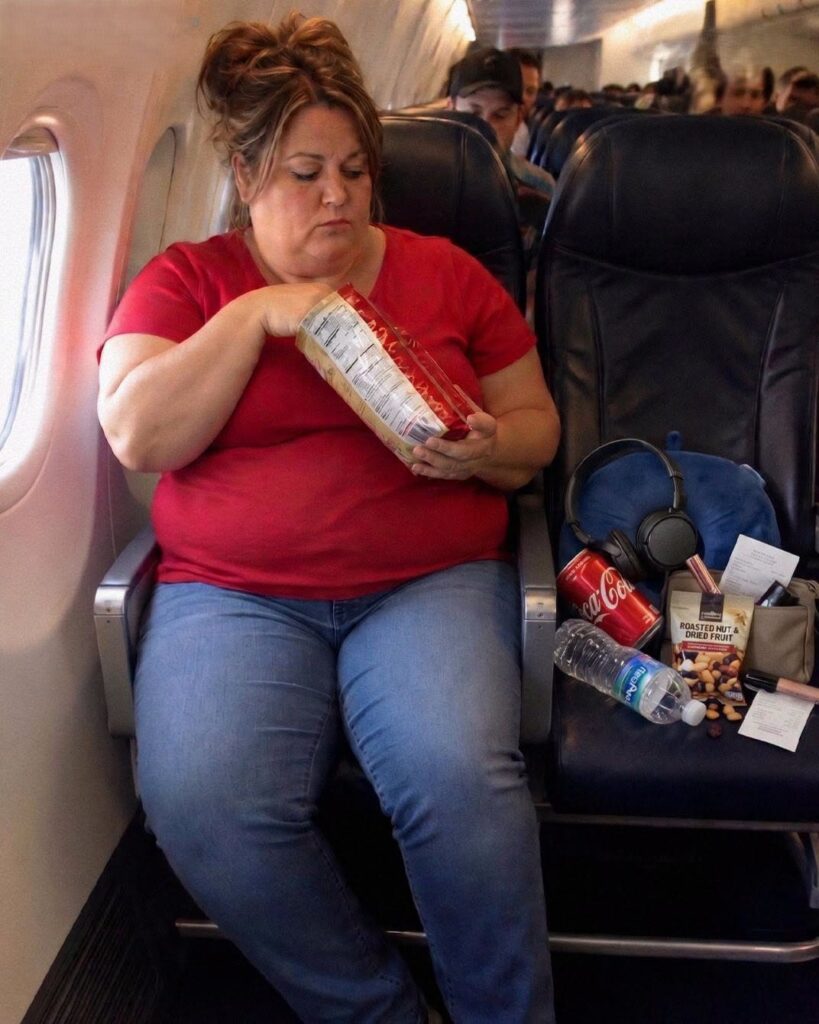
A window seat.
When that small piece of security was taken from us, I thought my only choice was to gather our things, avoid a scene, and accept that the trip might have been a terrible mistake.
The night before our flight, I sat cross-legged on Emma’s bedroom floor, closing a small suitcase covered in cloud-shaped stickers she had chosen herself.
Two years had passed since her father, Sean, died.
Since then, most of our plans had revolved around doctors, therapy appointments, school meetings, and the careful routines that helped Emma move through a world that often felt too loud and unpredictable.
This trip was different.
Four days at the beach.
That was all.
But to me, it felt like climbing a mountain.
Emma was already asleep, curled beneath her blanket with a stuffed airplane tucked under one arm.
She had named it Buzz a year earlier, and it had rarely left her side since.
I sat beside her for a moment, running my thumb over one of the cloud stickers on her suitcase.
“You’ve got this, Tina,” I whispered to myself. “It’s only a flight.”
My phone buzzed.
An email from the airline appeared on the screen.
There had been an aircraft change.
Some passengers might be reassigned automatically.
My stomach tightened as I opened our boarding passes.
Emma: 7A.
Tina: 7B.
The seats were still there.
Side by side.
Window and middle.
I released the breath I had been holding.
“We’re good,” I murmured. “The window is still ours.”
That seat was not simply a preference.
Emma was autistic, and looking outside helped her regulate herself when she became overwhelmed.
Clouds, sunlight, moving trees, passing cars—anything steady and visual could draw her attention away from noise and fear.
I had chosen 7A four months earlier because I wanted her first flight to feel exciting rather than frightening.
The next morning, Emma stood at the airport gate clutching Buzz against her chest.
Through the enormous glass windows, the airplane waited on the runway.
“Mommy,” she whispered, staring at it. “Is that our one?”
“That’s our one.”
“And I see the clouds?”
I crouched beside her.
“You have the window seat. Seven A. It’s waiting for you.”
A small, careful smile appeared on her face.
Emma did not smile widely when she was overwhelmed.
She saved those little smiles for moments that mattered.
My chest tightened with love.
Near the boarding counter, a gate agent frowned at her computer and spoke quietly into her headset.
I noticed her looking between the screen and the jet bridge, but I assumed she was handling one of the countless small problems that seemed to happen at airports.
“Ready, Em?”
“Ready.”
I took her hand.
Buzz dangled from her other one, one soft wing brushing the carpet as we walked toward the plane.
“The window seat is waiting,” I reminded her.
I had no idea that the aircraft-change email I had barely read had already changed everything.
Boarding went smoothly until we reached row seven.
Then Emma stopped.
Her fingers tightened around my sleeve.
A woman was already seated in 7A.
She appeared to be in her late forties, dressed in a tailored jacket with her handbag neatly tucked beneath the seat ahead of her.
She had already fastened her seat belt and was holding her phone toward the window.
I checked our boarding passes again.
7A and 7B.
I gave her my most polite smile.
“Excuse me. I believe those are our seats.”
The woman looked at me.
Then she looked at Emma.
“I was assigned this seat,” she said.
“So were we.”
She gave a small shrug.
“Then the airline made a mistake.”
A flight attendant appeared beside us.
Her name tag read Lisa.
I handed her our passes.
She examined them, then checked the woman’s boarding pass.
A tired sigh escaped her.
“I’m very sorry,” she said. “The aircraft was changed this morning, and several passengers were reassigned incorrectly.”
She turned toward the woman.
“Ms. Reyes, your original seat was 14C. The system moved you to 7A during the aircraft swap. This child was booked in 7A several months ago.”
Ms. Reyes crossed her arms.
“My boarding pass says 7A.”
“Yes, ma’am, but the seat was assigned twice.”
I lowered my voice.
“My daughter has autism. Looking out of the window helps her stay calm. It’s her first flight, and I specifically booked that seat for her.”
Lisa nodded with immediate understanding.
She turned back to Ms. Reyes.
“We have an aisle seat available in row twelve. It is closer to your original assigned row. Would you be willing to move there?”
Ms. Reyes stared at her.
“I paid for a window seat.”
“Your original reservation was an aisle seat.”
“I’m sitting here now.”
Emma tugged on my hand.
A faint tremble had begun in her fingers.
It was the first warning.
Soon, she might start rocking.
Then covering her ears.
Then crying.
I looked at Ms. Reyes.
“Please,” I said quietly. “I paid for the window too. It really matters for my daughter.”
She did not even look at Emma.
“That’s not my problem.”
I felt the words land inside me.
Behind us, the boarding line began to grow.
A suitcase wheel struck a seat.
Someone sighed.
A man cleared his throat.
The ordinary sounds of impatience became louder with every second.
“Ma’am,” I tried again, “she has prepared for this for months.”
“Then perhaps you should have arrived earlier.”
I stared at her.
“We booked the seat four months ago.”
Ms. Reyes turned toward the window.
“I’m already settled.”
Lisa watched her for a long moment.
Something in the flight attendant’s expression changed.
Not anger exactly.
Disappointment.
Perhaps disbelief.
Then she turned to me.
“I can seat you together in row twelve,” she said gently. “There is a middle and an aisle seat available.”
My heart sank.
“No window?”
“I’m afraid not right now.”
Emma made a small whimper.
Only I heard it.
Every parent of a child who becomes overwhelmed easily knows this calculation.
Do I fight for what is right?
Or do I protect my child from the fight?
At that moment, I could not do both.
I did not want Emma’s first memory of an airplane to be her mother arguing in a crowded aisle while strangers stared.
“Okay,” I whispered. “We’ll take row twelve.”
Lisa nodded, but before leading us away, she looked toward the back of the cabin.
Her eyes settled on a couple seated together near a window in row nineteen.
She hurried toward them and spoke quietly.
I could not hear the conversation.
Both passengers glanced toward Emma.
Then they exchanged a look and nodded.
Lisa smiled gratefully.
“Thank you,” she said.
She returned to us without explaining.
Ms. Reyes had already lifted her phone again and was photographing the wing.
I led Emma down the aisle.
Each step felt like a small defeat.
An older woman seated across from row twelve watched us settle in.
She had silver hair pinned neatly behind her head and kind brown eyes.
She smiled at Emma.
Then she smiled at me.
It was the first kind gesture anyone had offered that morning, and I nearly cried because of it.
I fastened Emma’s seat belt and placed Buzz securely in her lap.
“We’re going up,” I said in the gentle, rhythmic voice that usually comforted her. “Up, up, up, just like the birds.”
Emma gripped her stuffed airplane.
The engines grew louder.
She covered one ear with her shoulder and pressed against me.
As the cabin door closed, I noticed Lisa speaking into the interphone near the front galley.
She listened for a moment.
Then she said quietly, “Understood.”
I did not know she had informed the captain about what had happened.
I closed my eyes and prayed that I could help Emma through the next five hours.
When the plane began moving, I went into what I privately called mission mode.
I placed Emma’s headphones over her ears.
I opened her favorite coloring book to a page filled with airplanes and clouds.
“Count with me,” I whispered. “One cloud. Two clouds. Three clouds.”
She tried.
She always tried.
During takeoff, her body became rigid.
Her fingers dug into Buzz.
I kept one hand over hers until the plane leveled.
For the first twenty minutes, the coloring book worked.
Then Emma began rocking gently against the seat belt.
A soft whimper escaped her.
“Mommy, sky.”
“I know, sweetheart.”
“I want the sky.”
From our seats, she could see only the aisle, the pale cabin wall, and the back of another passenger’s head.
The older woman across from us leaned closer.
“Would she like to look through my window for a moment?”
I nodded gratefully.
Emma leaned across the aisle and caught a narrow glimpse of blue.
Her expression softened briefly.
Then she sat back.
It was not enough.
The woman’s window was too far away and partly blocked by the seat.
I continued our counting games, but a cruel voice had started speaking inside my head.
You should have fought harder.
You failed her.
This whole trip was a mistake.
Several rows ahead, I could see Ms. Reyes holding her phone beside the window.
She took photograph after photograph of herself with the clouds behind her.
I looked away.
When Lisa brought the drink cart through the cabin, she paused beside us.
“How is she doing?” she whispered.
“We’re managing.”
Her eyes moved toward Emma’s rocking body.
Then she looked toward row nineteen.
When she reached the couple there, she leaned down and exchanged a few quiet words with them.
One of them glanced back toward us and nodded again.
Lisa thanked them and continued.
About ninety minutes into the flight, the public-address system crackled.
The captain’s voice filled the cabin.
“Ladies and gentlemen, this is Captain Brown speaking.”
His tone was calm, but deliberate.
“I would like to take a brief moment to recognize that air travel often gives us unexpected opportunities to show patience and kindness toward one another.”
Passengers looked up from their books and phones.
“To the passenger seated in 7A, a crew member has something for you.”
Lisa stepped into the aisle carrying a small box.
Ms. Reyes immediately sat straighter.
She smiled and lifted her phone, apparently preparing to record.
“Oh my goodness,” she said. “Is this some kind of prize?”
Lisa handed her the box.
I turned back toward Emma.
Whatever was happening in row seven did not matter.
My daughter was still rocking beside me, and I was trying to hold our day together.
Then a sharp cry rang through the cabin.
“What is this?”
Emma’s head snapped up.
Passengers turned toward row seven.
Ms. Reyes held the open box in her hands, her face flushed.
Inside was not champagne, a voucher, or an expensive gift.
There was only a card.
Lisa calmly removed it.
“Since several people are now watching,” she said, “I’ll read it aloud.”
Ms. Reyes stared at her.
The flight attendant unfolded the card.
“Today, our crew witnessed a seat-assignment error involving a child who had reserved a window seat months in advance for disability-related needs.”
The cabin became silent.
“We also witnessed an opportunity for kindness being declined.”
Ms. Reyes’s face reddened.
Lisa continued.
“This card is a reminder that a boarding pass may assign a seat, but it does not determine the kind of person we choose to be while sitting in it.”
Several passengers murmured in agreement.
The captain’s voice returned through the speakers.
“We would also like to thank the passengers in row nineteen, who volunteered their window seat so a young traveler could enjoy the rest of her first flight.”
Applause spread through the cabin.
It began near the back and moved forward.
Ms. Reyes lowered herself into her seat and stared at her lap.
I did not feel victorious.
I did not want her humiliated.
I only felt seen.
After the seat belt sign switched off, Lisa came to us and knelt beside Emma.
“Do you remember the people I spoke to during boarding?” she asked me.
I nodded.
“They offered to move so Emma could have their window.”
I looked toward row nineteen.
The couple was already standing and gathering their belongings.
“You don’t have to do that,” I said.
The man smiled.
“We have flown many times.”
His wife looked at Emma.
“She only gets one first flight.”
Tears filled my eyes.
“Thank you.”
The couple moved into our middle and aisle seats.
Lisa helped Emma walk toward row nineteen while I carried our bag and Buzz.
When Emma reached the window, she froze.
The entire sky stretched beyond the glass.
White clouds floated beneath us like enormous islands.
Emma climbed into the seat and pressed both hands against the window.
“Mommy,” she whispered.
I sat beside her.
“What is it?”
“The clouds are pillows.”
Her voice was filled with wonder.
I laughed as tears ran down my cheeks.
“Yes, sweetheart.”
She rested Buzz against the window so he could see too.
For the remainder of the flight, Emma remained calm.
She counted clouds.
She watched the wing move.
She asked whether birds could fly as high as airplanes.
Every few minutes, she turned toward me with that same small, careful smile.
The vacation had not even begun, and she had already done something that once seemed impossible.
After landing, we waited until most passengers had left.
As we approached the front door, a man in a pilot’s uniform stood outside the cockpit.
“Is this Emma?” he asked.
She stepped partly behind me.
“This is Captain Brown,” Lisa explained. “He flew the airplane.”
Emma stared at him.
“You were in the front?”
“The whole time.”
“Did you see the clouds?”
“I saw every one.”
He knelt and showed her a small pair of golden plastic wings.
“Would you like these?”
Emma nodded.
Captain Brown pinned them to her shirt.
“You did very well on your first flight.”
Then he looked at me.
His voice became quieter.
“So did you.”
I swallowed.
“I felt like I was barely holding everything together.”
“That still counts as holding it together.”
Those words followed me through the airport.
Emma held my hand as we walked toward baggage claim, her golden wings shining on her shirt and Buzz tucked securely beneath her arm.
Outside, warm coastal air met us.
For the first time since Sean died, I felt something inside me loosen.
For two years, I had believed I had to carry every difficult moment alone.
That flight reminded me that sometimes strangers notice.
Sometimes they step aside.
Sometimes they offer a window.
And sometimes, just when you think the world is telling your child she is too difficult, too inconvenient, or too much, good people make room for her to see the sky.
{"post":107229,"page":2,"next":[{"id":107244,"title":"Remembering Rob Hirst: The Rhythmic Heartbeat and Enduring Cultural Legacy of an Australian Music Icon","url":"https:\/\/new24.info\/107244"},{"id":107238,"title":"Hidden Prom Dress Inside My Son\u2019s Beanbag Chair Revealed Painful Truths","url":"https:\/\/new24.info\/107238"},{"id":107234,"title":"How My Sister Hijacked My Empty Austin House For Her Secret Party","url":"https:\/\/new24.info\/107234"},{"id":107225,"title":"Returning Home To Discover My Parents Faked My Disappearance For Money","url":"https:\/\/new24.info\/107225"},{"id":107226,"title":"Why Unplugging This Popular Kitchen Appliance at Night Can Protect Your Home","url":"https:\/\/new24.info\/107226"},{"id":107221,"title":"How One Unanswered Text Message Ended Years Of Toxic Family Demands","url":"https:\/\/new24.info\/107221"},{"id":107216,"title":"Relentless Mother Uses Her Secret Investigative Past To Expose Reckless Family","url":"https:\/\/new24.info\/107216"},{"id":107212,"title":"How One Courageous Haircut Revealed A Beautiful Secret From A Father","url":"https:\/\/new24.info\/107212"},{"id":107208,"title":"Hidden Audio Files And Secret Financial Records Finally Exposed Victor Payne","url":"https:\/\/new24.info\/107208"},{"id":107205,"title":"High blood pressure, high cholesterol: Avoid these 3 habits in the morning","url":"https:\/\/new24.info\/107205"},{"id":107202,"title":"12 nasty things you do in old age that everyone notices, but no one dares to tell you","url":"https:\/\/new24.info\/107202"},{"id":107199,"title":"After 32 Years, My Company Handed Me a Box and Five Minutes to Leave \u2013 Three Days Later, a Man From the CEO\u0027s Office Knocked on My Door","url":"https:\/\/new24.info\/107199"},{"id":107197,"title":"A Practical Guide to Safely Washing and Reusing Your Kitchen Storage Bags","url":"https:\/\/new24.info\/107197"},{"id":107191,"title":"Is That Itchy Rash on Your Hands Actually a Hidden Danger? The Secret Signs of Dyshidrotic Eczema You Can\u2019t Afford to Ignore","url":"https:\/\/new24.info\/107191"},{"id":107187,"title":"The Night My Son Set a Place at the Table for My D3ad Husband \u2014 and Finally Told Me the Secret They\u2019d Hidden for Two Years","url":"https:\/\/new24.info\/107187"},{"id":107184,"title":"I Married a 78-Year-Old Wealthy Man \u2013 During Our Wedding Vows, He Grabbed the Mic and Said, \u0027My Bride Doesn\u0027t Know One Important Detail About Me\u0027","url":"https:\/\/new24.info\/107184"},{"id":107181,"title":"Psychological test: Which of these four babies is a little girl?","url":"https:\/\/new24.info\/107181"},{"id":107178,"title":"A Rude Man Tried to Kick Me Out of the Pool Because My 7-Month-Old Granddaughter Was Crying \u2013 Then a Waiter Came Over and Handed Him a Gift He Would Never Forget","url":"https:\/\/new24.info\/107178"},{"id":107170,"title":"How the girl who was called ugly became the sexiest woman alive","url":"https:\/\/new24.info\/107170"},{"id":107165,"title":"My Dead Daughter Walked Into Her Old School Two Years After Her Burial But What I Found On Her Neck Terrified Me Beyond Belief","url":"https:\/\/new24.info\/107165"}]}