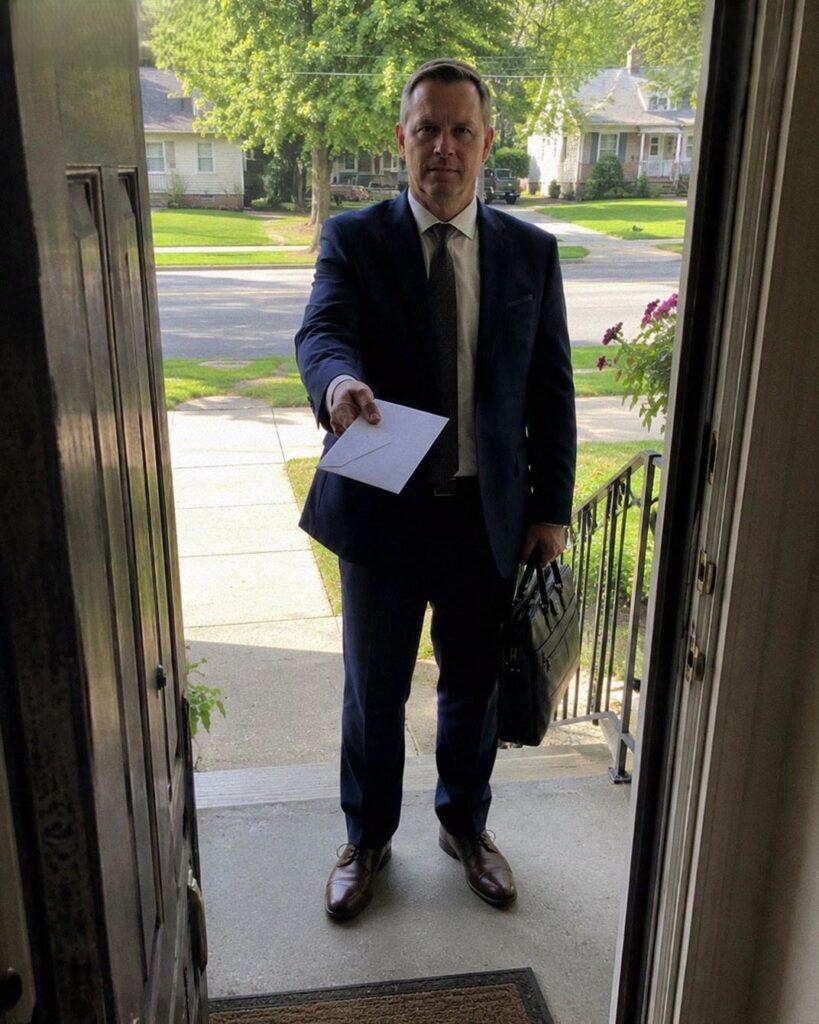
“Tell me you’ve never seen these before.”
My name is Carol Brooks.
I am sixty-one years old, and for most of my adult life, I believed loyalty was simple.
You showed up.
You stayed late when the work demanded it.
You did your job correctly, even when no one was watching.
And if you gave a company enough years, you trusted that it would remember you when your working days came to an end.
I began working in payroll at Harlan Manufacturing when I was twenty-nine.
Back then, the company occupied a single brick building with a leaking roof, loud machinery, and a break room that always smelled like burnt coffee.
By the time I left, it had expanded into three facilities and employed hundreds of people.
I stayed through mergers, recessions, layoffs, three chief executives, and two payroll software conversions.
I watched whole departments disappear.
I watched young apprentices become supervisors, then retirees.
I watched men and women who had given the factory their backs, knees, hearing, and best years walk into retirement parties decorated with paper banners and grocery-store sheet cakes.
Many of them came through my office before they left.
They carried folders, envelopes, and questions.
“How much will I receive?”
“Did my medical leave affect my service time?”
“What happens to my spouse if I die first?”
I printed their numbers, explained their deductions, and gave everyone the same advice.
“Keep your statements.”
Some laughed.
Most listened.
“Every payroll record. Every benefits estimate. Every retirement projection. Keep all of it. One day, you may need it.”
I thought I was offering routine advice.
I had no idea I was helping them preserve evidence.
I believed I would retire from Harlan Manufacturing.
I imagined a small party in the conference room, a cake with my name misspelled in icing, and coworkers joking that no one else knew where the old payroll files were kept.
Instead, on a Tuesday morning, an HR representative appeared beside my desk carrying an empty cardboard box.
My manager, Jerry Collins, stood behind her with his hands clasped tightly in front of him.
He would not meet my eyes.
“We’re restructuring,” the HR woman said.
I waited for the rest.
There was no rest.
“You have five minutes to collect your personal belongings.”
I stared at her.
“Five minutes?”
“I’m sorry, Carol.”
She did not sound sorry.
I looked past her at Jerry.
“Jerry?”
His gaze remained fixed somewhere near my shoulder.
He had worked beside me for fourteen years.
I had covered for him when his wife was ill.
I trained him when he first became manager.
He did not say a word.
I placed two framed photographs, a coffee mug, a cardigan, and a small plant into the box.
Around me, coworkers suddenly became fascinated by their computer screens.
Security escorted me through the office as though I had stolen something.
In the parking lot, I stood beside my car holding that box and felt ashamed, even though I had done nothing wrong.
That was the cruelest part.
They had humiliated me so efficiently that for several minutes, I wondered whether I deserved it.
I cried the entire drive home.
For three days, I sat in my kitchen replaying the dismissal.
Had Jerry known in advance?
Was the company truly restructuring?
Or had someone decided that firing a woman in her sixties was cheaper than allowing her to reach retirement?
I stared at the unopened box near the door.
I could not bring myself to unpack it.
On Friday morning, someone knocked.
A man in a navy suit stood on my porch holding a leather briefcase.
He looked to be in his early forties, with tired eyes and the careful manner of someone bringing bad news.
“Mrs. Brooks?”
“Yes.”
“My name is Daniel Price. I work with the CEO’s office.”
My first thought was that I had accidentally taken confidential company documents.
Panic makes people strangely polite.
I invited him inside.
At my kitchen table, Daniel opened his briefcase and spread out several payroll and retirement records.
Every page carried my electronic approval.
My stomach dropped.
He slid the first one toward me.
“Mrs. Brooks, tell me you’ve never seen these before.”
I picked up the page.
The approval showed my full name.
Carol M. Brooks.
The date stamp looked genuine.
The adjustment notes did not.
“What am I looking at?”
“Retirement and benefits calculations for employees over fifty-five,” Daniel said. “Credited service years were reduced. Their projected payouts fell with them.”
I turned to another record.
Then another.
My approval appeared on all of them.
“You’re saying I authorized this?”
“That is what the system shows.”
“I did not.”
My voice came out stronger than I felt.
I studied the approval mark more closely.
It had come from an archived signature file we used before the most recent software conversion.
“That signature file should have been locked years ago.”
Daniel’s shoulders lowered slightly, as though he had hoped I would say exactly that.
“That is what I’m investigating.”
“Why?”
“The CEO’s office received a complaint from a retired machinist. His final retirement figures did not match estimates he received while employed.”
I knew the name before Daniel said it.
“Frank Dorsey.”
He nodded.
Frank had worked at the plant almost as long as I had.
He had thick hands, a bad knee, and a mind for numbers that surprised anyone who mistook his quietness for simplicity.
He always entered payroll carrying a folder under one arm and a pencil behind his ear.
“Take me to him,” I said.
Daniel hesitated.
“Mrs. Brooks—”
“If my name is on those records, I want to see the papers he kept.”
Frank opened his front door holding the same battered folder he had carried into my office for years.
It was thicker now.
When he saw me, relief crossed his face first.
Then anger.
Then vindication.
“I told them,” he said. “I told them those numbers weren’t yours.”
At his dining table, he spread out annual statements, benefit projections, and handwritten notes.
I recognized my writing in the margins.
Overtime adjustment confirmed.
Medical leave credited.
Estimated retirement service: thirty-eight years.
Daniel placed the company’s current record beside the older statements.
Frank’s credited service had been reduced by nine years.
Nine years.
Frank stared at the page.
“That changes my payment by almost six hundred dollars a month.”
No one spoke.
“That’s half a truck payment,” he continued. “That’s heating oil every winter. That’s prescriptions.”
To someone in an executive office, the missing years may have looked like reduced liability.
To me, they looked like Frank choosing between medicine and heat.
“I want to see my record,” I said.
Daniel’s expression changed.
“Carol—”
“My retirement review was due next month. Pull it.”
He opened his laptop and accessed the file.
The screen showed twenty-one years of credited service.
I had worked there for thirty-two.
For a moment, the room moved around me.
I gripped the table.
“They took eleven years.”
Frank cursed under his breath.
Daniel closed his eyes.
The truth became clear all at once.
“They didn’t just fire me,” I said. “They removed me before I could discover what they had done to my own retirement.”
Daniel took a printed email from his briefcase.
It had been sent by Paula Simmons, the benefits director, three days before my dismissal.
The subject line read:
CONTROL RISK—IMMEDIATE ACTION RECOMMENDED
In the message, Paula described me as a possible threat to the department’s cost-reduction strategy.
She recommended that I be removed before my scheduled retirement review.
Jerry had been copied.
He had not merely known that I was being fired.
He had known why.
Daniel placed his hands flat on the table.
“The company would prefer to resolve this privately.”
I looked at the records bearing my forged approval.
For decades, employees trusted those marks because they trusted me.
Whoever changed the numbers had chosen my name deliberately.
A lie is more believable when it wears the face of someone people trust.
“How many records?” I asked.
“Nearly forty suspicious adjustments.”
“Then we start contacting people.”
Daniel hesitated.
“The company’s proposal is to correct the figures, compensate affected workers, and require confidentiality agreements.”
I laughed.
It was not because anything was funny.
It was because the suggestion was so insulting that anger had nowhere else to go.
“You want to steal years from forty people, restore them quietly, and make everyone promise not to mention it?”
“I’m telling you what the legal department recommended.”
“These people gave that factory their backs, their knees, and half their lives.”
My voice rose.
“You do not erase them in private and correct them in secret.”
Frank contacted former coworkers.
Those workers contacted others.
Anyone who wanted help signed a release allowing Daniel to compare their personal statements with the company’s records.
For the next two weeks, my life became a trail of kitchen tables.
I sat with a widow who kept her husband’s statements inside a yellow envelope.
I met a retired welder whose records were stored in a cracked plastic tote.
I visited a former maintenance supervisor who had organized every paycheck by year.
Everywhere I went, I asked the same question.
“Did you keep your statements?”
Most of them had.
Because I had told them to.
We placed old projections beside current records.
Service years had disappeared.
Wage histories had been lowered.
Retirement calculations had fallen.
Some workers had already signed final agreements and feared that protesting might endanger the payments they still received.
One man pushed his papers away from me.
“I can’t afford to make them angry.”
I pushed the folder back toward him.
“That fear is exactly why they believed this would work.”
A retired assembler named Margaret began crying when she saw the difference in her records.
“I thought I was losing my mind,” she whispered. “Every time I called, they told me I had misunderstood the earlier statement.”
“You didn’t misunderstand.”
“How long has this been happening?”
The suspicious changes began shortly after Paula became benefits director.
Senior executives praised her for reducing long-term staffing costs.
They called her disciplined.
Efficient.
Brilliant.
Daniel uncovered reports describing the missing service years as reduced retirement obligations.
He also discovered that Paula was due a substantial bonus if those obligations fell below a certain target.
To Paula, the changes were numbers in a performance report.
To the workers, they were food, medicine, heating bills, and years of labor no one had the right to erase.
By the end of the second week, I had evidence from twenty-seven workers.
My dining room table disappeared beneath neatly organized stacks.
Old statement.
Current record.
Discrepancy summary.
Estimated loss.
For the first time since my dismissal, my house no longer felt like the place where I had been discarded.
It felt like a place where something was being rebuilt.
Daniel visited twice.
During the second visit, he looked across the table at the growing evidence.
“If this becomes public, the company will suffer serious damage.”
“Good.”
“You are not interested in a settlement?”
“I am interested in correction.”
I tapped the stack in front of me.
“And witnesses.”
The company’s annual employee meeting was scheduled for the following Thursday.
Paula was expected to give a presentation on efficiency, labor forecasting, and benefit sustainability.
Daniel arranged for the retirees to attend.
The night before the meeting, Jerry called me.
I nearly ignored him.
Then I answered.
“Carol,” he began, “I need you to understand that I didn’t know everything.”
“You knew my retirement review was due.”
Silence.
“You knew Paula wanted me gone before I saw my file.”
“She said removing you would protect the department.”
“And you signed the paperwork.”
“I thought—”
“You chose not to think.”
He began apologizing.
I listened for several seconds.
Then I said, “You knew enough to look away.”
I ended the call.
The meeting hall was nearly full when Frank and I entered with twenty-six current and former workers.
Each person carried records I had prepared or explained years earlier.
Conversations faded as we walked down the aisle.
Heads turned.
Onstage, Paula paused briefly, then continued speaking.
A slide behind her displayed a descending graph.
“Through careful management,” she said, “we have achieved a responsible reduction in long-term benefit obligations.”
Frank leaned toward me.
“There she is. Cutting us into neat little savings.”
When the presentation opened for questions, I stood.
Paula saw me approaching the microphone.
“This is not the appropriate time, Carol.”
I reached for it.
“It is exactly the time.”
The room fell silent.
“For thirty-two years, I told employees at this company to keep their payroll and retirement statements.”
Behind me, twenty-seven people raised their folders.
Paper rustled across the hall.
I held up Frank’s original statement.
“This record reflects his full credited service.”
Then I displayed the altered version.
“The current file removes nine years he worked.”
I turned toward Paula.
“Nine missing years are not an accounting adjustment. They are his medicine, his heating bill, and the retirement he earned.”
Paula’s expression remained smooth.
“Early projections are not guarantees.”
“These approvals were added after the original calculations closed.”
I placed three records on the podium.
“My electronic signature was attached to changes I never made.”
“That is false,” she said. “Carol made routine corrections herself. What she is showing you is confusion between preliminary estimates and final calculations.”
Then, for the first time, her composure cracked.
“Those projections were unsustainable,” she snapped. “Someone had to correct them.”
A murmur moved through the hall.
I stared at her.
“Then you tell people the truth.”
My voice echoed through the room.
“You do not erase years they already worked.”
Daniel stepped onto the stage carrying a folder.
“Our audit logs show that Paula Simmons’s office accessed Carol Brooks’s archived approval file hundreds of times over a fourteen-month period.”
Paula turned toward him.
“You had no authority—”
“The altered approvals were generated after the original records closed,” Daniel continued. “We also recovered the recommendation that Carol be dismissed before her retirement review.”
Paula gripped the podium.
“That proves nothing.”
Frank stood.
“It proves enough for me.”
The CEO rose from the front row.
“We are ending this session. Employees with questions may submit concerns through the proper channels.”
No one moved.
A welder shouted, “Answer her.”
Another voice followed.
“Answer all of us.”
Then ten voices joined.
Then fifty.
“Answer all of us.”
The CEO looked around the hall.
The room had not become chaotic.
It had become united.
He could dismiss one fired payroll clerk.
He could not dismiss an entire room of workers holding evidence above their heads.
He returned to the microphone and announced an independent audit.
Paula and her assistant were suspended immediately.
Every disputed retirement calculation was frozen.
The investigation lasted six weeks.
It confirmed that Paula’s department had altered service records, attached my approval after the fact, and disproportionately targeted employees approaching retirement.
Her motive was unmistakable.
The lower the company’s projected retirement expenses fell, the larger her bonus became.
Paula was dismissed.
Her bonus disappeared with her.
Every missing year was restored.
Every affected calculation was corrected.
Then the CEO offered me my job back.
I gave him my conditions.
Independent oversight.
Written notification to every affected employee.
Restoration of my own service record.
No confidentiality agreements.
Direct access to every disputed case.
“And I supervise the corrections myself,” I said.
He agreed.
For three months, I sat at my old desk.
Former coworkers arrived carrying boxes, binders, envelopes, and folded statements softened by years in drawers.
I checked every figure.
I explained every adjustment.
I called each person personally when the corrected amount was ready.
Jerry eventually came to my office to apologize.
He stood in front of my desk with his hands clasped exactly as they had been on the day I was fired.
This time, he looked me in the eyes.
“I failed you,” he said.
I let him finish.
Then I replied, “An apology does not restore the moment when you could have spoken and chose not to.”
I did not forgive him.
But I no longer needed his shame to explain who he was.
Frank received his corrected statement first.
I placed it in front of him and walked through each number.
His service record showed all thirty-eight years.
His retirement amount had been restored.
He tapped the page with one thick finger.
“Most of us never understood any of this until you explained it.”
He looked at me.
“What happens to the next person who doesn’t have you?”
The question stayed with me.
When the corrections were complete, I left the company for good.
The first time, they gave me five minutes, a cardboard box, and a security escort.
Three months later, I packed the same box when I was ready.
No one followed me.
No one watched to ensure I did not take anything.
I walked through the lobby with my head raised.
I did not cry.
Six months later, I attended Frank’s retirement celebration.
A large cake carried the names of all forty workers whose records had been corrected.
Frank raised a glass toward me.
“I knew you wouldn’t let them forget us,” he said.
That meant more than any retirement party the company could have given me.
I returned home, cleared my dining room table, and started a small retirement-record review service.
Nothing grand.
A printer.
A calculator.
A filing cabinet.
And a promise that someone would read the fine print before another worker signed away years that belonged to them.
People began arriving with folders.
Some had questions about pensions.
Others worried their service histories were wrong.
A few simply needed someone patient enough to explain what the numbers meant.
For thirty-two years, I believed loyalty meant giving everything to one company.
I was wrong.
My loyalty had never belonged to the building, the executives, or the logo printed on my paychecks.
It belonged to the people whose lives sat behind the numbers.
The machinist worried about heat.
The widow carrying her husband’s records.
The welder afraid to speak.
The woman who had been convinced she was losing her mind.
The workers who trusted my signature because they trusted me.
The company tried to erase me in five minutes.
Instead, it reminded me exactly why my work had mattered.
And this time, the people I had spent thirty-two years protecting remembered me.