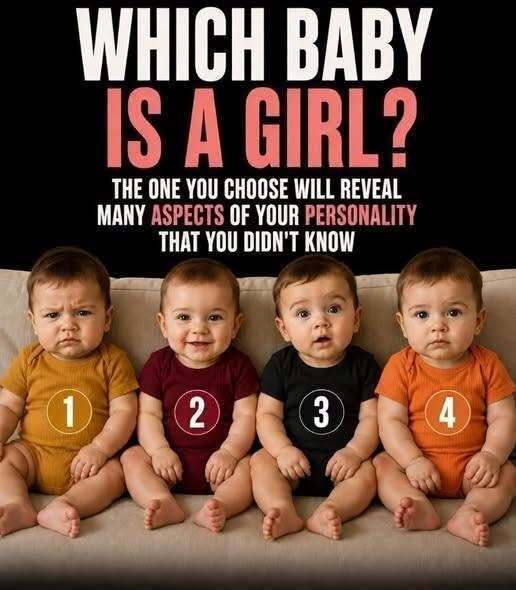
Part of the challenge’s popularity comes from the way it combines curiosity with entertainment. Rather than asking participants to analyze facts or solve a logical puzzle, it encourages them to trust their instincts and make a quick decision. That simple choice is then linked to a playful personality description, making the experience feel more engaging and personal.
According to the viral explanation accompanying the image, baby number two is presented as the “correct” answer. People who choose this baby are often described as warm-hearted, intuitive, and compassionate. They are said to value close relationships, understand the emotions of others, and naturally bring positive energy into the lives of those around them. The baby’s cheerful expression is often cited as the reason people are drawn to this choice.
However, there is an important reality behind the challenge. There is no scientific or reliable way to determine a baby’s gender simply by looking at a photograph. At such a young age, boys and girls often have very similar facial features, and appearance alone cannot accurately reveal a baby’s sex.
This means the challenge isn’t really a test of observation or intelligence. Instead, it’s designed as a fun social media activity that encourages people to participate, compare answers, and discuss the different personality descriptions attached to each choice.
Psychologists note that people naturally enjoy quizzes and visual puzzles that appear to reveal something about themselves. Even when the results have no scientific basis, these activities can feel entertaining because they invite self-reflection and spark conversations with friends and family.
The popularity of challenges like this also highlights the power of social media engagement. Simple images paired with intriguing questions encourage users to leave comments, share their answers, and see how their choices compare with others. This interaction helps such posts spread rapidly across platforms.
While it’s perfectly fine to enjoy these viral personality games for fun, it’s important to remember that they should not be taken as accurate assessments of personality or perception. There is no evidence that choosing one baby over another reveals hidden traits, nor can a baby’s gender be identified from facial features alone.
In the end, the challenge’s appeal lies not in finding the “right” answer but in the conversations it creates. Whether you choose baby number one, two, three, or four, the experience is simply an entertaining reminder of how easily our curiosity can be captured by a clever visual puzzle.