
Two years ago, I buried my eleven-year-old daughter, Grace.
I still remember the hospital room with a clarity that hurts: the harsh fluorescent lights, the sterile smell, the silence after the doctor said the words no parent should ever have to hear.
After that day, I did not really live.
I functioned.
I answered questions. I paid bills. I folded laundry. I walked past her bedroom door and kept breathing because the world seemed to require it.
But my heart stayed somewhere behind me, in that room where Grace’s life was declared over.
Then her old elementary school called.
The voice on the phone was tense and careful, as if the person speaking was trying not to panic. They asked me to come immediately. There was, they said, “a situation” involving a student.
I drove there without thinking clearly.
Part of me expected a misunderstanding. A child who looked a little like Grace. A name mixed up in a file. Some strange, painful coincidence that would reopen the wound and leave me apologizing for having hoped too quickly.
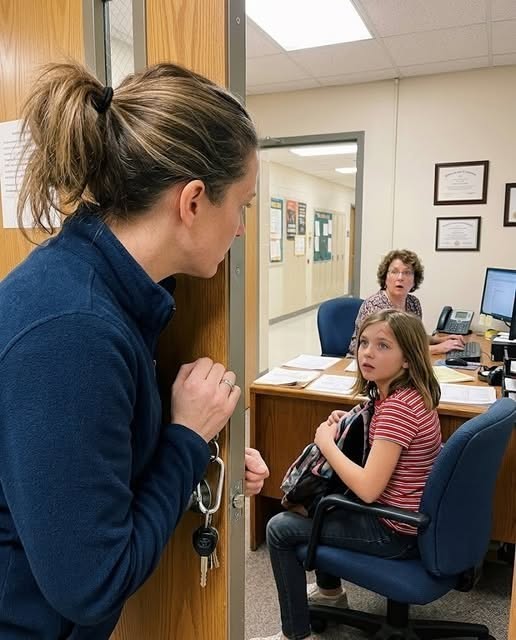
But when I stepped into the principal’s office, the air left my lungs.
A girl sat in the chair near the window, turning a pencil slowly between her fingers.
She looked up.
And my knees nearly gave way.
She had Grace’s eyes.
Not similar eyes.
Not eyes that reminded me of her.
Grace’s eyes.
The same deep shade. The same shape. The same way of looking at the world as if she were studying both what people said and what they hid.
Then she tucked a loose strand of hair behind her left ear.
That small movement undid me.
Grace had started doing that when she was seven, whenever she felt nervous or unsure. It was one of those tiny habits a parent notices without meaning to, the kind that becomes part of how you know your child.
The principal stood beside the desk, pale and overwhelmed.
After a long silence, she stepped out quietly and closed the door, leaving me alone with the impossible.
The girl stared at me with the same confusion I felt burning in my own chest.
Then she whispered, “Mom?”
That word broke something open inside me.
For two years, I had tried to be reasonable. I had listened to my husband, Neil, tell me that grief could trick the mind. I had accepted that no miracle was coming. I had learned to live in a world where Grace was memory, not presence.
But reason became very small when I saw the scar on her chin.
The tiny one she got after tripping over the garden hose while chasing our dog in the backyard.
No stranger would know that scar.
No cruel prank would think to copy something so ordinary.
I sank to the floor before I realized I was moving. My hands shook as I reached for her face.
Her skin was warm.
Real.
Alive.
“Grace,” I said, though my voice sounded like it had traveled from somewhere far away.
She leaned into my hand, tears spilling down her cheeks.
For one brief moment, the last two years loosened their grip. The funeral, the empty bedroom, the nights I woke thinking I had heard her voice — all of it seemed to blur at the edges.
I pulled her into my arms and held her tightly, almost afraid that if I let go, the world would correct itself and take her back.
Then my hand brushed the back of her neck.
Something was there.
At first, I thought it might be a smudge beneath her collar. Ink, maybe. A stain from a marker or pen.
I pulled back carefully and lifted the fabric.
What I saw turned my relief into fear.
A neat sequence of numbers had been printed in blue ink on her skin.
Perfectly aligned.
Too precise.
Too deliberate.
It looked less like a child’s mark and more like an identification code.
A label.
A claim.
The joy that had flooded me only seconds earlier drained away, replaced by a deep instinctive dread. The kind of fear that rises before the mind can explain it.
I asked Grace where she had been.
Her face changed.
She looked down, searching for an answer that would not come easily. Her eyes grew distant, as if the memories were hidden behind fog.
She said she remembered being very sick.
Then darkness.
Then waking up in a room with white walls.
No windows.
No familiar voices.
Only silence and bright light.
She did not know how she got there. She did not know how long she had been there. She only knew that one day she walked out, kept moving, and followed the first place that felt familiar until she reached her old school.
I did not press her.
Not then.
There would be time for questions later. There would be doctors, police, records, explanations, and perhaps truths I was not yet ready to understand.
But in that moment, she was a frightened child sitting in front of me with a number on her neck.
And she was my daughter.
I stood, took her hand, and walked her out of the office.
The principal called after me. People whispered in the hallway. Someone asked if they should contact authorities.
I kept walking.
Not because I intended to hide the truth forever.
But because Grace had spent two years somewhere unknown, and the first thing she needed was not another room full of adults demanding answers.
She needed safety.
She needed warmth.
She needed to know that the mother she remembered was still there.
Whatever had happened to her — science, crime, cruelty, or something beyond anything I could yet name — would have to face the light soon enough.
But that day, I had only one clear thought.
My daughter was alive.
Someone had marked her as if she belonged to them.
And I was taking her home.
The rest of the truth could wait until she was safe enough to tell it.