My siblings had better titles.
Tristan, Barrett, and Serena were praised as proof of the family’s success. Their choices were celebrated, their ambitions funded, their flaws quietly excused. My work, meanwhile, was treated as something small.
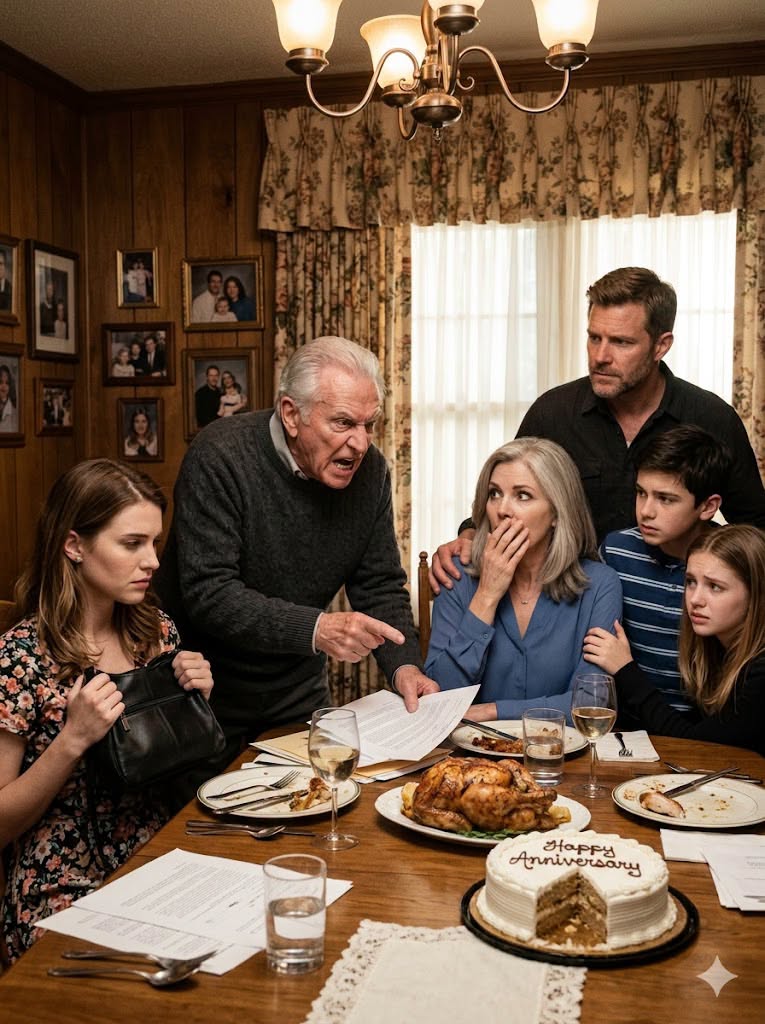
That evening, my father, Harrison Fletcher, used the dinner table as his stage.
He mocked my career in front of everyone.
He said I spent my life giving advice to teenagers because I had never managed to become anything important myself. My siblings looked down at their plates. My mother said nothing.
Their silence hurt in a familiar way.
For years, I had accepted that silence as part of the cost of belonging.
Not that night.
When my father finished speaking, I placed a thick manila envelope on the table.
“A gift for you,” I said.
Then I stood, walked out of the dining room, and went to my car.
The night air was cool and still. I sat behind the wheel without starting the engine, waiting.
It did not take long.
From inside the house came shouting.
Then panic.
Then the sound of a family story beginning to collapse under the weight of documents no one could dismiss.
Inside the envelope were certified legal records, including a medical report proving that Harrison Fletcher was not my biological father.
There were also bank statements showing that he had secretly drained eighty thousand dollars from the trust fund my grandmother had left for me. That money had not vanished by accident. It had been redirected into Harrison’s business, then used to support the education, ventures, and comfortable lives of the children he had chosen to favor.
I had included a letter too.
Not bitter.
Not pleading.
Just clear.
I wrote that I finally understood why he had treated me like a problem my whole life. He had punished me for a biological truth I had not created and could not control.
I had uncovered that truth months earlier during a routine medical screening.
The results raised questions my mother could no longer avoid. Eventually, she admitted that years ago she had been involved with a man named Wesley Rhodes.
The admission did not heal anything immediately.
It explained the shape of the wound, but explanation is not the same as repair.
That night, my siblings called me again and again.
I ignored the phone.
The next morning, I met with my attorney and began formal legal action.
As we reviewed the financial records, the pattern became clearer. My stolen inheritance had not only supported Harrison’s business. It had helped pay for the paths my siblings walked so easily — medical schooling, professional ventures, expensive opportunities they believed had come from family generosity.
Once they understood that part of their comfort had been built on money withheld from me, their loyalty to Harrison began to crack.
Not because they suddenly understood all my pain.
But because the truth had reached their own reflection.
The family unit fractured quickly after that.
For years, I had been told I was less successful because I had not worked hard enough, chosen wisely enough, or become impressive enough. Now the records showed that the comparison had never been fair. My siblings had been lifted while I was lectured about standing alone.
Eventually, I traveled to Asheville to meet Wesley Rhodes.
He was a college history teacher.
When he opened the door and saw me, he looked confused at first. Then, after I explained who I was and what my mother had admitted, his face changed. He sat down slowly, as though the past had entered the room carrying a son he never knew existed.
He cried.
Not dramatically.
Not for effect.
Quietly, with the grief of a man learning that a whole life had grown without him.
Wesley did not try to claim years he had not lived with me. He did not pretend blood alone made him a father. But he offered honesty. Warmth. A willingness to know me without measuring me against anyone else.
That was more than I had received in a long time.
Back in Oak Ridge, the lawsuit moved forward.
Harrison was forced to sell properties to repay the money he had stolen. His reputation, built so carefully on authority and family image, suffered under the simple force of documented truth.
My mother moved into a modest apartment and began therapy.
My siblings distanced themselves from Harrison, each of them facing, in their own way, the reality that the man they had admired had used all of us to protect his pride.
As for me, I continued my work as a guidance counselor.
The job my father mocked remained the place where I felt most useful. I sat with teenagers who were afraid, confused, angry, grieving, or unsure of who they were allowed to become. I listened to them in ways I had once wished someone would listen to me.
And every time I helped one of them feel less alone, I remembered that dignity is not measured by status.
It is measured by what we protect.
What we refuse to pass on.
What we choose to build after the truth sets us free.
I lost the illusion of the family I thought I needed.
But I gained something stronger.
A name no longer defined by Harrison’s contempt.
A connection with a father who had never been given the chance to know me.
And a peaceful life outside a house where love had always come with rankings.
Walking away from that dinner was not the end of my family story.
It was the first honest page.