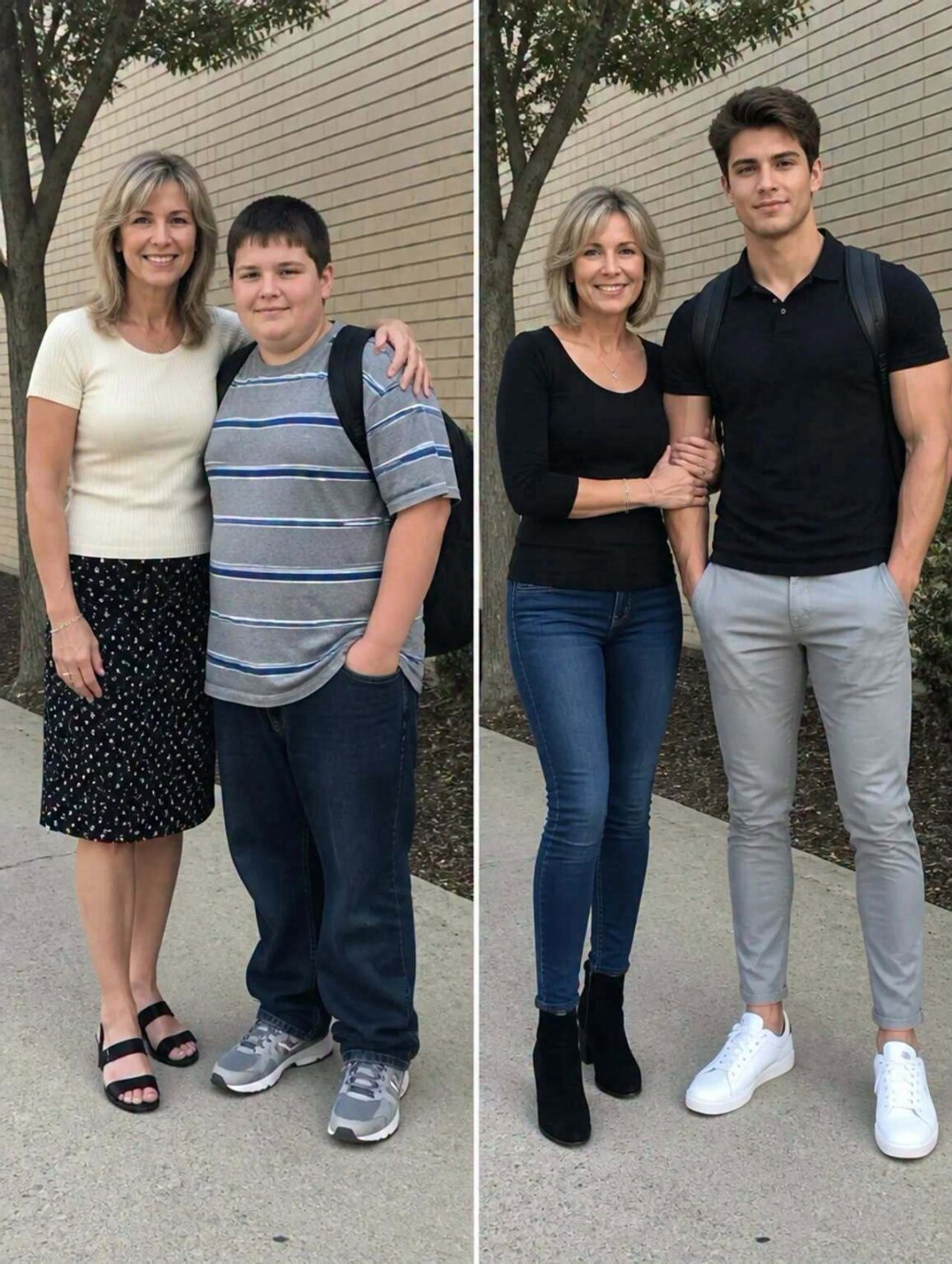
At first, he told himself it had been an innocent mistake.
Then he remembered how often people had forgotten him when they were teenagers.
Some things, he thought, never changed.
Still, when he heard about the reunion through an old classmate, he decided to attend.
He did not go to prove anything.
At least, that was what he told himself.
But as he stood outside the hotel ballroom, one hand resting on the door handle, the memories returned.
The whispered jokes.
The empty seat beside him at school events.
The way conversations seemed to continue around him as though he were not there.
For a moment, he considered turning around.
Then he opened the door and walked inside alone.
The room was filled with noise.
Music played softly beneath overlapping conversations.
Former classmates hugged, laughed, and compared photographs of children, homes, and vacations.
Some recognized him immediately.
Others stared for a second too long before pretending they had.
“Daniel?”
A man near the entrance squinted at him.
“Wow. I almost didn’t recognize you.”
Daniel smiled politely.
“It has been a long time.”
A few people asked what he had been doing since graduation.
Before he could answer fully, their attention drifted elsewhere.
The feeling was familiar.
For several minutes, he moved through the room almost unnoticed.
Then the conversation shifted.
A group near the stage began discussing a technology company that had recently made headlines.
The business had expanded rapidly, created hundreds of jobs, and funded several community programs.
“I read an article about the founder,” one woman said. “Apparently, he started with almost nothing.”
“He must be brilliant,” someone else replied.
Daniel stood nearby, listening.
Then one of the organizers glanced at his name tag.
Her expression changed.
“Wait.”
She looked at him, then at the company logo displayed in an article on someone’s phone.
“Daniel Mercer?”
“Yes.”
“You’re the founder of Mercer Innovations?”
The nearby conversation stopped.
Several heads turned.
Daniel nodded.
The organizer’s face brightened instantly.
“You should speak tonight.”
“Oh, that isn’t necessary.”
“No, really. This is incredible.”
Within minutes, the man who had not been included on the original invitation list was being escorted toward the stage.
People whispered as he passed.
Some smiled at him with sudden warmth.
Others looked embarrassed.
Daniel noticed the difference, but he did not enjoy it as much as he once imagined he would.
The event host handed him a microphone.
“Tonight, we discovered that one of our own has built one of the most successful companies in the region.”
Applause spread across the room.
“We would love to hear how you did it.”
Daniel looked out at the audience.
He saw classmates who had ignored him.
People who had laughed when he stumbled through presentations.
Others who had never been cruel but had never made room for him either.
For years, he had imagined what he might say if he ever stood before them as someone important.
He had pictured himself describing every achievement.
Every award.
Every headline.
Every moment they had underestimated him.
But standing there, none of that felt important.
Instead, he thought of Mrs. Carter.
She had been the school guidance counselor.
Her office had been small and crowded with college brochures, filing cabinets, and a dying plant that she refused to throw away.
Daniel first visited her during his junior year.
His grades had begun to fall.
He was missing classes.
At home, his mother was working two jobs, and money was always tight.
At school, he felt invisible.
One afternoon, Mrs. Carter found him sitting alone outside the library.
“You have been avoiding my office,” she said.
“I didn’t know I was expected.”
“You are now.”
He followed her reluctantly.
Inside, she handed him a cup of water and waited.
Daniel stared at the floor.
“I don’t think I’m good at anything.”
Mrs. Carter leaned back in her chair.
“Why do you believe that?”
“No one notices me.”
“That was not my question.”
He looked up.
She continued gently.
“You are confusing visibility with value.”
He did not understand.
Mrs. Carter pointed toward the dying plant on her windowsill.
“Most people walk past that plant and assume it has nothing left to offer.”
Daniel almost smiled.
“It looks dead.”
“It is stubborn.”
She touched one of its dry leaves.
“It grows slowly. Quietly. But it keeps growing.”
Then she looked directly at him.
“Your worth is not determined by how many people invite you somewhere, Daniel.”
The words hit him harder than he expected.
“It is not decided by popularity, applause, or whether other people are wise enough to recognize what is in front of them.”
She slid a college application across the desk.
“You do not need everyone to believe in you.”
Her voice softened.
“You only need to begin believing in yourself.”
Daniel kept that application.
He filled it out that night.
Years later, when his first business failed, he remembered her words.
When investors dismissed him, he remembered them again.
When he worked from a borrowed desk in the back room of a repair shop, he remembered them.
When success finally came, he understood that Mrs. Carter had given him something more valuable than advice.
She had given him a different way to measure himself.
On the reunion stage, Daniel held the microphone with both hands.
“I could tell you about the company,” he began.
The room quieted.
“I could talk about revenue, expansion, or the awards we have received.”
Several people leaned forward.
“But none of those things explain why I am standing here.”
He paused.
“The reason is Mrs. Carter.”
A murmur moved through the room.
The former guidance counselor was seated near the back.
She looked startled.
Daniel found her in the crowd.
“When I was seventeen, I believed being overlooked meant I had no value.”
Mrs. Carter’s eyes filled with tears.
“She told me that recognition and worth were not the same thing.”
The room became completely silent.
“She was the first person at this school who made me feel seen.”
Daniel looked toward the reunion organizers.
“And because of that, I would like to announce something.”
He reached into his jacket and removed a folded page.
“Beginning next year, Mercer Innovations will fund the Carter Opportunity Scholarship.”
Mrs. Carter covered her mouth.
“The scholarship will support students who are often overlooked.”
Daniel’s voice grew steadier.
“Students who may not be the most popular, the loudest, or the easiest to notice.”
He glanced around the room.
“It will help young people who have ability but lack resources, confidence, or someone willing to tell them that they matter.”
For several seconds, no one moved.
Then Mrs. Carter stood.
The applause began quietly.
Within moments, the entire room was on its feet.
Daniel looked at his former counselor.
She was crying openly now.
He stepped down from the stage and walked toward her.
“You named it after me?” she whispered.
“You changed my life.”
“I only told you the truth.”
“You told it to me when I needed it most.”
She wrapped her arms around him.
For the first time that evening, the applause felt meaningful.
Not because it was for him.
Because it was for what would come next.
After the reunion, Daniel drove his mother home.
She sat in the passenger seat, still holding the event program.
“I am proud of you,” she said.
“For the company?”
“For what you did with it.”
Daniel watched the road.
“For years, I thought I needed them to accept me.”
“Your classmates?”
He nodded.
“I imagined returning one day and making them regret overlooking me.”
His mother smiled faintly.
“And did they?”
“Probably.”
“Did it help?”
Daniel thought for a moment.
“No.”
He glanced at her.
“What helped was realizing I didn’t need their invitation.”
His mother rested her hand over his.
“You never did.”
The reunion did not erase the lonely years.
It did not make every classmate kinder in his memory.
It did not turn exclusion into something harmless.
But it changed the meaning he had given those years.
He was no longer the forgotten student waiting to be chosen.
He had become the person who could choose others.
The Carter Opportunity Scholarship began with ten students.
Within three years, it supported more than one hundred.
Some recipients came from unstable homes.
Others had disabilities, financial struggles, or no family history of higher education.
Many described themselves with the same word Daniel had once used.
Invisible.
At every award ceremony, he told them the same thing.
“Being overlooked does not mean you have nothing to offer.”
Mrs. Carter attended whenever her health allowed.
She always sat near the front.
And every time Daniel saw her, he remembered the dying plant in her office.
Years later, after she retired, he visited her at home.
On the windowsill stood a healthy green plant.
Daniel laughed when he saw it.
“Is that the same one?”
Mrs. Carter smiled.
“No. That one finally gave up.”
He shook his head.
“So much for the metaphor.”
“The metaphor was never about the plant.”
She looked at him.
“It was about you.”
Daniel smiled.
For most of his life, he believed success would mean becoming impossible to ignore.
Eventually, he learned that true success was not measured by how many people finally noticed him.
It was measured by how many people felt seen because he had lived.
He had entered the reunion without an invitation.
He left knowing he no longer needed one.
His greatest achievement was not returning as the most successful person in the room.
It was transforming years of disappointment into a door held open for someone else.
Someone quiet.
Someone overlooked.
Someone waiting for one person to believe in them.