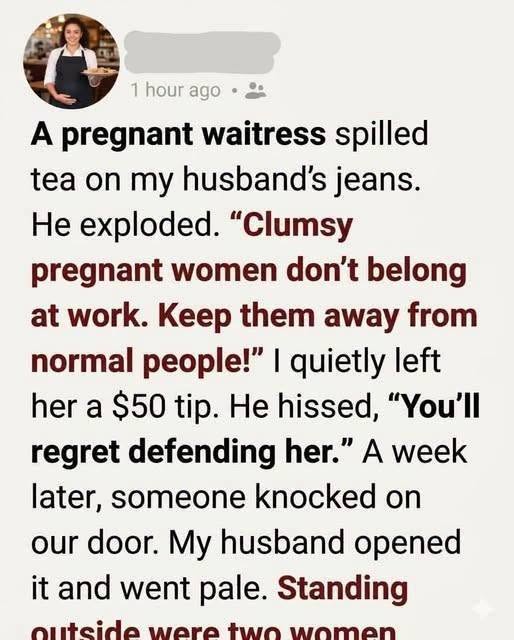
At least, that was what he believed.
Then he opened the door.
The waitress he had humiliated stood on the other side.
Evelyn was no longer wearing the stained apron and name tag from the restaurant. She wore a simple dark coat, her hair pulled back neatly, her expression calm.
Beside her stood Claire.
His employer.
The woman who controlled the promotion he had been expecting for months.
His hand remained frozen on the doorknob.
“Claire?”
His voice came out smaller than he intended.
She did not smile.
“May we come in?”
He glanced at Evelyn.
Recognition turned quickly into panic.
“This is about the restaurant?”
Evelyn held his gaze.
“It is about what you did at the restaurant.”
A few hours earlier, she had accidentally spilled a small amount of water near his table while serving dinner.
She apologized immediately.
She offered to replace everything.
The manager arrived and assured him that his meal would be covered.
But none of that had been enough.
He had raised his voice so the entire restaurant could hear.
He called Evelyn incompetent.
Asked whether she was capable of doing anything correctly.
Then he told the manager that people like her should not be allowed near paying customers.
Evelyn had stood there silently while nearby diners lowered their eyes.
He had mistaken her silence for weakness.
Now she stood at his front door with the one person whose opinion mattered to his career.
His confidence disappeared.
He stepped aside.
They entered the living room, but neither woman sat down.
He closed the door slowly.
“I think there has been a misunderstanding,” he began.
“There hasn’t,” Evelyn said.
Her voice remained steady.
“You were angry because I made a mistake. You had every right to complain. You did not have the right to humiliate me.”
“I was frustrated.”
“You insulted me personally.”
“I had a difficult day.”
Claire finally spoke.
“So did she.”
He turned toward her.
“I don’t understand why this concerns the company. This happened outside work.”
Claire’s expression hardened.
“Character does not disappear when someone leaves the office.”
He opened his mouth, but no words came.
Evelyn reached into her bag and placed a folded receipt on the coffee table.
Several diners had written their names and phone numbers on the back after witnessing the incident.
One of them had also recorded part of his outburst.
He stared at the paper.
“You recorded me?”
“I didn’t,” Evelyn said. “Someone else did.”
His face tightened.
“This feels like retaliation.”
“No,” Claire replied. “Retaliation would be Evelyn treating you the way you treated her.”
Silence filled the room.
He looked between them.
“What do you want?”
Evelyn’s expression changed slightly.
Not softer.
Sadder.
“I wanted you to understand that the person carrying your plate is still a person.”
He looked away.
She continued.
“I work two jobs. I am studying at night. My mother is ill, and I help pay her medical bills.”
Her voice remained controlled, but her hands tightened around the strap of her bag.
“You knew none of that when you decided I was worthless.”
“I never said you were worthless.”
“You made sure I felt it.”
Claire folded her arms.
“This company is considering you for a leadership position.”
He looked at her quickly.
“I know.”
“A leader is not measured only by how he treats people who can help his career.”
She glanced toward Evelyn.
“He is measured by how he treats people when he believes there will be no consequences.”
The words landed harder than any accusation.
He had spent years perfecting the image of a respectable man.
He remembered birthdays at the office.
Praised employees during meetings.
Shook hands firmly.
Used words like integrity and teamwork whenever senior executives were listening.
But in the restaurant, Evelyn had held no power over him.
So he had shown her who he believed he was allowed to be.
For the first time, he saw the difference between his reputation and his character.
His shoulders lowered.
“I was cruel.”
Neither woman answered.
He swallowed.
“I was embarrassed by the accident, and I wanted everyone to know it wasn’t my fault.”
He looked toward Evelyn.
“So I made you feel small.”
“Yes,” she said.
“I’m sorry.”
The apology sounded unfamiliar in his own voice.
There was no explanation attached to it.
No attempt to blame stress, alcohol, or a difficult day.
“I am deeply sorry.”
Evelyn studied him.
“An apology does not erase what happened.”
“I know.”
“You embarrassed me in front of a room full of people.”
“I know.”
“If you truly regret it, you should correct it in front of them too.”
He nodded slowly.
The following evening, he returned to the restaurant.
Several members of staff recognized him immediately.
Conversation quieted as he walked toward the center of the dining room.
Evelyn stood near the counter.
He had prepared a speech, but when he saw her, the polished words felt dishonest.
So he spoke plainly.
“I came here yesterday and treated one of your employees disgracefully.”
Every face in the room turned toward him.
“She made a small mistake. I responded by humiliating her because I believed being a customer gave me the right to speak to her however I wanted.”
He looked at Evelyn.
“It did not.”
The restaurant remained silent.
“I apologize to Evelyn, to the staff, and to everyone who had to witness my behavior.”
He then asked the manager to charge him for the meal that had been removed from his bill.
He left a generous tip, but Evelyn did not thank him.
She should not have needed to.
Money was not the apology.
Accountability was.
Claire postponed his promotion.
She told him that professional advancement would now depend on months of consistent behavior rather than one dramatic gesture.
For the first time, he accepted a consequence without arguing.
Over the following weeks, his colleagues noticed a change.
He stopped interrupting junior employees.
He asked assistants for their opinions.
He apologized quickly when he made mistakes.
Not because Claire was always watching.
Because he had finally understood that someone always was.
Even when the only witness was the person being hurt.
Months later, he returned to the restaurant.
This time, he waited patiently near the entrance.
When Evelyn approached, he did not ask whether she remembered him.
Of course she did.
“I wanted to tell you something,” he said.
She waited.
“You changed how I see myself.”
Evelyn shook her head.
“No. You finally decided to look.”
He nodded.
She was right.
That night at his front door had not destroyed his future.
It had destroyed the version of himself he had used to avoid responsibility.
Evelyn had not come seeking revenge.
She had come carrying the truth.
And once the truth entered the room, the man he had been could no longer remain untouched.