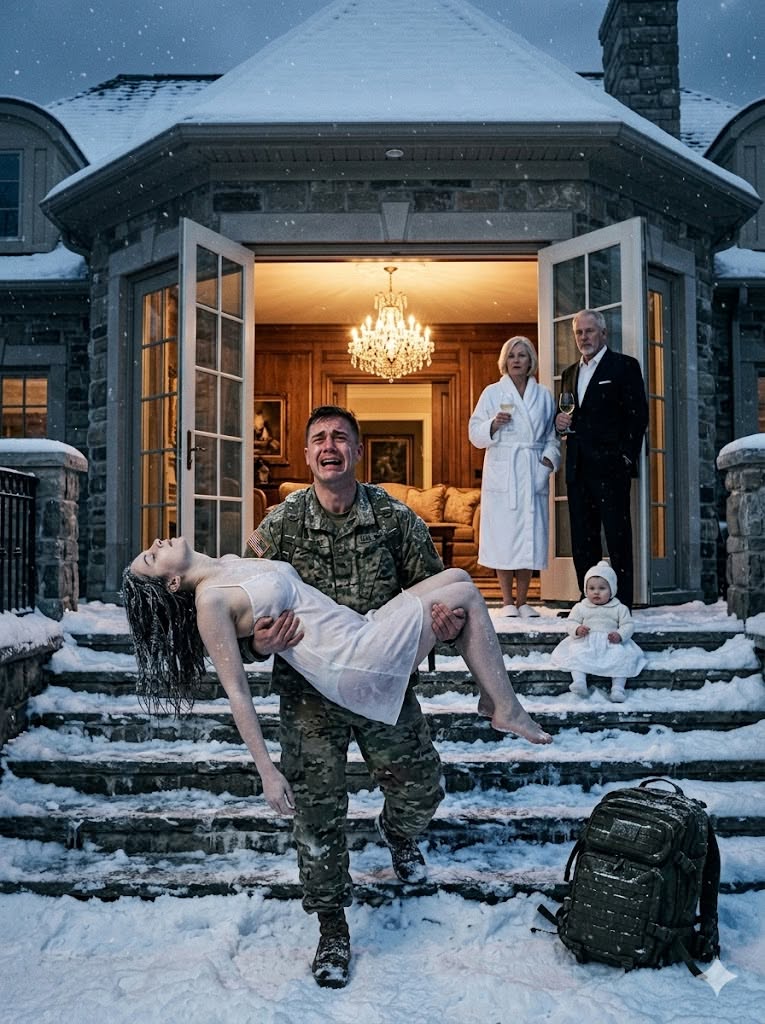
Instead, I found them on the frozen porch.
Claire was shivering, her face pale from the cold, while six-month-old Lily whimpered weakly against her chest. The winter storm around them had turned the steps slick and white. Their bags sat beside them like evidence of something too cruel to understand at first glance.
My parents, Evelyn and Richard, had locked them out.
Not strangers.
Not confused neighbors.
My own parents.
They had taken control of my home while I was away and left my wife and infant daughter outside in a severe storm.
I carried Claire and Lily inside immediately. Anger came quickly, but the need to protect them came first. Blankets. Heat. Emergency care. A call to the hospital. Lily’s small body felt too cold against my hands, and in that moment, every excuse my parents would later offer had already lost its power.
They tried anyway.
My father accused Claire of stealing my deployment funds.
My mother claimed Claire had ruined our marriage.
They demanded I surrender my house keys, speaking as though the home, the money, and even my family belonged to them more than to me.
They believed they still held control.
What they did not know was that for the past six months, I had been quietly investigating them.
With help from Army investigators, I had already gathered evidence of forged signatures, missing deployment pay, diverted contracts, and financial records that led back to the people standing in my own living room pretending to be wronged.
Claire and Lily were taken to the local hospital for treatment after their exposure to the cold.
Only once I knew they were safe did I turn toward the rest of the battle.
My father believed he owned Vale Defense Construction.
He did not.
He held a minority share. The controlling interest had transferred into my trust on my thirty-fifth birthday, exactly as my grandfather had arranged years earlier. Richard had built his confidence on the assumption that I would not understand the structure of my own inheritance.
He was wrong.
When he called an emergency board meeting to declare me mentally unfit and seize full control, I arrived with federal agents, a forensic accountant, and the documents he never expected to face.
The boardroom went silent as the evidence was presented.
Forged signatures.
Diverted military contracts.
Deployment pay funneled into a secret shell company.
Fraudulent filings meant to strip me of authority while I was serving overseas.
My parents turned on each other almost immediately. The loyalty they had demanded from everyone else disappeared the moment consequence entered the room.
Federal authorities arrested Evelyn and Richard for identity theft, corporate fraud, and conspiracy.
My father eventually pleaded guilty to diverting eleven million dollars and received an eight-year federal prison sentence. My mother received four years for her role in the forgery and deception.
Their shares, luxury vehicles, and hidden accounts were forfeited to repay stolen funds and reimburse the employees harmed by their crimes.
Because their actions violated the trust my grandfather had established, I permanently revoked their right to live in the family mansion and changed the locks.
Before her trial, my mother briefly returned asking for shelter.
I paid for one week at a modest motel.
It was more mercy than she had shown Claire and Lily on that frozen porch, but I could not allow compassion to become another open door to abuse.
After the arrests, I sold the estate.
Claire never wanted to see that porch again, and I did not ask her to. Some places cannot be redeemed simply because they once belonged to a family. A home that has witnessed cruelty must sometimes be released so healing can begin somewhere else.
We moved into a smaller, comfortable house built around peace rather than display.
I left active military duty and took over the family business. We renamed it Lily Shield Construction.
The name mattered.
It reminded me that the purpose of strength is not domination. It is protection.
Claire and I later established a housing program for military families facing emergencies during overseas deployments. We knew too well how vulnerable a spouse and child could become when the person expected to protect them was thousands of miles away.
Our program offered temporary housing, legal guidance, and emergency support for families who had been abandoned, threatened, or financially trapped while a service member was deployed.
It became the legacy my grandfather would have recognized.
Not wealth for its own sake.
Not power held tightly.
But resources turned toward shelter.
Sometimes, in the evenings, I sit beside our fireplace and watch Lily play on the rug while Claire reads nearby. The room is quiet in a way I once thought only existed in dreams during deployment.
My parents lost their empire because they chose greed over family.
But we saved ours by choosing truth.
I did not return home to the reunion I had imagined.
I returned to a porch that showed me exactly what needed to end.
And from that cold, painful beginning, we built a warmer life — one no one else holds the keys to.