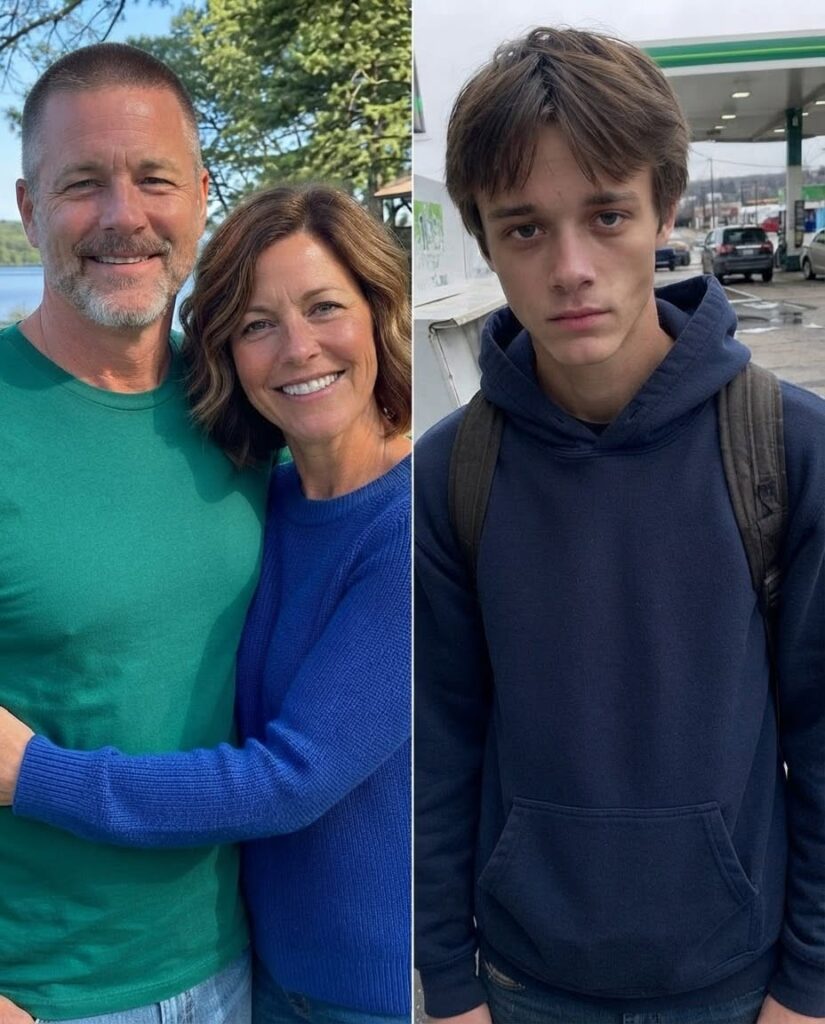
“What?”
His fingers tightened around the strap of his worn backpack.
“Your husband has been paying me to follow you.”
At first, I laughed.
Not because it was funny.
Because the alternative was too strange to accept.
Then he told me how long it had been happening.
My name is Rachel.
Until that Tuesday evening, I believed my life was stable.
Our two children, Emma and Ben, were away at college.
My husband, David, was a respected physician.
Friends described our marriage as solid, enviable, and unbreakable.
We hosted dinners.
Sent anniversary cards.
Took photographs beside the same lake every summer.
From the outside, we looked like the kind of couple people trusted.
I also owned a cabin on that lake.
My father had left it to me before he died.
It was small, weathered, and worth more emotionally than financially—at least until a developer began buying nearby properties.
A few months earlier, the developer had offered me an enormous amount of money.
I refused.
The cabin held the sound of my father’s laugh.
His old fishing rods were still mounted above the fireplace.
Pencil marks showing my childhood height remained on the kitchen doorframe.
No check could replace that.
David disagreed.
“You’re being sentimental,” he told me.
“I’m allowed to be.”
“That money could change our retirement.”
“We are already comfortable.”
“It could change the children’s future.”
“The cabin is part of their future.”
He stopped arguing, but I could tell he had not accepted my answer.
Around the same time, other small things began bothering me.
David installed a new lock on his home office while I was away visiting Emma.
When I asked why, he said he had begun storing confidential medical files there.
Then I found a business card in his coat pocket.
The attorney’s specialty was printed beneath her name.
Guardianship.
Estate administration.
Capacity proceedings.
“Why are you carrying this?” I asked.
David barely looked up from his tablet.
“One of my elderly patients needs help.”
“You handle legal referrals now?”
“I’m trying to keep a family from making a terrible mistake.”
His answer sounded reasonable.
David was good at sounding reasonable.
I believed him.
That evening at the gas station, I pulled into my usual pump after leaving the grocery store.
While the tank filled, I noticed a thin teenage boy sitting beside the ice machine.
His sweatshirt was too large.
A worn backpack rested between his knees.
He watched people come and go without asking anyone for money.
A few minutes later, he approached me carefully.
“Ma’am?”
“Yes?”
“Could I borrow your phone? I need to call my aunt.”
I hesitated only a second.
He looked close to my son’s age.
I unlocked the phone and handed it over.
He stepped several feet away, spoke quietly, and returned it less than a minute later.
“Thank you. She’s coming.”
“You’re welcome.”
I reached for the car door.
That was when his expression changed.
He looked toward the entrance of the lot, then back at me.
“Please don’t leave yet.”
Something in his voice made me stop.
“Why?”
He stepped closer.
“I know this sounds crazy, but your husband has been paying me to watch you.”
I stared at him.
“My husband?”
“David.”
The sound of his name erased my smile.
“How do you know his name?”
“He found me at a church dinner program.”
The boy looked ashamed.
“He said his wife had memory problems. He said sometimes you drove around without knowing where you were.”
A chill moved through me.
“What exactly did he ask you to do?”
“Follow you when I could. Write down where you went. Who you talked to. Whether you drove toward the lake.”
“How long?”
“Almost two months.”
I felt the gas pump click off behind me.
The sound was oddly loud.
The boy introduced himself as Marcus.
David had offered him three hundred dollars a week.
At first, the requests sounded almost caring.
Tell me whether she gets lost.
Tell me whether she leaves stores without paying.
Tell me whether she seems frightened or confused.
Then the questions changed.
Did she meet any men?
Did she buy alcohol?
Did she stumble?
Did she forget where she parked?
“Have you ever seen me confused?” I asked.
Marcus shook his head.
“No.”
“Lost?”
“No.”
“Drunk?”
“No.”
“What did you tell him?”
“The truth.”
He swallowed.
“He got angry.”
“What did he say?”
“He told me I wasn’t watching closely enough.”
Marcus looked down.
“He reminded me of my dad.”
I waited.
“My dad used to tell people my mother was unstable. He said it so often that everyone started believing him.”
Marcus lifted his eyes.
“She wasn’t broken. He just needed everyone else to think she was.”
I held the edge of my car for support.
Every strange detail from the previous months rearranged itself in my mind.
The locked office.
The guardianship attorney.
David’s questions about the cabin.
His sudden concern over my memory whenever I misplaced something ordinary.
Marcus gave me the phone number David used and showed me payment messages.
Most were brief.
Same schedule this week.
Watch the lake road.
Need better details.
One message made my stomach turn.
She must be slipping somewhere. Find it.
“Why are you telling me?” I asked.
Marcus glanced toward the road.
“Because he wants me to lie now.”
He took a breath.
“He offered extra money if I could get pictures of you drinking or looking confused.”
I wanted to confront David immediately.
I wanted to drive home, throw open his office door, and demand the truth.
Instead, I asked Marcus one question.
“Would you be willing to speak to my attorney?”
He looked startled.
“You’re not calling the police?”
“Eventually.”
I took a business card from my purse and wrote my number on the back.
“For now, keep sending normal reports.”
His eyebrows lifted.
“You want me to keep doing it?”
“I want him to believe nothing has changed.”
Marcus studied me.
Then he nodded.
I drove home without confronting my husband.
That was one of the hardest things I had ever done.
David sat at the kitchen table reading messages when I arrived.
He glanced at the grocery bags.
“You were gone a while.”
“The gas station was busy.”
“Did you stop anywhere else?”
The question sounded casual.
It no longer felt casual.
“No.”
He watched me for a moment.
Then he smiled.
“Did you think any more about the cabin offer?”
“I’m not selling.”
His smile faded almost imperceptibly.
“You might feel differently after reviewing the numbers.”
“I have reviewed them.”
“Rachel, holding onto a decaying property because of childhood memories is not rational.”
The word struck me.
Rational.
I placed a carton of milk in the refrigerator.
“It’s my property.”
“Our decisions affect both of us.”
“This one is mine.”
He stared at me.
“You seem unusually tense.”
“I’m tired.”
That night, I barely slept.
Every time David shifted beside me, I wondered how long he had been planning whatever Marcus had uncovered.
The next morning, David left for the hospital at seven.
I waited until his car disappeared before opening our financial records.
Every Friday, he had withdrawn between three and four hundred dollars in cash.
The amounts were small enough to look ordinary.
Together, they formed a salary.
Marcus’s salary.
Then I searched the kitchen for the spare key to David’s office.
I found it taped beneath the back of a drawer.
My hands shook as I unlocked the door.
The office smelled faintly of cedar and coffee.
Everything was arranged with clinical precision.
I opened the top desk drawer.
Nothing.
The second held insurance papers.
In the bottom drawer, beneath old tax records, I found a black notebook.
My name was written across the front.
Inside were dated reports about my movements.
Some were accurate.
Rachel visited grocery store at 4:15.
Rachel drove to pharmacy.
Rachel spoke to unknown woman outside café.
Others were completely fabricated.
Rachel appeared disoriented in parking lot.
Rachel purchased two bottles of wine.
Rachel stumbled beside vehicle.
Rachel repeated herself during conversation.
I remembered the day listed beside the wine entry.
I had bought laundry detergent and driven directly home.
Marcus had refused to invent the evidence David wanted.
So David had begun inventing it himself.
A folder beneath the notebook contained photographs.
Me at a traffic light.
Me leaving the dentist.
Me standing outside a bookstore.
Me walking toward the lake cabin.
The images looked harmless in isolation.
Together, they felt like surveillance.
Then I found the petition.
David had prepared an application seeking legal guardianship over me due to “progressive memory impairment and diminished mental capacity.”
The filing described me as forgetful, erratic, and unable to make sound financial decisions.
Behind it was a fresh appraisal of the lake cabin.
The value was substantially higher than the offer David had shown me.
A printed email from the developer referred to a confidential consulting payment for David if the sale moved forward.
Another email from the attorney explained that if David became my legal guardian, he could petition the court for authority to sell property held solely in my name.
I sat down in his chair.
The plan was suddenly clear.
He was manufacturing evidence that I was mentally incapable.
Once he controlled my finances and property, he intended to sell the cabin.
Then he would profit privately from the deal.
My husband was not worried about my memory.
He was building a case against it.
I photographed every page.
Then I returned each document to its exact position.
I locked the office and called my friend Karen.
She had practiced family and estate law for almost twenty years.
When she answered, I said, “I need you to be my attorney today, not my friend.”
Her voice changed immediately.
“What happened?”
I told her everything.
She listened without interrupting.
When I finished, she gave me one instruction.
“Do not confront him.”
“I don’t know how I’m supposed to sit across from him tonight.”
“He has spent months preparing this.”
Her tone was firm.
“We are going to be smarter than him for one more week.”
Two days later, I met Marcus at a roadside diner.
He slid into the booth across from me and kept glancing toward the windows.
“David contacted me again.”
“What does he want?”
“Pictures.”
“Of what?”
“You looking confused or drinking in public.”
“When?”
“Saturday.”
My pulse quickened.
“He said he’d send the location.”
That evening, David poured himself a drink and leaned against the kitchen counter.
“I made us a reservation for Saturday.”
“Where?”
“A restaurant near the lake.”
I looked down at the vegetables I was chopping.
“That sounds nice.”
“I thought we could talk about the cabin afterward.”
Everything became clear.
The restaurant was close enough to the property that he could claim I had driven there in confusion.
He could order alcohol for me.
Marcus could photograph me.
The evening would become evidence.
I smiled.
“That sounds perfect.”
After David went upstairs, I texted Karen one word.
Saturday.
By the time the evening arrived, we were ready.
Marcus had given a sworn statement.
His payment records traced the money back to David.
The guardianship petition had already been filed, which meant Karen could obtain it legally through the court.
We no longer needed anything I had secretly photographed.
At the restaurant, David behaved like the devoted husband he wanted the world to see.
He pulled out my chair.
Helped me remove my coat.
Placed one hand gently against my back.
Then he ordered wine without asking me.
“My wife will have the cabernet.”
“I’ll have water,” I told the server.
David laughed lightly.
“One glass won’t hurt.”
“I said water.”
His eyes tightened.
The server left.
David reached across the table.
“You’ve seemed tired lately.”
“I have.”
“I’m worried about you.”
“That’s interesting.”
“What does that mean?”
I reached into my bag and removed a folder.
“I’ve been worried too.”
I slid it across the table.
David opened it.
The color disappeared from his face.
Inside were copies of the guardianship petition.
Marcus’s sworn statement.
Payment records.
The communications with the developer.
The fabricated observations.
David quickly closed the folder.
“Where did you get this?”
“I know about Marcus.”
His expression changed.
“Rachel, listen to me.”
“I know you’re trying to have me declared mentally incapable so you can control and sell my cabin.”
“You are misunderstanding the situation.”
“Am I?”
People at nearby tables began glancing toward us.
David lowered his voice.
“You broke into my office.”
“Anything obtained that way would be inadmissible.”
He leaned back slightly, relieved to have found a legal argument.
I continued.
“Fortunately, I don’t need anything from your office.”
The relief vanished.
“Marcus gave a sworn statement. The payment records came from his account. Your guardianship petition is a public court filing. Karen obtained the developer correspondence through legal channels.”
For the first time in twenty-two years, David had no answer ready.
“Our children will hear the truth from me tonight,” I said. “Not from you.”
His jaw tightened.
“You’re overreacting.”
I placed another envelope on top of the folder.
Divorce papers.
He stared at them.
“This is absurd.”
“You don’t have to sign them here.”
“You’re ending our marriage over a misunderstanding?”
“I’m ending it because you tried to steal my legal independence.”
“I was protecting our future.”
“You invented an illness.”
“I was concerned.”
“You paid a homeless teenager to follow me.”
“I needed objective observations.”
“You told him to lie.”
David looked around the restaurant.
“Keep your voice down.”
“You planned to make me look drunk tonight.”
“That is paranoid.”
“Marcus is outside.”
His face froze.
“He knows why you sent him here.”
The waiter approached with the wine.
David waved him away.
I left enough cash to cover my portion of the meal and stood.
David grabbed my wrist.
“Sit down.”
I looked at his hand until he released me.
“You planned to turn this restaurant into proof that I was unstable.”
I picked up my coat.
“Instead, it became the place where your entire plan collapsed.”
I walked out.
David was not finished.
Before I reached my car, he called Emma and Ben.
He told them I had suffered an emotional episode.
He claimed I had accused him of stealing, become paranoid, and abandoned him in public.
Fortunately, Karen had warned me.
I had already sent both children a message.
Your father may call you tonight. Please do not react until you see the documents I am sending.
Emma called me first.
“Mom, what is happening?”
“I’m sending you evidence.”
“Dad says you’re not well.”
“I know.”
My voice nearly broke.
“He has been preparing you to believe that.”
Karen filed an emergency response opposing the guardianship petition.
She requested an independent medical evaluation and immediate financial safeguards.
The following morning, I underwent a complete neurological and psychological assessment.
Memory testing.
Cognitive screening.
Decision-making analysis.
The results showed no impairment.
No confusion.
No diminished capacity.
Meanwhile, Marcus met with investigators.
He explained how David had recruited him.
How he had been paid.
How David repeatedly pressured him to report things that had never occurred.
“I told him she acted normal,” Marcus said.
“He told me to keep looking until I found something wrong.”
The financial motive became equally obvious.
The developer’s real offer was far higher than the amount David had mentioned to me.
The emails showed he expected a personal consulting payment once the sale was approved.
He had intended to control my inheritance, sell it, and profit privately while presenting himself as a husband protecting a sick wife.
When the guardianship case reached court, David arrived wearing the calm, concerned expression he had perfected over decades.
His attorney argued that he had acted out of love.
They submitted the notebook.
Photographs.
Descriptions of my supposed confusion.
Then Karen called Marcus.
He walked to the witness stand wearing a borrowed jacket that was slightly too large.
His hands shook.
His voice did not.
He described the church meal program.
The first payment.
The instructions.
The pressure to lie.
“I told Dr. Walsh that Mrs. Walsh seemed fine,” he testified.
“What did he say?” Karen asked.
“He said I needed to find something wrong.”
David stared straight ahead.
The payment records supported every word.
My medical evaluation confirmed that I was fully capable of managing my health, finances, and property.
Then Karen presented the communications with the developer and the guardianship attorney.
The judge read them in silence.
When she finally looked up, her expression had changed.
The guardianship petition was dismissed.
The matter was referred for investigation.
Outside the courtroom, David approached me.
“I was trying to protect what we built.”
“What we built did not require you to erase me.”
“You are twisting this.”
“No.”
I looked directly at him.
“For the first time, I understand it completely.”
Our children struggled with the truth.
Emma cried for hours after reading the documents.
“He’s our father,” she kept saying.
“I know.”
“How could he do this?”
“I don’t know.”
Ben remained silent for several days.
Then he met David alone and asked one question.
“If Mom was really sick, why did you need someone to lie about her?”
David had no answer.
The divorce was finalized months later.
The cabin remained mine.
Because it had been inherited from my father, David received no ownership interest in it.
He also received no consulting payment.
The hospital opened an internal investigation after learning that he had used his professional status to support false claims about my mental health.
The respected doctor our friends believed they knew began disappearing beneath the evidence of who he had been at home.
Marcus entered a housing and employment program with help from Karen’s office.
He found part-time work at an auto shop and later enrolled in evening classes.
I made sure he had a reliable phone and transportation.
But I never treated him as though he owed me gratitude.
He had already given me more than I could repay.
He had told me the truth when every adult around him expected silence.
One afternoon, after the divorce was complete, I drove to the lake cabin alone.
The porch boards creaked beneath my feet.
Dust floated in the late-afternoon light.
For months, David had treated the place like money waiting to be extracted.
But standing on the dock, I remembered why my father had left it to me.
It was not just property.
It was evidence that I had existed before my marriage.
That I belonged to myself.
David had tried to turn that independence into proof that I needed to be controlled.
I replaced the locks.
Repaired the porch.
Restored the old stone fireplace.
Then I converted the bedroom David once planned to use as an office into a reading room.
Above the desk, I framed a short note Marcus gave me after the hearing.
You weren’t confused.
He just needed you to believe you were.
A year later, Emma and Ben joined me at the cabin for Thanksgiving.
We cooked too much food.
Ben burned the rolls.
Emma found the pencil marks my father had made beside the kitchen door and added her own height beneath mine as a joke.
At sunset, the three of us walked to the dock.
Emma slipped her arm through mine.
“I’m sorry I almost believed him.”
“You believed your father.”
“That feels worse.”
“It shouldn’t.”
I looked across the water.
“He spent months building a story. You only needed time to see through it.”
Ben stood beside us with his hands in his pockets.
“Do you miss him?”
The question surprised me.
“I miss who I thought he was.”
“Is that the same thing?”
“No.”
It was the first time I had said it aloud.
My marriage ended because of five whispered seconds at a gas station.
But the truth was that David had been dismantling it long before Marcus spoke.
He did it with locked doors.
Carefully worded questions.
Manufactured concern.
Small suggestions that I was forgetful.
Quiet attempts to make me doubt my own judgment.
Marcus’s warning did not destroy my life.
It interrupted the story David was writing about me.
It gave me enough time to take the pen back.
And in the end, the boy my husband believed he could buy was the only person brave enough to tell me I was never losing my mind.
I was only living beside someone who needed me to believe I was.