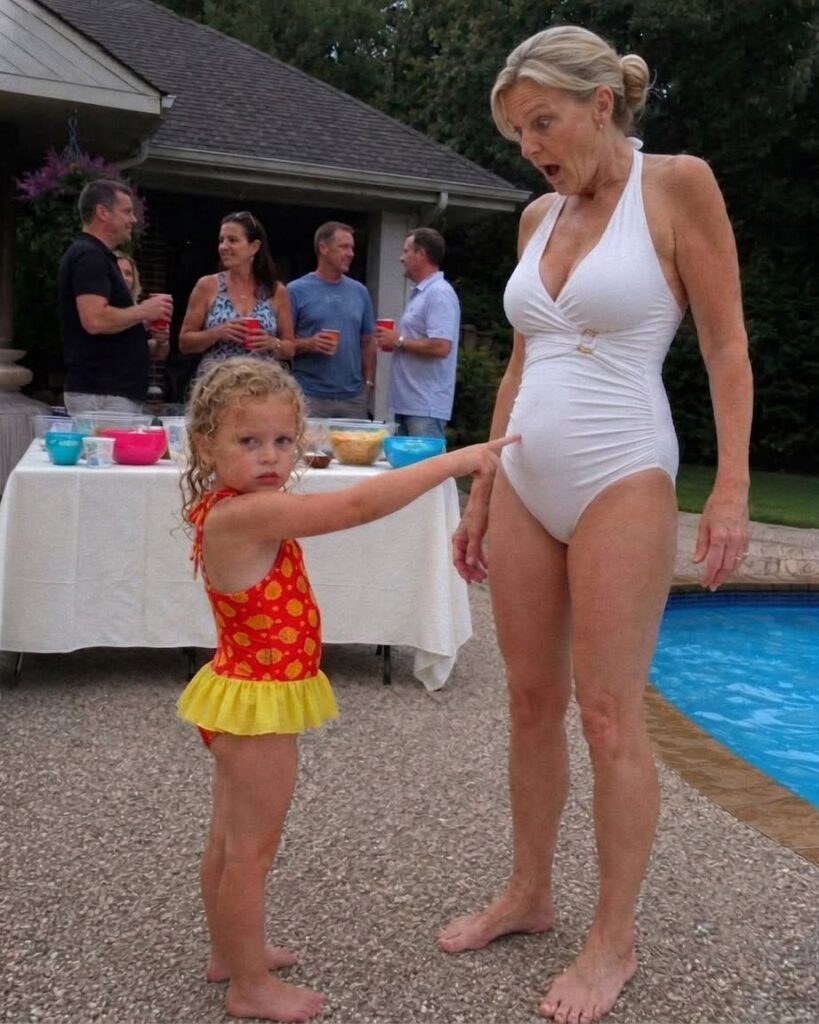
By noon, damp footprints covered my kitchen floor, frosting smeared the patio table, and one small pink sandal floated in the deep end.
Ariel stood beside the pool wearing purple goggles and a paper birthday crown that had already begun to sag from the humidity.
She refused to remove it.
“Queens wear crowns in the water,” she informed me.
Apparently, there were no exceptions.
My husband, Glen, stood beneath the maple tree trying to grill hot dogs.
Every few minutes, smoke rose beneath the lid, and he stared at the grill as though it had betrayed him personally.
I was carrying a tray of watermelon toward the patio when my stepmother arrived.
Clara stopped outside the gate instead of walking straight in.
That was typical of her.
She rarely entered any room without first looking as though she expected someone to tell her she did not belong there.
She wore a white cover-up over a dark one-piece swimsuit and carried a carefully wrapped present beneath one arm.
“You’re late,” my father called from beneath the umbrella.
Clara smiled.
“I know.”
She offered no explanation.
She rarely did.
Fifteen years earlier, she had married my father two years after my mother died.
I was seventeen then.
Angry at death.
Angry at my father for continuing to live.
And especially angry at any woman who dared enter my mother’s kitchen.
Clara never fought me.
She simply made herself smaller.
She never sat in Mom’s chair.
She left the curtains exactly as they were.
She asked before using dishes from cupboards in the house where she lived.
At the time, I thought her caution meant she did not care about me.
Eventually, distance became the language we both understood.
Still, she had come to Ariel’s birthday.
That meant something.
Ariel spotted her and raced across the lawn.
“Grandma Clara!”
Clara’s entire face changed.
She crouched and opened her arms.
Ariel crashed into her so hard that the gift nearly slipped from Clara’s hand.
Inside the package was a wooden tea set decorated with tiny strawberries.
Ariel gasped.
“Can we have tea now?”
“After cake,” Clara said.
Ariel stared at her as though this was a personal betrayal.
Then she reluctantly accepted the delay.
For the next two hours, the party unfolded the way preschool parties always did.
Loud.
Sticky.
Slightly dangerous.
Children chased one another with water guns.
My father fell asleep beneath the patio umbrella.
Glen burned the first tray of hot dogs and blamed the wind.
Clara stayed near the edge of everything.
She refilled cups.
Collected paper plates.
Retied balloons that slipped loose from the fence.
When I asked whether she wanted to swim, she looked toward the crowded pool.
“Maybe later.”
“You wore a swimsuit.”
Her smile barely appeared.
“That does not mean I am brave enough to get in.”
I assumed she meant the dozen shrieking children splashing in every direction.
After cake, the heat became unbearable.
Even Clara finally removed her cover-up.
Her swimsuit was simple and dark, with a curved cutout near the waist.
She descended the steps slowly, gripping the handrail.
Ariel was racing past with two friends when she suddenly stopped.
The children behind her collided with her back.
She stared at Clara.
Then she pointed.
“Daddy is in Grandma Clara’s tummy!”
Every adult close enough to hear turned.
For one second, no one understood.
Then laughter rolled across the patio.
My father nearly dropped his lemonade.
Glen raised both hands from the grill.
“I can confirm that I am not.”
Everyone laughed harder.
I did too.
Clara glanced down at herself and then gave me a strained smile.
Children said strange things.
We all knew that.
I hurried toward Ariel.
“Sweetheart, we do not point at people’s bodies.”
She did not lower her arm.
“Daddy is in there.”
I crouched beside her and gestured toward the grill.
“Daddy is over there.”
Glen waved the tongs.
Ariel looked at him.
Then she looked back at Clara.
Her face crumpled.
“No!”
She began crying.
Not the loud, theatrical sobbing she used when denied another cookie.
This was different.
Frightened.
Desperate.
She grabbed my wrist and pulled me toward the pool.
“No, Mommy. Look!”
Clara climbed quickly from the water and reached for a towel.
“Helen, honestly. She is three.”
But Ariel pulled harder.
“Look at Daddy’s sun!”
I followed the direction of her finger.
At first, all I saw was the edge of Clara’s swimsuit and a narrow strip of pale skin.
Then Clara shifted.
A faded tattoo appeared along her ribs.
It was a lighthouse surrounded by curling waves.
The ink had softened over the years into blue-gray shadows.
Beside the lighthouse was a tiny smiling sun.
A circle.
Seven uneven rays.
Two dots for eyes.
A crooked curve for a mouth.
My breath stopped.
I knew that sun.
Glen drew it everywhere.
On grocery lists.
On napkins.
Inside birthday cards.
On every note he tucked into Ariel’s lunch bag.
I stood too quickly.
The change in my voice silenced the yard.
“Glen.”
He turned from the grill.
“What?”
“Come here.”
He approached, wiping his hands on a towel.
I pointed toward Clara’s side.
“Why is your drawing tattooed on her body?”
Glen looked.
The towel fell from his hand.
Clara stared at him.
For one long, terrible second, neither of them spoke.
My aunt stopped gathering plates.
My father sat upright beneath the umbrella.
Someone reached over and turned off the music.
Glen’s face lost all color.
“Helen, let me explain.”
It was the worst possible sentence he could have chosen.
Clara wrapped the towel around her waist.
“I do not know what story you are creating, but—”
“What story?”
My voice rose.
“My daughter recognized my husband’s drawing on your body.”
Ariel stood between us, tracing the symbol in the air.
“Daddy makes the happy sun.”
Glen lowered himself beside her.
“You’re right, sweetheart.”
The admission passed through the guests like cold water.
I stared at him.
He looked up at me.
“Before I met you, I volunteered at an arts center downtown.”
“I know.”
He had mentioned painting community murals and helping with weekend classes.
He had never mentioned Clara.
“There was a program for people recovering from surgery,” he continued. “Artists helped them design images around scars.”
Clara’s grip tightened around the towel.
“The community room on Willow Street?”
Glen looked at her more closely.
“Yes.”
Her lips parted.
“I remember a young man with paint on his hands.”
My father glanced between them.
“You two knew each other?”
“No,” Clara said.
“Not really.”
Glen shook his head.
“It was almost twenty years ago.”
He looked again at the tattoo.
“There were dozens of people there. We did not use full names. Most of us only met once.”
Clara rested one hand over the lighthouse.
“I had surgery.”
My father stared at her.
“What surgery?”
She looked away.
“A tumor.”
The word silenced even the children at the far end of the patio.
“I had a tumor removed from my abdomen,” she continued. “The scar was long and uneven. I could not look at it without remembering how afraid I had been.”
My father leaned forward.
“You never told me that.”
“I told you I had surgery years before we met.”
“You never said cancer.”
“The doctors removed it before it spread.”
Her voice trembled.
“I did not want to spend my life introducing myself by the worst thing that had happened to me.”
Glen rubbed his thumb across his palm.
“I remember the assignment.”
Clara looked at him.
“You asked everyone to draw what hope looked like.”
He nodded.
“I drew a lighthouse because it stands in bad weather without pretending the storm is not there.”
Ariel leaned against his shoulder.
“And the sun?”
Glen smiled faintly.
“I used that little sun on everything even back then.”
Clara stared down at the faded tattoo.
“I chose his drawing.”
She lowered the edge of the towel slightly.
Beneath the lighthouse, nearly hidden by the swimsuit, were two faded words.
Still Standing.
My father slowly lowered himself back into his chair.
No one laughed now.
The suspicion inside me did not disappear all at once.
It loosened slowly.
Glen had been twenty-one.
Clara had been using her maiden name.
Years later, she married my father.
By then, Glen had moved away, changed his hair, and become the man I eventually met at a barbecue.
Clara had changed too.
Different name.
Different hairstyle.
Different life.
One afternoon in a crowded art room had been buried beneath almost two decades.
Until a three-year-old recognized a crooked sun.
Ariel reached toward the tattoo.
Clara hesitated and then nodded.
Ariel touched one finger to the lighthouse.
“Daddy made it pretty.”
Clara let out a broken little laugh.
“He did.”
Ariel traced the tiny sun.
No one spoke.
Those simple words seemed to settle across every year separating us.
The scar.
The drawing.
The life that came after.
For the first time, I saw Clara as more than the woman who had married my father.
More than the person who had entered our house after my mother died.
She had once been a frightened woman sitting inside a community center, unable to look at her own body without remembering that she had nearly lost her life.
And a stranger had drawn her a reason to keep looking.
The realization should have softened me immediately.
Instead, another question rose inside me.
“Then why have you always hated me?”
Clara recoiled as though I had struck her.
My father started to say my name, but she raised one hand.
“I never hated you.”
“You barely spoke to me for fifteen years.”
“I know.”
“You missed birthdays. You left dinners early. You always acted like being around me was uncomfortable.”
Clara looked toward the patio.
The other adults began guiding the children back toward the pool, pretending to give us privacy while still listening.
She lowered herself onto a lounge chair.
“I was afraid of you.”
I nearly laughed.
“Afraid of me?”
“Of loving you incorrectly.”
The answer stopped me.
Clara touched the edge of the lighthouse.
“Your mother had been gone only two years when I married your father. Her photographs were still everywhere. Her recipes were taped inside the cupboards. You wore one of her sweaters even in warm weather.”
I remembered it.
Green wool.
Long sleeves covering my hands.
“You looked at me as though every breath I took inside that house was an insult to her,” Clara said.
“I was seventeen.”
“I know.”
She swallowed.
“I thought if I tried to mother you, you would believe I wanted to replace her. If I stayed distant, I thought I was respecting your grief.”
“So you chose distance.”
“Yes.”
Her voice broke.
“And then I did not know how to undo it.”
It was not an excuse.
It was something more difficult.
An admission.
“I kept telling myself there would be a better time,” she continued. “After your graduation. After college. After your wedding. After Ariel was born.”
She wiped beneath one eye.
“But every year made the distance feel more permanent.”
Memories returned differently now.
Clara wrapping my Christmas presents in brown paper because my mother had always done it that way.
Clara making cinnamon rolls from Mom’s recipe, then letting Dad receive the praise.
Clara keeping my childhood drawings framed in the hallway.
At graduations and holidays, she always stood at the edge of photographs.
I had interpreted every backward step as rejection.
Maybe some of it had been fear.
Maybe I had helped teach her to stay there.
Ariel climbed onto Clara’s lap without asking.
Clara stiffened.
Then she wrapped both arms around her.
“Does the lighthouse still work?” Ariel asked.
Clara blinked.
“What do you mean?”
“The hope.”
Clara looked at me.
Something inside me cracked open.
“Yes,” she whispered. “I think it does.”
The party slowly resumed.
Glen returned to the grill.
My father brought Clara a clean towel.
Ariel spent the rest of the afternoon drawing smiling suns on every paper cup she could find.
Near sunset, after the final guest had gone, I found Clara sitting beside the quiet pool with her feet in the water.
I sat next to her.
For a while, neither of us spoke.
Forgotten balloons swayed against the fence.
Water reflected pink and gold across the patio.
“I thought the tattoo was hiding something that could destroy our family,” I said.
Clara stared into the pool.
“Instead, it was hiding something you survived long before you became part of it.”
Her eyes filled.
“I am sorry I made you feel unwanted.”
I looked down at our reflections in the water.
“I am sorry I never wondered whether you were scared too.”
Clara placed her hand over mine.
Across the patio, Ariel sat with a box of sidewalk chalk.
She had drawn a crooked lighthouse rising from pink waves.
Inside the tower stood three smiling figures.
I called to her.
“Who is that?”
She looked up proudly.
“Family.”
Clara’s fingers tightened around mine.
The drawing remained on the patio until the evening air blurred its edges.
I did not photograph it.
I did not need to.
Some things remain because someone preserves them.
Others remain because they finally make sense of everything that came before.
For fifteen years, Clara and I had stood on opposite sides of the same grief.
Each of us believed distance was safer.
Each of us waited for the other to cross first.
In the end, it took a three-year-old, a faded lighthouse, and a crooked smiling sun to show us that the doorway had been there all along.