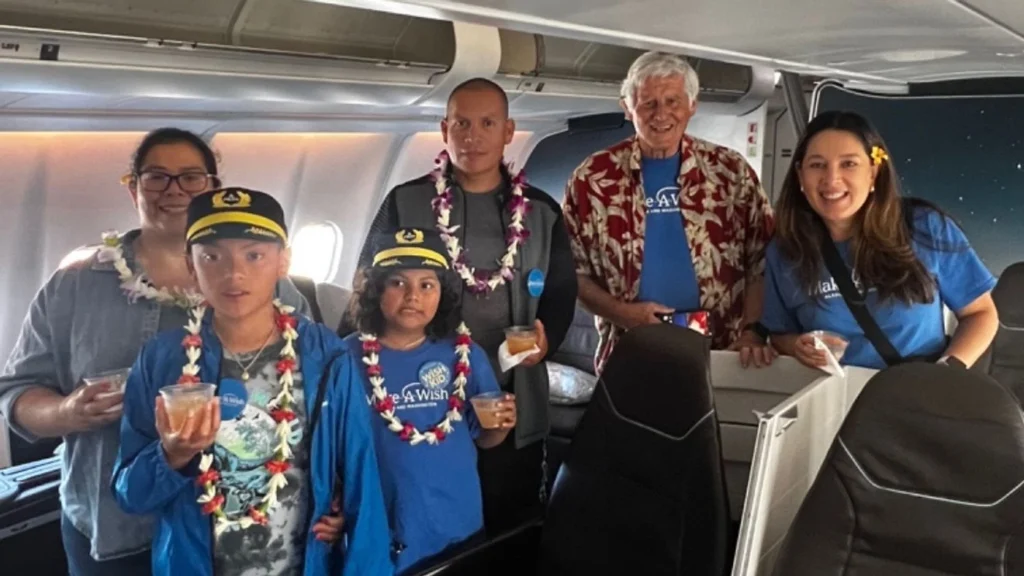
The morning we left for California, Mike barely slept.
He was already dressed before sunrise, sitting on the edge of his bed with Mickey Mouse ears tucked beneath one arm and a backpack almost as big as he was.
“Dad,” he whispered as I carried our luggage downstairs, “do airplanes fly above the rain?”
“I think they do.”
“So if it’s raining down here…”
He pointed toward the ceiling.
“…is it sunny up there?”
I smiled.
“Sometimes.”
He nodded thoughtfully.
“I hope we get the sunny part.”
Watching him that morning hurt more than I could explain.
For eight months, hospitals had become our second home.
Chemotherapy.
Blood tests.
Emergency admissions.
Long nights listening to machines instead of crickets.
Every good day felt borrowed.
Every bad day reminded us how little control we had left.
Now my eight-year-old son was worried about sunshine above the clouds.
It felt almost unfair that something so innocent could still exist inside him.
At the airport, everything fascinated him.
The luggage belts.
The moving walkways.
The giant windows overlooking the runway.
He waved enthusiastically at every airport employee who glanced his way.
Most waved back.
When we finally boarded, he settled into seat 12A beside the window.
My wife, Stella, sat between us.
Mike immediately picked up the safety card.
Instead of skimming it like everyone else, he studied every picture.
He traced the drawings with one finger.
“Dad?”
“Yeah?”
“If we have to slide down that inflatable thing…”
He pointed toward the emergency slide.
“…can we go again?”
I laughed for the first time in days.
“I don’t think that’s how emergencies work.”
“Oh.”
He considered that.
“Probably for the best.”
Then he pressed his forehead against the window.
Outside, a baggage worker spotted him waving wildly.
The man stopped loading suitcases, lifted both hands high above his head, and waved back.
Mike gasped.
“He saw me!”
“He sure did.”
As the engines roared and the plane lifted into the sky, Mike laughed so loudly that people several rows away smiled.
Beside me, Stella quietly reached for my hand.
Neither of us spoke.
Some moments are too fragile for words.
Eight months earlier, Mike had been chasing a soccer ball across our backyard.
He suddenly stopped.
One hand pressed against his stomach.
“I don’t feel good.”
That evening he developed a fever.
Within days we were sitting across from an oncologist.
I remember almost nothing from that conversation.
Only fragments.
Aggressive.
Rare.
Advanced.
Treatment.
Then the word terminal.
After that, time changed.
Life became measured in scans instead of seasons.
In blood counts instead of birthdays.
His muddy soccer cleats remained beside the back door.
Neither Stella nor I ever moved them.
Somehow putting them away felt like admitting he might never wear them again.
Hospital nurses learned his favorite jokes.
Doctors recognized his stuffed dinosaur before they recognized us.
Mike became friends with children whose parents knew exactly how to smile while falling apart.
One afternoon, during chemotherapy, a Make-A-Wish volunteer named Claire visited.
“If you could go anywhere in the whole world,” she asked.
Mike didn’t hesitate.
“Disneyland.”
Claire smiled.
“Why there?”
He looked down at the IV in his arm.
“Because nobody is sick at Disneyland.”
The room became very quiet.
A month later, Claire called.
The wish had been approved.
Stella and I waited until we held the plane tickets before telling Mike.
Hope had become dangerous.
Too many plans had disappeared after one bad scan.
When he opened the envelope, he stared at the tickets.
Then he looked at both of us.
“All three of us?”
“All three.”
He hugged the tickets against his chest.
“I’ve never been on an airplane.”
“I know.”
“I’ve never even left the state.”
“I know.”
His smile lit up the room.
“I get to fly.”
That smile carried us onto Flight 482.
A flight attendant named Dana quickly fell in love with him.
She brought him apple juice.
Extra pretzels.
An airline pin.
He asked endless questions.
“Do pilots really say ‘Roger’?”
“Sometimes.”
“Do airplanes sleep?”
“I don’t think so.”
“Can clouds get tired?”
Dana laughed.
“They probably rest at night.”
Mike accepted that answer.
Half an hour into the flight, the captain’s voice filled the cabin.
“Ladies and gentlemen, this is Captain Harris. We’re cruising comfortably at thirty-five thousand feet.”
Mike looked disappointed.
“He didn’t say ‘Roger.'”
The captain continued.
“We also have someone very special traveling with us today.”
Passengers glanced around.
“Mike, in seat 12A…”
My son froze.
“…I hope you’re enjoying your first flight.”
Mike looked at me with huge eyes.
“He knows my name.”
“He sure does.”
Captain Harris continued.
“Before we land, there is something your parents—and you—don’t know.”
Stella squeezed my hand.
The cabin suddenly felt different.
Quieter.
“I’d like everyone on board to reach beneath your seat.”
Paper rustled throughout the aircraft.
Every passenger pulled out a folded card.
So did I.
On the front was a hand-drawn blue airplane.
Crooked.
One wing slightly larger than the other.
Three round windows.
Across the top someone had written:
BOARDING PASS TO SOMEWHERE BETTER
Mike stared.
“I drew these.”
The captain began telling a story.
Months earlier, another little boy named Nolan had stopped talking during chemotherapy.
He refused food.
He refused medicine.
He refused hope.
One afternoon another child wheeled his IV pole into Nolan’s room carrying crayons and folded paper.
That child was Mike.
“I remember him,” Mike whispered.
Captain Harris continued.
Mike sat beside Nolan without talking about cancer.
Instead he drew two airplanes.
He handed one to Nolan.
“Pretend we’re already leaving,” Mike had said.
He didn’t promise everything would be okay.
He didn’t tell Nolan to be brave.
He simply asked one question.
“Where should we go?”
Nolan pointed upward.
“The moon.”
It was the first word he’d spoken in three days.
I remembered seeing paper airplanes taped to hospital walls afterward.
I remembered nurses smiling whenever they collected new drawings.
I never understood why.
The captain explained.
Soon other children wanted boarding passes.
Then every child.
Nurses started keeping crayons at their station.
Before painful procedures, children created imaginary tickets.
The beach.
Mars.
Pirate islands.
Castles.
Jurassic jungles.
Anywhere except hospital rooms.
“The boarding passes didn’t remove pain,” Captain Harris said.
“They gave children somewhere else to travel while their bodies stayed behind.”
Mike leaned toward the aisle.
“It was just our game.”
“It became much more.”
The captain explained that one of the volunteers had shared the story with a national Make-A-Wish coordinator.
Eventually airline crews heard about the little boy who had never flown yet somehow taught children how to travel.
Then came the announcement that changed everything.
“For months now,” Captain Harris said, “every Wish flight our airline operates carries one handmade boarding pass in the cockpit.”
Dana appeared near the cockpit door.
She held up a laminated piece of paper.
Even from twelve rows away, I recognized the uneven airplane.
Mike’s drawing.
“It reminds every crew that hope sometimes begins long before takeoff.”
Silence filled the cabin.
Then Dana slowly walked toward us carrying a framed photograph.
She handed it to Mike.
The picture showed dozens of children standing beneath a hospital bulletin board covered with colorful boarding passes.
In the middle stood Nolan.
Holding the moon ticket Mike had made.
Captain Harris spoke again.
“When we received today’s passenger list and recognized Mike’s name, we contacted his nurses.”
Dana smiled through tears.
“They’ve been waiting for this day.”
Every passenger still held their boarding pass.
An elderly man quietly wiped his eyes.
A teenage girl openly sobbed.
A businessman removed his glasses.
Mike looked around nervously.
“Did I make everybody sad?”
Stella immediately wrapped both arms around him.
“No, sweetheart.”
“Then why are they crying?”
I opened my mouth.
Nothing came out.
Captain Harris answered instead.
“Because sometimes people cry when they discover the world is kinder than they believed.”
The cabin remained completely still.
Then he added softly,
“You’ve been flying with us much longer than today, son.”
Applause began somewhere near the back.
Not loud.
Gentle.
Warm.
Like rain slowly moving across a roof.
One row after another joined in.
Mike smiled uncertainly.
Then he waved.
The same enormous wave he’d given the baggage worker.
One by one…
Nearly every passenger waved back.
I watched two hundred strangers waving to my little boy.
Stella buried her face in his hair.
I wrapped both of them in my arms.
For months I had measured Mike’s life by everything cancer had stolen.
Soccer.
School.
Sleepovers.
Hair.
Energy.
Time.
Thirty-five thousand feet above the ground, I suddenly understood something illness could never touch.
My son had already left fingerprints on the world.
Disneyland was everything he’d imagined.
He laughed on every ride he was tall enough to enjoy.
He hugged every character.
He insisted Mickey Mouse probably remembered him.
On our final night, we watched fireworks explode above Sleeping Beauty Castle.
The colors reflected across Mike’s face.
I tried desperately to memorize him.
Not photographs.
Not videos.
The warmth of his shoulder leaning against mine.
The rhythm of his laughter.
The way he squeezed my hand every time another firework exploded.
Three weeks after we returned home, a large package arrived.
Inside was a handcrafted scrapbook.
Each passenger from our flight had written Mike a note.
One man described losing his younger brother to leukemia.
A college student admitted she had boarded terrified because she suffered panic attacks whenever she flew.
She wrote:
I forgot to be afraid because I spent the flight watching you believe in magic.
Another passenger simply wrote:
Thank you for reminding me that courage can wear Mickey Mouse ears.
Near the back was Captain Harris’s page.
Beside his boarding pass he had written:
Pilots trust instruments when clouds hide the horizon.
Children like you remind us to trust hope the same way.
Then Stella turned the final page.
Beneath protective plastic rested one faded drawing.
Blue crayon.
Crooked airplane.
Three windows.
One oversized wing.
Mike’s original boarding pass for Nolan.
A nurse had quietly saved it after Nolan recovered and went home.
Below it someone had written:
Hope sometimes arrives before the airplane does.
Mike touched the page gently.
“I thought I was helping Nolan.”
“You were.”
He smiled.
“I didn’t know he was helping me believe we’d all get there too.”
Six months later, on a snowy afternoon, Mike slipped away peacefully.
The soccer goal still stood in our backyard.
His cleats were still beside the back door.
This time, I finally picked them up.
Not because I was letting him go.
Because I knew he’d already gone somewhere I couldn’t follow yet.
I sat beside his bed holding the little crayon boarding pass.
His breathing had become soft.
Almost peaceful.
I leaned close.
“Ready for another flight, buddy?”
His eyes opened just enough for me to see one last smile.
“Somewhere better.”
Those were the last words my son ever spoke.
I folded the little boarding pass into his hands.
His first flight ended in California.
But the flight he gave away…
The one that carried frightened children beyond hospital walls and reminded strangers that kindness still existed…
That one is still taking off.
Every time a child picks up a crayon.
Every time someone chooses hope over fear.
Every time a plane lifts into the clouds carrying a family desperate for one beautiful memory.
My son never lived long enough to grow old.
But somehow, he left behind something that will never stop flying.