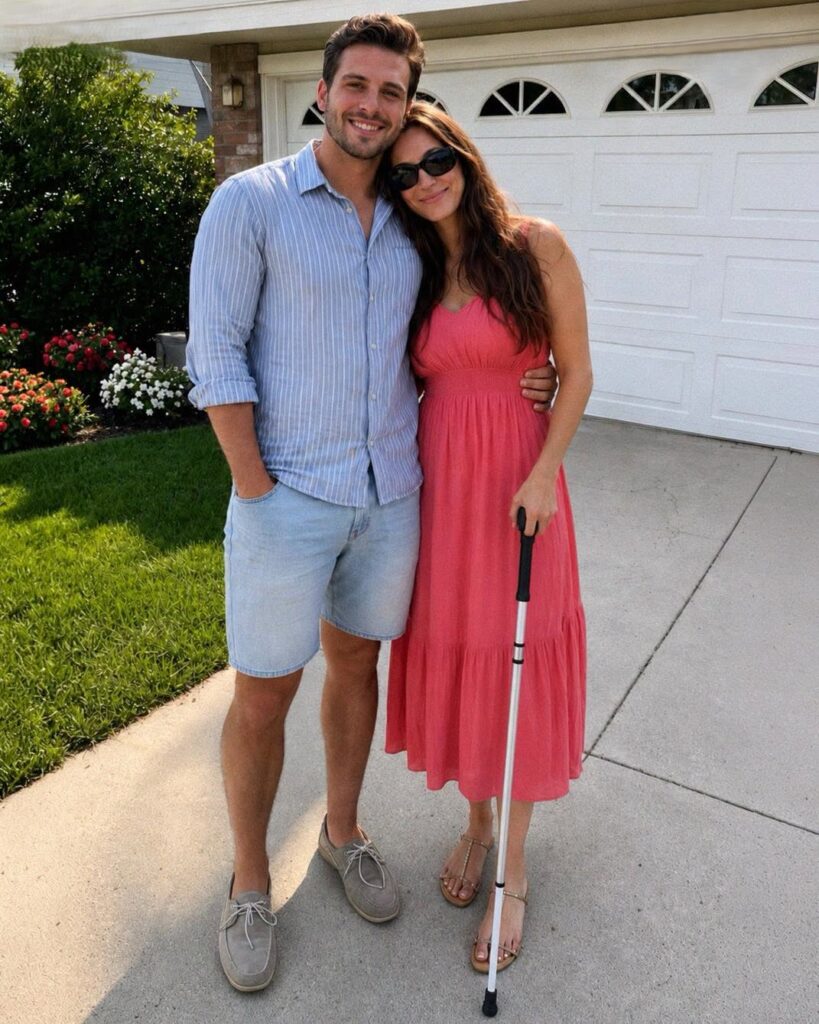
It was what my husband believed he could hide from me because I was blind.
The afternoon sun warmed the living-room window while I sat with both hands wrapped around a mug of tea.
I could feel the light against my face, but I could no longer see the cup clearly.
At thirty-five, I knew my home almost entirely by sound and touch.
The hum of the refrigerator.
The faint tick of the clock in the hallway.
The loose floorboard near the stairs.
The low growl of Brian’s car entering the driveway each evening.
Eleven years of marriage had shaped my life into a series of familiar noises.
There had been a time when I could see everything.
When Brian and I married, my eyesight was normal.
I drove at night.
I painted rooms without asking anyone whether the colors matched.
I traveled alone.
I loved autumn because I could see every shade of red and gold spreading across the mountains.
Then, a year after our wedding, the headaches began.
Street signs blurred.
Faces softened at the edges.
Lights formed halos.
After months of testing, doctors diagnosed me with a rare degenerative eye disease.
There was no cure.
At first, the loss was gradual enough that I could pretend it was not happening.
I moved closer to the television.
I enlarged the text on my phone.
I memorized grocery-store aisles.
Then the world became shapes.
After that, shadows.
By the fourth year, I carried a white cane.
By the sixth, I could distinguish little more than brightness and movement.
Brian became my eyes.
He drove me everywhere.
He read the mail.
He managed the bills.
He chose groceries, handled appointments, and dealt with repairs.
Whenever I reached for something independently, he was already there.
“I’ve got it, honey.”
“Let me do that.”
“You don’t need to worry about it.”
At first, his attention felt like love.
Then it became the structure of our marriage.
One room in the house remained almost completely off-limits to me.
The garage.
Over the years, Brian told me it had filled with tools, old machinery, storage containers, car parts, and equipment related to my condition.
“Let me help you organize it,” I once offered.
His hand immediately closed around my elbow.
“No, Gina. It’s a mess in there.”
“I can still label boxes.”
“There are sharp tools everywhere.”
“I know how to be careful.”
His voice tightened.
“There is nothing in there for you.”
I remember the sentence because it stung.
He must have heard it too, because he softened his tone.
“Let me take care of that space. I’ll bring you anything you need.”
I accepted his explanation.
That was what devotion looked like, I told myself.
Protection.
Patience.
A husband arranging his life around a wife who could no longer see.
My best friend, Marissa, was less convinced.
“You’re disappearing,” she told me one afternoon.
We were sitting at the kitchen table, and I could hear the uneasiness in her voice.
“I’m sitting right here.”
“You know what I mean.”
“No, I don’t.”
“You used to fight everyone about everything.”
I laughed.
“That sounds exhausting.”
“You argued with a contractor for three weeks because he used the wrong wood on your porch.”
“He did use the wrong wood.”
“You chose your own clothes. You traveled alone. You made decisions without asking permission.”
“I don’t ask permission.”
Marissa went quiet.
“Don’t you?”
I tightened my hands around my mug.
“Brian has taken care of me.”
“I know.”
Her voice softened.
“But care is supposed to make your life bigger, Gina. Not smaller.”
I did not answer.
Then she asked me about a clinical trial she had found.
A hospital two hours away was testing an experimental laser procedure for patients with my condition.
The success rate was uncertain.
The risks were real.
But a small number of participants had regained partial sight.
“I sent you the information last week,” she said.
“Brian read it.”
“And?”
“He said it was probably false hope.”
“What do you think?”
“I don’t know.”
“That wasn’t my question.”
I turned my face toward her voice.
“What do you want?”
The question unsettled me.
Somewhere during the years of losing my vision, I had stopped asking myself what I wanted.
That evening, I brought up the trial over dinner.
“Dr. Halim’s clinic called.”
Brian’s fork paused against his plate.
“The laser program?”
“Yes.”
“I thought we agreed it was too risky.”
“You thought it was too risky.”
“Gina.”
“They accepted my medical file for review.”
He set his fork down.
“We’ve discussed this.”
“You discussed it.”
His chair scraped slightly.
“I’m trying to protect you.”
“From what?”
“From disappointment.”
I heard the frustration in his voice.
“You’ll build this up in your head. Then, when it doesn’t work, I’ll be the one helping you through another breakdown.”
The words hurt more than I expected.
“Another breakdown?”
“You know what I mean.”
“No. Explain it.”
He sighed.
“This disease nearly destroyed you.”
“It changed me.”
“It changed both of us.”
“I want to try.”
His tone became gentle again.
Too gentle.
“Sweetheart, sometimes accepting reality is healthier than chasing miracles.”
“Marissa offered to help me during recovery.”
His silence sharpened.
“Of course she did.”
“What is that supposed to mean?”
“She fills your head with ideas and leaves me to deal with the consequences.”
“I am not a consequence.”
“I didn’t say you were.”
“You did.”
Brian pushed his chair back.
“I have an early meeting.”
The conversation ended because he decided it had.
A few days later, Brian left for a week-long business trip.
He kissed my forehead in the hallway.
“I’ll call every night.”
“Where are you staying?”
“The usual hotel.”
“What city?”
He hesitated for half a second.
“Chicago.”
Then he left.
The house settled into silence.
The following afternoon, Marissa arrived carrying a large envelope.
Her voice trembled when she spoke.
“You were accepted.”
I gripped the edge of the counter.
“What?”
“The clinical trial.”
She laughed and began crying at the same time.
“They want you there Friday.”
For the rest of that evening, I thought about the woman I had been before my diagnosis.
The woman who drove herself through a snowstorm because she wanted to see the mountains.
The woman who painted the kitchen yellow even though Brian hated yellow.
The woman who trusted her own instincts.
I had surrendered those pieces of myself gradually.
Not because anyone demanded them all at once.
Because giving them away made life easier.
Brian could handle the bills.
Brian could choose the route.
Brian could read the forms.
Brian could decide whether hope was worth the risk.
By midnight, I had made my decision.
I was having the surgery.
Marissa arrived Friday morning with coffee and an overnight bag.
She helped me into the passenger seat.
“Last chance to change your mind.”
“I’m more frightened of never trying.”
Dr. Halim was patient and direct.
“The procedure may not work,” he told me.
“I understand.”
“You may regain only limited vision.”
“I understand.”
“There is also a possibility of complications.”
“I know.”
He paused.
“Are you making this decision freely?”
The question surprised me.
“Yes.”
For the first time in years, the answer was completely mine.
The procedure took less than two hours.
What followed felt much longer.
For the first two days, the world was a blur of light and color.
On the third morning, I woke in the recovery room and stared upward.
At first, I did not understand what I was seeing.
Then the shape sharpened.
A ceiling fan.
Four white blades.
A silver chain hanging from its center.
Dust gathered along one edge.
I could see the dust.
A sob tore out of me.
A nurse hurried into the room.
“Are you in pain?”
“No.”
I laughed through my tears.
“It’s dirty.”
“What?”
“The fan.”
I pointed upward.
“The fan is dirty.”
I cried for nearly an hour.
The results were better than anyone had expected.
My vision was not perfect.
Objects remained soft at a distance, and bright light hurt my eyes.
But I could see faces.
Colors.
Letters.
My own hands.
Marissa drove me home several days later.
I stood in the hallway and stared at the house I had lived in for eleven years.
It looked both familiar and completely foreign.
“The curtains are blue,” I whispered.
Marissa glanced toward them.
“Yes.”
“Brian said they were green.”
Her expression changed.
“They’ve always been blue.”
I walked slowly from room to room.
I saw the scratch on the dining table.
The water stain near the window.
The framed photographs on the mantel.
In the bathroom, I stood before the mirror for a long time.
The woman looking back at me was older than the last face I remembered.
There were lines around her mouth.
Gray near her temples.
But she was mine.
“I look like my mother,” I whispered.
Marissa smiled behind me.
“You look like you.”
I had not told Brian about the surgery.
I wanted to surprise him.
I imagined him walking through the door and seeing me standing there without my cane.
I imagined joy.
Tears.
Maybe even gratitude.
“I want to see his face when I tell him,” I said.
Marissa’s smile was careful.
“Then we won’t tell him.”
After she left, I wandered through the house for hours.
I touched objects while looking at them, matching familiar textures to forgotten shapes.
Then I remembered the Christmas lights.
Brian had often complained that they were tangled in boxes in the garage.
I had not seen Christmas lights glowing in nearly ten years.
I decided to surprise him.
I would string them around the living room before he returned.
The garage door stood at the back of the kitchen.
I had not opened it in years.
My hand closed around the cool metal knob.
For a moment, I heard Brian’s warning in my mind.
There is nothing in there for you.
I turned the knob.
The door creaked inward.
I expected darkness, dust, gasoline, and clutter.
Instead, the air smelled faintly of lavender.
I found the switch and flipped it.
The lights flickered on.
The world I had imagined for nearly a decade vanished.
There were no tools.
No shelves of machinery.
No storage boxes.
The garage had been converted into a small apartment.
A gray sofa stood against one wall.
A coffee table held two wineglasses.
A neatly made bed filled the far corner.
There was a television.
A small bathroom.
A clothing rack.
A woman’s cream-colored coat hung beside the outer door.
For several seconds, I could not move.
Then I noticed the photographs.
They lined two floating shelves above the couch.
Brian at a restaurant with a dark-haired woman.
Brian with his arm around her on a beach.
Brian kissing her beneath Christmas lights.
Brian standing in the very room where I now stood, holding a bottle of champagne while she leaned against him.
My knees weakened.
I stepped closer.
A piece of mail rested on the table.
PENELOPE CROSS.
The address beneath her name was my address.
I picked up the envelope.
My hands shook so violently that the paper rattled.
“No.”
The word came out as a whisper.
Then louder.
“No.”
I called Marissa.
She answered immediately.
“How does everything look?”
“You need to come here.”
“What happened?”
“The garage.”
“What about it?”
“It isn’t a garage.”
Twenty minutes later, she ran through the open doorway and stopped.
“Oh my God.”
I stood beside the bed, unable to look away from the photographs.
“This has been here the whole time.”
Marissa moved slowly around the room.
“Maybe it was an office first.”
“It’s a bedroom now.”
“We need to document everything.”
Together, we searched.
Inside a cabinet, Marissa found renovation permits dated six years earlier.
Brian had converted the garage into a legal living space while telling me it was too dangerous to enter.
Furniture receipts and utility records showed that someone had begun living there four months earlier.
Before that, a framed certificate identified the space as:
BRIAN WHITFIELD — PRIVATE OFFICE.
“He prepared it years ago,” I said.
Marissa looked at me.
“For this?”
“I don’t know.”
We found women’s clothes in the closet.
A toothbrush in the bathroom.
Medication prescribed to Penelope Cross.
A second key to Brian’s car.
Then Marissa opened the drawer beside the bed.
“Gina.”
Her voice changed.
“What?”
She held out a folded note.
“You need to read this.”
The handwriting was rounded and feminine.
Brian,
I know this is difficult with your wife getting worse.
I still feel awful staying hidden, but you’re right that she would never understand. Once you move her into the care facility, we can finally stop living like this.
I hate that everyone thinks your wife is dying, but I understand why you had to explain your situation that way.
I’ll return from Portland Sunday night. Mom’s surgery is Thursday, so please don’t call before then.
Just a few more months.
Then we’ll have the house and our life.
Love,
Penelope
The paper shook in my hands.
“He told her I was dying.”
Marissa placed one hand on my shoulder.
“He told her he was moving me into a facility.”
“Gina—”
“He has been planning to remove me from my own home.”
I sat on the edge of the bed.
Memories came back in pieces.
Brian guiding me away from the garage.
Brian insisting on handling every letter.
Brian telling friends that my condition was “progressing rapidly.”
Brian encouraging me to sign papers without explanation.
Brian saying I needed to consider long-term care if he could no longer manage everything alone.
I had believed those conversations were about fear.
They had been preparation.
For one long minute, I let the truth crush me.
The meals he had cut into small pieces.
The hand placed gently at my back.
The soft voice telling me not to worry.
Every act of care now looked different.
Not all of it had been false.
That almost made it worse.
Then something inside me steadied.
“Photograph everything,” I said.
Marissa crouched beside me.
“Gina, you don’t have to do anything tonight.”
“Yes, I do.”
“You’re in shock.”
“I have spent nearly ten years allowing Brian to decide what I could handle.”
I stood.
“He was wrong.”
We spent two hours documenting the room.
Every photograph.
Every receipt.
Every permit.
Every personal item.
Inside the desk, Marissa found a leather notebook filled with passwords.
One of them opened our joint banking account.
We discovered dozens of transfers made over several years.
Small amounts at first.
Then larger ones.
Money moved into accounts under Brian’s name.
Payments for restaurants, hotel rooms, furniture, and jewelry.
A deposit to a private assisted-living facility.
In my name.
My husband had already placed me on a waiting list.
“He paid the deposit three months ago,” Marissa whispered.
I stared at the screen.
“He wasn’t waiting for me to get worse.”
“No.”
“He was waiting until moving me looked believable.”
By morning, I was sitting in the office of a family-law attorney named Evelyn Price.
I placed the photographs, statements, permits, and Penelope’s letter across her desk.
Evelyn listened without interrupting.
Then she asked, “Does your husband know your vision has returned?”
“No.”
“Good.”
The word startled me.
She leaned forward.
“Do not confront him until we preserve the financial records and secure your interest in the house.”
“The house is jointly owned.”
“Then he cannot legally force you out without due process.”
“He has been telling people I’m dying.”
“We’ll document that.”
“He opened accounts I knew nothing about.”
“We’ll trace them.”
“He put down money at a care facility.”
Her expression hardened.
“That may be particularly important.”
Evelyn prepared a preservation notice, emergency financial requests, and separation papers.
She advised me to change my personal passwords and place an alert on my credit.
By evening, I returned home with a folder beneath my arm.
The Christmas lights I wanted had never been in the garage.
I found them in a hallway closet.
I strung them across the living-room windows.
I wanted light around me when Brian came home.
At 7:16, the front door opened.
“Gina?”
His voice was cheerful.
“I got an earlier flight.”
His suitcase rolled across the floor.
“Honey, where are you?”
I stood in the center of the living room without my cane.
Brian rounded the corner.
He stopped.
The smile disappeared from his face.
His eyes moved from my face to the glowing lights and then to my empty hands.
“Gina?”
“I had the surgery.”
His suitcase tipped over.
“You can see?”
“Yes.”
For a second, he looked frightened rather than happy.
That was the answer I needed before I asked another question.
“I opened the garage.”
His face drained of color.
“Gina, listen to me.”
“I saw the apartment.”
“It isn’t what you think.”
“I saw the photographs.”
His mouth opened.
“I read Penelope’s letter.”
He staggered toward the couch.
“You went through my private things?”
“Your private things were hidden in my home.”
“I can explain.”
“Please do.”
He rubbed both hands over his face.
“I was lonely.”
I stared at him.
“You were lonely?”
“You don’t know what these years have been like.”
“No. Tell me.”
“I became your caregiver.”
“You became my husband before you became my caregiver.”
“Everything changed.”
“For me too.”
“I needed someone who could…”
He stopped.
“Who could what?”
His eyes flicked toward mine.
“Someone who could see me.”
The words hung between us.
I stepped closer.
“Look at me now, Brian.”
He did.
“I see you completely.”
His face crumpled.
“I never meant for this to happen.”
“You renovated that room six years ago.”
“It was an office.”
“You moved her in four months ago.”
“She had nowhere else to go.”
“You told her I was dying.”
“I panicked.”
“You told her you were putting me in a care facility.”
“I was considering options.”
“You paid a deposit.”
His silence answered me.
I placed Evelyn’s folder on the coffee table.
“What is that?”
“Separation papers.”
“Gina, don’t do this.”
“Financial-disclosure requests.”
He took a step toward me.
“We can work through this.”
“Copies of the account transfers.”
His expression changed.
“You had no right to access my accounts.”
“Our money funded them.”
“I was going to explain everything.”
“When?”
He said nothing.
“After I was locked inside a facility?”
“You could not manage alone.”
“I managed perfectly well before you convinced me I couldn’t.”
“That’s not fair.”
“No, Brian. Fair would have been telling me you no longer wanted the marriage.”
“I did want it.”
“You wanted my house, my money, and my dependence.”
His voice became desperate.
“I took care of you for years.”
“You did.”
The admission silenced him.
“And I trusted you because of it.”
I swallowed hard.
“That is what made this betrayal possible.”
He reached for my hand.
I stepped back.
“Penelope thinks I’m dying.”
“I’ll talk to her.”
“I already did.”
His head snapped up.
“What?”
“I called her this afternoon.”
“How did you get her number?”
“It was written on an envelope.”
“What did you say?”
“The truth.”
His face collapsed.
“She’s going to misunderstand.”
“She understands perfectly.”
The conversation with Penelope had lasted less than ten minutes.
At first, she thought I was lying.
Then I sent her a photograph of myself holding that morning’s newspaper.
I told her about the surgery.
The care-facility deposit.
The joint money.
The marriage Brian claimed was already over.
Penelope cried.
She insisted Brian had told her we slept in separate rooms and that I no longer recognized him.
She had believed she was moving into the house after I received permanent medical care.
She had also believed the property belonged solely to Brian.
“I’m sorry,” she whispered.
“So am I.”
“I never would have agreed to this.”
“You agreed to hide inside my garage.”
There was silence.
Then she said, “You’re right.”
By the end of the call, she promised to remove her belongings and send me copies of every message Brian had written.
I looked at my husband now.
“She won’t be returning Sunday.”
“Gina, please.”
“The woman you believed would never see your betrayal is standing in front of you.”
Tears filled his eyes.
“I love you.”
“No.”
“I do.”
“You loved being necessary.”
“That isn’t true.”
“You discouraged the surgery.”
“Because it could have hurt you.”
“You were terrified it would work.”
He looked away.
That was enough.
I picked up my overnight bag.
“Where are you going?”
“To Marissa’s.”
“This is your home.”
“Yes.”
I paused at the front door.
“And I intend to keep it.”
The divorce took nearly a year.
Brian denied planning to institutionalize me until Evelyn obtained the assisted-living application.
On the form, he had described me as confused, emotionally unstable, and incapable of managing daily decisions.
My doctors contradicted every claim.
The financial investigation revealed that he had moved almost a third of our savings into private accounts.
Most of it was recovered in the settlement.
The hidden apartment helped establish that the affair had been ongoing and that marital funds had supported it.
Penelope provided years of messages.
Some were painful to read.
Others were useful.
She ended her relationship with Brian immediately.
She never moved back into the garage.
The house was sold as part of the settlement.
At first, I grieved losing it.
Then I realized I did not want to remain in rooms where I had been trained to doubt myself.
I bought a smaller apartment with enormous windows.
I chose every piece of furniture.
The curtains were yellow.
Brian would have hated them.
That made me smile.
My vision continued improving during the following months.
It was not perfect.
I still used magnification to read.
I avoided driving at night.
Some mornings were blurrier than others.
But I could see Marissa’s expression when she laughed.
I could see trees moving in the wind.
I could see my own face changing as I learned to live independently again.
One evening in December, Marissa arrived with takeout and a bottle of wine.
Christmas lights glowed around my windows.
“You look different,” she said.
“I am different.”
“No.”
She smiled.
“You look like yourself again.”
On the counter rested a short letter from Penelope.
She had moved to Portland permanently.
The message contained only two sentences.
Thank you for telling me the truth.
I’m sorry I helped him hide it.
I folded the note and placed it in a drawer.
Not because I forgave everything.
Because I no longer wanted reminders of Brian controlling the rooms I lived in.
Months later, Brian asked to meet.
I agreed to see him in a public café.
He looked smaller than I remembered.
Perhaps he always had been.
I simply had not been able to see it.
“I’m in therapy,” he told me.
“I hope it helps.”
“I’ve spent a lot of time thinking.”
“That must be new for you.”
He accepted the insult without protest.
“I was angry when you got sick.”
I waited.
“Not at you. At first.”
“But eventually?”
“I hated the life we had.”
“You could have left.”
“I thought leaving a blind wife would make me a monster.”
“So you stayed and became one privately.”
He closed his eyes.
“Yes.”
The honesty surprised me.
“I told myself I deserved something for staying.”
“You believed care was a debt I owed you.”
“Yes.”
“And because I could not see, you thought I would never learn the cost.”
Tears gathered in his eyes.
“I did love you.”
“I believe part of you did.”
His face lifted.
“But love without respect becomes possession.”
I stood.
“Gina, is there any chance—”
“No.”
He nodded slowly.
“I understand.”
“You understand now because I can see you leaving.”
I walked away before he could answer.
That night, I stood by my apartment window.
The Christmas lights reflected in the glass around my face.
For years, losing my eyesight taught me how much trust could matter.
I trusted hands that guided me across roads.
Voices that described rooms.
People who told me where the edge was.
But Brian taught me something else.
Trust should never require surrendering your own judgment.
Blindness had not made me weak.
It had not made me foolish.
It had not made me incapable of knowing when something felt wrong.
Brian did not betray me because I could not see.
He betrayed me because he believed my dependence had erased my power.
Getting my sight back exposed the truth.
But seeing clearly was only the beginning.
The real freedom came when I stopped asking other people to tell me what was in front of me.
Losing my sight taught me how to trust others.
Getting it back taught me how to trust myself.