Now she was gone.
And my father, Victor Hale, stood beside her grave as if even her memory annoyed him.
Our relatives whispered beneath black umbrellas. Some said my grandmother had wasted her final years on me. My stepmother, Celeste, watched with thinly veiled satisfaction. My half brother, Mark, smirked as though the whole funeral were nothing more than the closing of a family account.
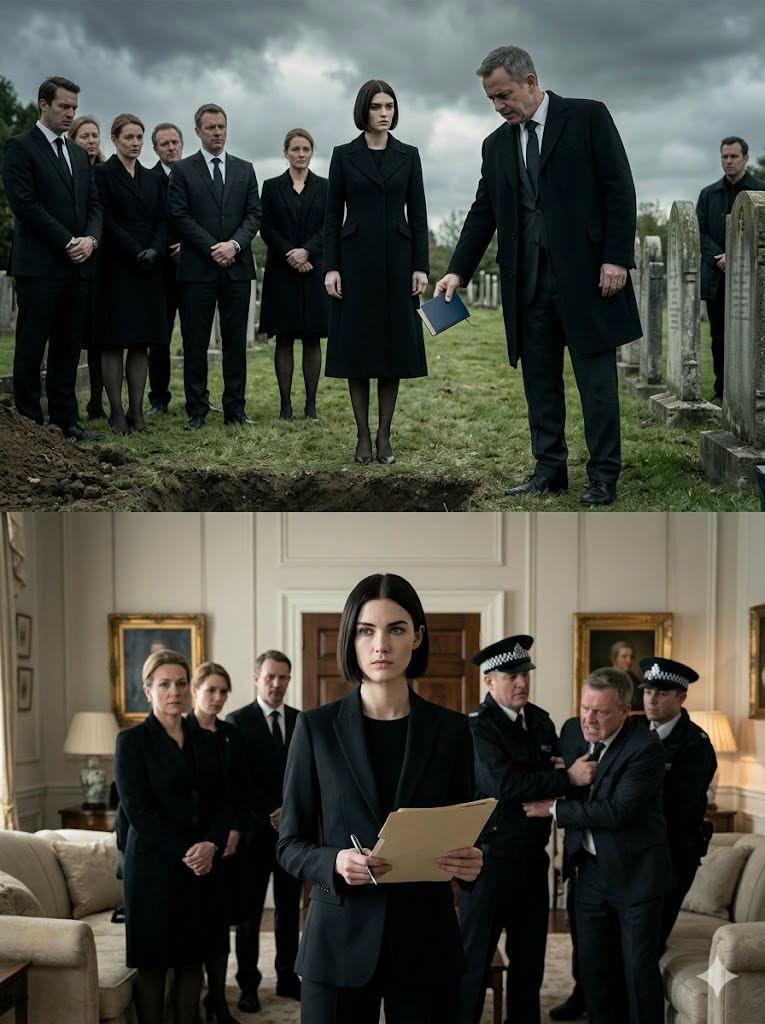
Our lawyer, Mr. Bell, had just announced that the small blue savings book was the only item left directly to me.
My father laughed.
“Useless junk,” he said.
Then he threw it into the grave.
The book landed in the wet dirt beside the casket.
He looked at me and said, “Leave it there.”
For a moment, I stood still in the rain, hearing the whispers, feeling the cold water run down my face, and looking at the little book my grandmother had chosen for me.
It did not matter what they thought it was worth.
She had left it to me.
So I climbed down into the mud.
Gasps rose behind me. Someone laughed. My father cursed under his breath.
I reached for the book, wiped the wet dirt from its cover, and held it against my chest.
Then I climbed back out of the grave and walked away from their laughter.
I drove straight to the bank.
By the time I reached the counter, my shoes were muddy and my hands were still shaking. The clerk took the faded savings book gently and began entering the account numbers.
Her expression changed almost immediately.
She called security.
For one terrible moment, I thought something was wrong with me.
Then the bank manager, Diana Cross, came out and asked me to follow her into a private room.
She explained that someone had tried to access the account that very morning using fraudulent documents. The attempt had failed only because my grandmother had placed a strict fraud lock on her accounts years earlier.
Then Diana told me what the blue book truly represented.
My grandmother had a protected portfolio worth two million eight hundred thousand dollars.
I sat there, unable to speak.
For years, my father had mocked her as confused, stubborn, and poor. He had spoken of her as if she had nothing left to give anyone.
But Margaret Rose Hale had not been helpless.
She had been careful.
Diana explained that seventeen years earlier, someone had submitted forged documents trying to take control of my grandmother’s assets. My grandmother discovered the attempt and locked everything down. She had been protecting her estate quietly ever since.
Then Mr. Bell arrived.
He carried a sealed letter from my grandmother and the key to a safe deposit box.
Inside were records, signatures, bank notices, legal statements, and proof that my father had been trying to steal from her for years.
Financial crimes.
Elder abuse.
Forgery.
The truth had not been buried with my grandmother.
She had left it waiting.
Three days later, my father summoned me to her house.
He believed I was frightened. He believed the bank had given me only enough information to make me easier to pressure. He believed, as he always had, that I would fold under the weight of his voice.
When I arrived, he was standing in the living room like a man already claiming victory.
Celeste sat nearby drinking from my grandmother’s fine china. Mark tossed a silver lighter from hand to hand, careless with things that had never belonged to him.
My father told me to sign over whatever the bank had given me.
In exchange, he said, I could keep a few pieces of old furniture.
He spoke as if he were being generous.
Then he claimed the house was his.
That was when I finally understood how much he had built his life on assuming no one would ever challenge him.
“My grandmother placed this estate in an irrevocable trust for me twelve years ago,” I said.
His face tightened.
Before he could answer, I opened the front door.
Mr. Bell walked in first.
Diana Cross followed.
Behind them came two police detectives carrying a thick folder of evidence.
For once, my father had no room to twist the story before anyone else heard it.
The detectives laid out the facts clearly: attempted bank fraud, forged documents, financial exploitation, and a long pattern of abuse directed at an elderly woman whose only mistake had been trusting blood longer than it deserved.
They arrested Victor in the living room.
Celeste stood too quickly, knocking over her teacup. It shattered across the floor, tea spreading over the polished wood.
My father stepped back, slipped, and fell hard to his knees.
For a moment, he looked up at me from the floor of the house he had tried to steal, surrounded by the evidence my grandmother had left behind.
I did not laugh.
I did not need to.
His downfall was not something I had created. It was the harvest of choices he had made for years, believing no one would ever hold him accountable.
Mark eventually accepted a plea deal and testified against him. My father’s fraudulent business collapsed under the weight of public evidence, unpaid obligations, and the shame he had spent a lifetime trying to pass onto others.
Six months later, I stood in my grandmother’s house again.
But it no longer felt like a battlefield.
It had become the Rose Hale Center, a place offering legal aid to elderly women facing financial abuse, family coercion, and quiet exploitation by people who assumed age made them powerless.
The room where Celeste once drank from my grandmother’s china became a consultation office.
The dining room became a meeting space.
The front porch became a place where women arrived afraid and left with papers, plans, and people who believed them.
On my desk, I kept the little blue savings book.
Its cover was still stained from the cemetery mud.
I never cleaned it completely.
I wanted to remember.
My father had thrown it into a grave because he thought it was worthless.
But my grandmother knew exactly what she was doing.
She had left me more than money.
She left me proof.
Protection.
A final lesson in dignity.
And in trying to bury what she gave me, my father uncovered the truth that buried him.