The stadium was filled with an extraordinary concentration of famous faces, including Donald and Melania Trump, who observed the proceedings from a VIP suite alongside FIFA President Gianni Infantino. They were joined by a diverse group of international leaders, including Mexican President Claudia Sheinbaum, Canadian Prime Minister Mark Carney, and Spain’s King Felipe VI and Queen Letizia, as well as a vast array of Hollywood stars such as Tom Cruise, Matt Damon, Jay-Z, Beyoncé, and the Beckhams. This convergence of political and entertainment power set the stage for a series of viral moments that began well before the opening whistle. The sheer scale of the guest list, which also included figures like Timothée Chalamet, Kylie Jenner, and Serena Williams, turned the venue into a hub of global pop-culture significance that rivaled the intensity of the match itself.
The pre-match entertainment was designed to be a grand spectacle, featuring performances by Post Malone and Swae Lee, alongside a collaborative anthem titled “Desire” performed by Robbie Williams, Laura Pausini, and Nicole Scherzinger. However, the most discussed segment of the opening ceremony involved actor Tom Cruise, who took to the field to deliver remarks on the sport’s capacity for global unity. His earnest speech, which repeatedly referred to the sport as “football,” sparked an immediate and polarized debate across social media platforms. While some viewers appreciated his attempt to honor the global terminology of the game, others expressed surprise or amusement at an American actor eschewing the term “soccer” in favor of the international standard. The discourse highlighted the cultural friction that often accompanies such high-profile, globally televised events, turning a moment intended for solemnity into a subject of widespread online commentary. Cruise spoke with dramatic flair, emphasizing that the tournament was a journey of 48 nations, yet the linguistic choice became the primary takeaway for many digital observers.
Following the opening remarks, the atmosphere shifted to the U.S. national anthem, performed by Jennifer Hudson. Her rendition of “The Star-Spangled Banner” was marked by powerful, theatrical vocal flourishes that immediately divided the audience. Online reactions were sharply split between those who praised her technical ability and emotional intensity, and those who felt the arrangement was overly dramatic or unsuited for the traditional anthem. This debate over vocal style underscored the intense scrutiny placed on every element of the ceremony, as viewers dissected the performance with the same fervor they applied to the match itself. Some listeners characterized the performance as a masterful display of vocal power, while others argued that the theatricality detracted from the song’s solemnity, leading to a prolonged discussion about the appropriateness of such arrangements at major sporting events.
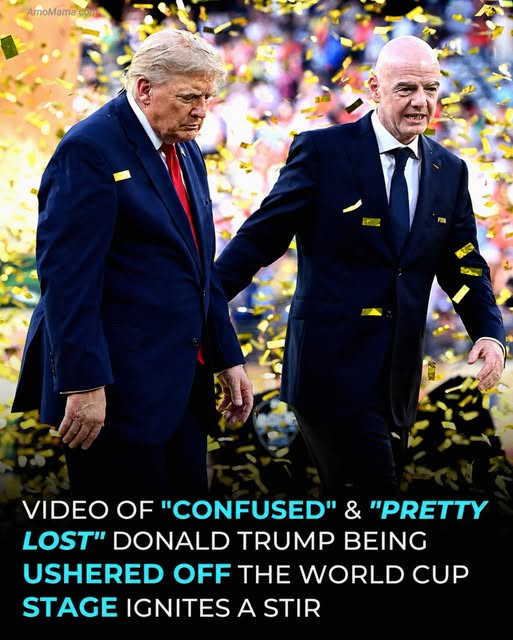
The final, and perhaps most scrutinized, viral moment occurred during the trophy presentation. After Spain’s victory, Donald Trump and Gianni Infantino walked onto the stage to present the gold trophy to the Spanish team. Once the formal handoff was complete, video footage appeared to show Infantino attempting to guide Trump away from the center of the stage as the players began their celebrations. Trump, however, remained to interact with the athletes, prompting the FIFA president to return and gesture toward the exit on multiple occasions. The brief, awkward exchange was widely circulated, with viewers debating whether the moment was a result of unclear staging or a genuine misunderstanding of the post-match protocol. The visual of the FIFA president attempting to clear the stage while the former U.S. President engaged with the players provided a stark contrast to the expected formality of a trophy ceremony.
This incident, like the earlier celebrity appearances, became a focal point of the digital conversation, illustrating how the presence of high-profile figures can transform a standard sporting ceremony into a complex, multi-layered spectacle. The event concluded with Spain celebrating their hard-won title, while the internet continued to process the collision of sports, politics, and celebrity culture that had unfolded throughout the day. The halftime show, which featured an unprecedented lineup including Madonna, BTS, Justin Bieber, and the New York Philharmonic, further cemented the event’s status as a global entertainment milestone. As of the latest reports, the match remains a landmark moment in tournament history, remembered as much for its off-field discourse as for the final score that crowned Spain as the champions of the 2026 FIFA World Cup.