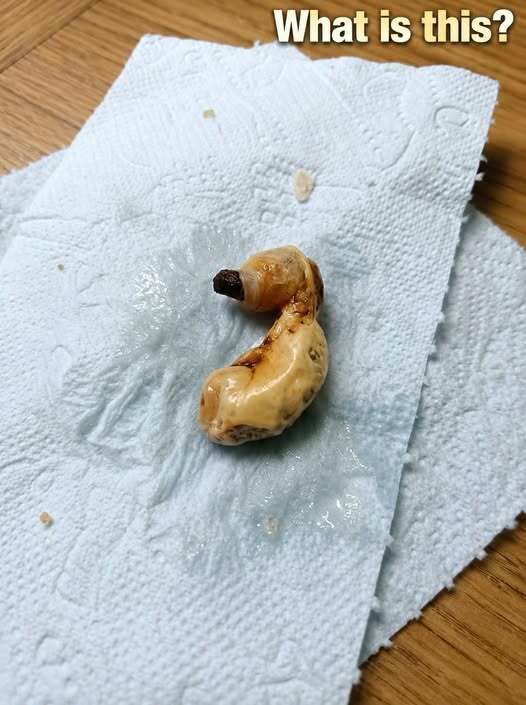
The object was motionless, yet it possessed a disturbing quality that made my skin crawl. It appeared soft, slightly twisted, and featured a dark, pointed tip that my brain immediately interpreted as a sign of something biological and potentially dangerous. My imagination, always eager to fill in the blanks of the unknown, began to spiral into a series of catastrophic scenarios. Was it a parasite that had fallen from a pet? A severed rodent tail? Perhaps some kind of unidentified, rotting creature that had crawled into the house to die in the shadows? The more I stared at it, the more my pulse quickened, and the room began to feel like a place where something sinister had been lurking just inches from our feet for days. I felt a cold knot of dread tighten in my stomach, convinced that I was looking at evidence of an infestation or some other household nightmare that would require professional intervention to resolve. I retreated a few steps, my eyes locked on the pale curve, feeling as though the item might shift or twitch at any second.
I called my son into the room, desperate for a second opinion that might ground me in reality. I expected him to glance at the floor, roll his eyes, and dismiss my panic with the effortless confidence of youth. Instead, he approached the bed, leaned down, and froze. He squinted at the object with the same uneasy confusion that had gripped me, his brow furrowed in genuine concern. When he whispered, “What is that?” the fear in his voice confirmed my worst suspicions. If he did not recognize it as a toy or a piece of trash, then it had to be something truly alien. The silence in the room grew heavy, and we stood there like investigators at a crime scene, keeping a respectful, terrified distance from the mysterious intruder. We began to mentally catalog every strange creak in the walls and every faint, unidentifiable smell we had noticed over the past few weeks, retroactively assigning them significance. The house, which had been a sanctuary, suddenly felt like a place of hidden, creeping threats.
We debated whether to call for help or simply seal the room off until a professional could arrive. The absurdity of the situation was lost on us in the heat of the moment. We were two people standing in a bedroom, paralyzed by a tiny, curved shape that seemed to defy explanation. I found myself thinking about the history of the house, wondering if there were gaps in the floorboards that I had never noticed before. Every shadow seemed to stretch and shift, turning the mundane furniture into potential hiding spots for more of these creatures. We were genuinely convinced that we were on the verge of uncovering a massive, gross problem that would necessitate a total upheaval of our living situation. The fear was visceral, physical, and entirely consuming.
After several minutes of this agonizing speculation, I decided that we could not simply stand there and let our fears dictate the narrative. I grabbed a broom from the hallway, my hands trembling slightly as I prepared to face whatever this thing was. With a slow, deliberate motion, I nudged the object, sliding it from the shadows beneath the bed frame and into the bright, unforgiving light of the afternoon sun. I braced myself for the worst, expecting it to scuttle away or reveal a gruesome texture once it was no longer obscured by the dimness of the floorboards.
The truth, however, was as underwhelming as it was absurd. It was not a parasite, it was not a creature, and it was certainly not dangerous. It was a single, dusty pistachio shell. It was merely the discarded husk of a snack, darkened at one end by old seasoning and coated in a fine layer of bedroom lint. It had clearly rolled under the bed weeks ago, where the combination of poor lighting and the accumulation of dust had transformed it into a miniature, curved, and deeply unsettling object that looked nothing like a nut. The sheer banality of the item was jarring. For a long, silent moment, we both just stared at the shell, processing the transition from mortal terror to utter ridiculousness. Then, the tension snapped, and we burst into laughter—the kind of loud, relieved, and slightly hysterical laughter that only follows a genuine, misplaced panic. The fear dissolved instantly, leaving us feeling both foolish and profoundly relieved.
This experience served as a humbling reminder of how quickly the human mind defaults to fear when faced with uncertainty. We are wired to scan for danger, and in the absence of clear information, our brains will happily manufacture a monster out of a piece of refuse. It was a lesson in perspective; something completely harmless can appear monstrous when viewed from the wrong angle or in the wrong light. My son and I spent the rest of the afternoon joking about our “parasite,” but the incident left a lasting impression. I still check under the bed when I clean, though now I do it with a bit more humor and a lot less dread, knowing that even the most terrifying mysteries are often just forgotten snacks waiting to be found. It is a strange comfort to know that the monsters under the bed are usually just the remnants of a midnight snack, and that the most dangerous thing in the room is often just our own overactive, imaginative, and occasionally panicked minds.