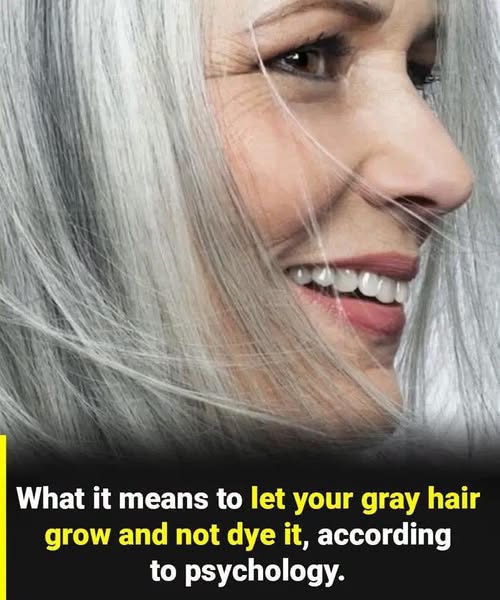
beauty standards; it is fundamentally altering the internal landscape of how we perceive our own worth. Choosing to stop dyeing is rarely just a matter of grooming or convenience; it is a profound psychological pivot that touches the very core of identity. For years, many of us have absorbed the pervasive, unspoken message that human value peaks in youth and steadily declines with every visible sign of aging. By refusing to continue the cycle of hair dye, one is effectively standing up to that narrative, choosing to stop apologizing for existing in a body that is naturally evolving. It becomes a quiet but powerful declaration: I am not disappearing, and my value is not tethered to a specific shade of pigment.
This transition often brings an unexpected, profound sense of relief. When the constant, exhausting battle against regrowth and the anxiety of potential judgment are removed, people frequently report feeling more honest in their daily interactions and more deeply grounded in their own skin. The act of letting go of the dye is an act of reclaiming time—not just the hours spent in salon chairs or bathroom mirrors, but the mental energy previously dedicated to maintaining a facade. In this space, individuals often discover a new kind of authority and calm that was previously obscured by the need to perform a version of themselves that felt increasingly distant.
Women, who have long been conditioned to believe that their beauty and relevance fade with every gray strand, often discover a surprising sense of liberation. They find that by embracing their natural hair, they are not merely accepting a physical change but are actively cultivating a new, more resilient form of self-worth. Men, who face their own unique pressures to remain perpetually competitive and vital, often find a renewed sense of dignity in no longer pretending to be someone they were decades ago. In accepting gray, many find not a sense of resignation or defeat, but a more stable, grounded confidence—one that no longer depends on the fleeting ability to pass for younger than they actually are.
The psychological maturity required to make this shift is significant. It involves a conscious rejection of the societal pressure to maintain a youthful appearance at all costs. It requires an honest look at why we fear the aging process and an acknowledgment that our worth is not a depreciating asset. This journey toward authenticity is often marked by a healthier relationship with time. Instead of viewing the passage of years as an enemy to be fought, those who embrace their gray hair often begin to view it as a testament to their experiences, their resilience, and the life they have lived thus far. It is a transition from external validation to internal peace.
This is not to say that the process is without its challenges. There is often a period of transition where one must navigate the opinions of others and the discomfort of being seen in a way that defies conventional expectations. Yet, this very discomfort is often where the most growth occurs. By sitting with the reality of our changing appearance, we develop a thicker skin and a more robust sense of self. We learn that we can be seen, acknowledged, and valued exactly as we are, without the need for artifice or concealment. This realization is a cornerstone of emotional maturity, allowing us to interact with the world from a place of truth rather than a place of performance.
Ultimately, the decision to go gray is an empowering statement of self-acceptance. It signals a shift from living for the gaze of others to living for the comfort of one’s own soul. It is a quiet, steady movement toward an existence defined by integrity rather than appearance. As we age, we gain wisdom, perspective, and depth; it is only fitting that our outward appearance begins to reflect the complexity of the person we have become. By choosing to age honestly, we grant ourselves the freedom to grow into the next chapters of our lives with grace, confidence, and an unwavering sense of who we truly are.
To navigate this transition effectively, start by acknowledging the specific fears you associate with your graying hair. Are you worried about professional perception, personal attractiveness, or the fear of appearing ‘old’? Writing these fears down can help strip them of their power. Gradually phase out the dyeing process if a sudden change feels too overwhelming, allowing yourself time to adjust to your reflection in stages. Focus on nourishing your hair and skin to maintain health, rather than just masking color. Finally, surround yourself with supportive voices who value your character over your appearance, and remember that this journey is a personal evolution toward a more authentic version of yourself. Your gray hair is not a sign of decline, but a badge of the experience and emotional depth you have earned over time.