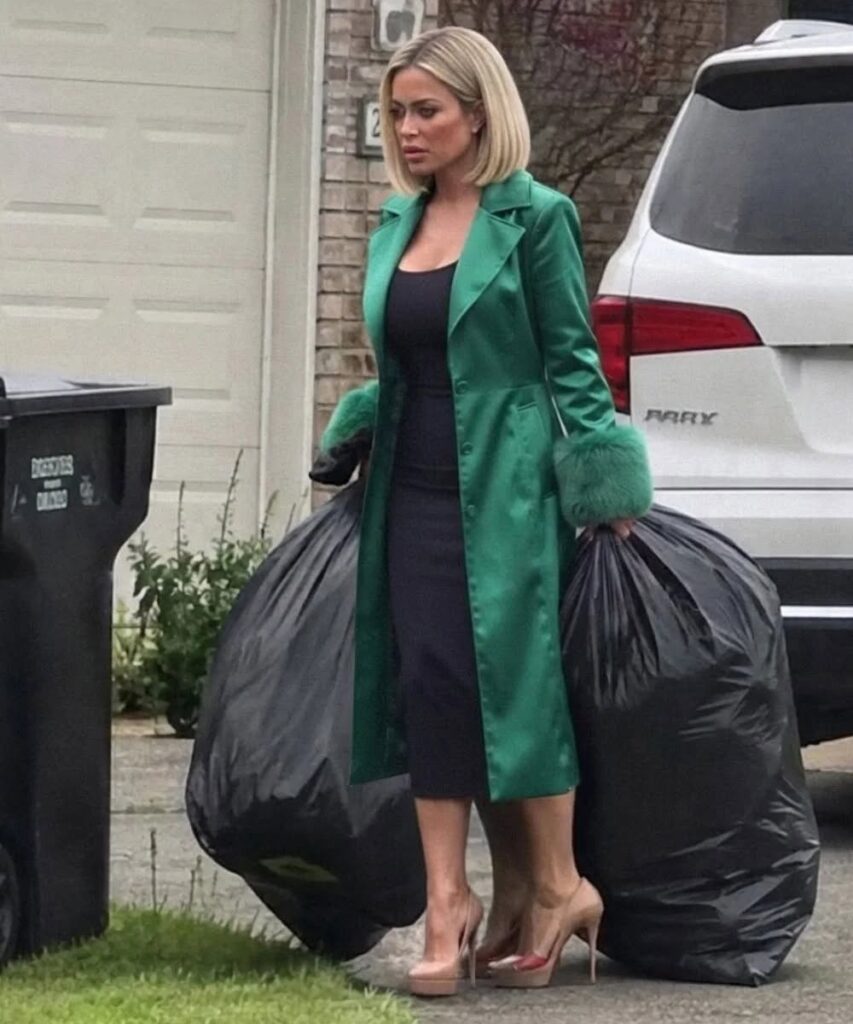
For weeks, I watched from our kitchen window.
At first, I was only curious.
Then I opened one of the bags.
What I found inside made me believe Barbara was hiding something terrible.
I could not have been more wrong.
Barbara lived directly across the street from my wife, Anna, and me.
Her house was one of the most beautiful on the block, with white shutters, trimmed hedges, and a garden that seemed untouched by weeds or weather.
Her silver SUV was always polished.
Her clothes were elegant.
Even when she collected the mail, she looked as though she were on her way to an important lunch.
Then the bags began appearing.
One or two every morning.
They were heavy black contractor bags, tied carefully at the top. Around eight, an unmarked truck would stop, collect them, and disappear.
There were no construction workers at Barbara’s house.
No cleaning company.
No signs that she was renovating or moving.
Still, the bags kept coming.
Anna noticed something else.
“She’s losing weight,” she said one morning.
I barely looked away from the window.
“She has always been thin.”
“Not like this.”
Barbara was crossing the driveway with another bag.
The morning was warm, but she wore a silk scarf around her head.
“She’s been wearing scarves every day,” Anna continued. “Even when it’s hot.”
I shrugged.
I was more interested in what she was throwing away than in why she looked ill.
That is difficult for me to admit now.
One Tuesday morning, Barbara placed two bags near the curb and drove away before the collection truck arrived.
I stood at the window watching them.
Anna noticed.
“Don’t,” she said.
“I’m only going outside to check the mail.”
“The mail does not come until this afternoon.”
I reached for the door.
“Maybe something fell out.”
“Nothing fell out.”
She knew exactly what I intended to do.
So did I.
I crossed the street anyway.
The larger bag was tied with a double knot.
For a few seconds, I stood over it feeling ashamed.
Then curiosity defeated whatever remained of my good judgment.
I loosened the knot and opened the bag.
The first thing I saw was a pink cardigan.
Beneath it lay a denim jacket with a butterfly patch sewn onto the pocket.
There were jeans, sneakers, school notebooks, novels, costume jewelry, and several folders decorated with stickers.
Near the bottom was a worn stuffed rabbit with one ear partly detached.
Then I found the photographs.
There were three framed pictures of the same teenage girl.
In one, she stood beside the ocean with her hair blowing across her face.
In another, she sat at a piano.
The last showed her leaning toward a birthday cake covered with sixteen candles.
On the back of the frame, someone had written one name.
Emily.
A cold feeling moved through me.
Barbara lived alone.
I had never seen a young girl enter or leave her house.
My imagination began creating explanations before I had learned a single fact.
Why did Barbara have a teenager’s possessions?
Why was she throwing them away?
Why had I never heard of Emily?
By the time I returned home, I had convinced myself the bag contained evidence of something dark.
Anna took one look at my face.
“You opened it.”
“There were a girl’s belongings inside.”
She closed her eyes.
“You had no right.”
“There were photographs too. Her name was Emily.”
“That does not mean anything terrible happened.”
“Barbara does not have a daughter living with her.”
“The more important issue is that you searched through her private belongings.”
She was right.
I knew she was right.
But shame did not erase my curiosity.
That afternoon, we visited Mrs. Patterson, who had lived on our street for more than thirty years.
She was watering flowers beside her porch when I mentioned Emily’s name.
Her expression changed immediately.
“Where did you hear that name?”
I hesitated.
Anna answered before I could invent a kinder explanation.
“He opened one of Barbara’s bags.”
Mrs. Patterson stared at me.
I lowered my eyes.
“I know I should not have.”
“No,” she said. “You should not have.”
Then she set down the watering can.
“Emily was Barbara’s daughter.”
The words settled heavily between us.
“She died eleven years ago,” Mrs. Patterson continued. “She was sixteen.”
I looked toward Barbara’s house.
“What happened?”
“Emily and Barbara argued one evening. It was a terrible argument. Emily ran out of the house and walked along the highway.”
Mrs. Patterson paused.
“A drunk driver struck her.”
Anna covered her mouth.
“Barbara has a son too,” Mrs. Patterson said. “David. He blamed her for Emily’s death.”
“Why?”
“Because of the argument. He left for college the following year and never came home.”
“And Barbara?”
“She blamed herself too.”
According to Mrs. Patterson, Emily’s bedroom had remained locked since the funeral.
No one entered it.
Nothing was moved.
For eleven years, Barbara lived across from that closed door.
That night, I could not stop thinking about the bag.
The clothes.
The photographs.
The stuffed rabbit.
“She’s erasing her,” I said.
Anna looked up from her book.
“You do not know that.”
“What kind of mother throws away her dead daughter’s belongings?”
“A grieving one.”
Her answer came quickly.
“A mother who may be drowning in memories. A mother whose health is clearly failing. A mother whose private pain you turned into a mystery for your own entertainment.”
I flinched.
Anna rarely spoke to me that sharply.
But I deserved it.
“Stop judging her,” she said. “We do not understand what she is facing.”
Two mornings later, a heavy thud came from across the street.
Anna reached the window first.
Barbara had collapsed beside the curb.
She was down on one knee, gripping the top of another black bag as though it were the only thing keeping her upright.
We ran outside.
“I am fine,” she insisted when we reached her.
She was not fine.
Up close, her skin looked gray beneath carefully applied makeup.
Her scarf had slipped to one side, revealing patches where her hair had fallen out.
She seemed far smaller than the woman I had watched from our window.
Together, Anna and I helped her into the house.
The interior was immaculate.
Everything had a place.
Every surface shone.
But medicine bottles covered the kitchen counter.
A calendar on the refrigerator was filled with hospital appointments, blood tests, scans, and treatment sessions.
Barbara lowered herself into a chair.
Her breathing remained shallow.
Anna brought her water.
I stood near the table, unable to carry my guilt any longer.
“There is something I need to tell you.”
Barbara looked at me.
“I opened one of your bags.”
Her expression hardened.
“You did what?”
“I crossed the street after you left and opened it.”
Anger flashed across her face.
“You had no right.”
“I know.”
“You searched through my daughter’s belongings?”
The shame in my chest became almost unbearable.
“Yes.”
“Why?”
“Because I was curious.”
The honesty sounded uglier when spoken aloud.
“I am deeply sorry.”
Barbara turned away from me.
For several moments, the only sound in the kitchen was the ticking of a clock above the stove.
Anna sat beside her.
“Barbara,” she said gently, “are you ill?”
Barbara touched the scarf covering her head.
“Stage-four ovarian cancer.”
Anna reached for her hand.
Barbara looked toward the calendar.
“The doctors believe I have one or two months.”
I felt the room tilt around me.
All those mornings, I had been watching a dying woman struggle with bags and wondering what secret she was hiding.
I had never once crossed the street to ask whether she needed help.
Barbara took a sip of water.
“My son is coming home on Saturday.”
“David?” Anna asked.
Barbara nodded.
“He has not stepped inside this house in eleven years.”
She looked toward the staircase.
“He is coming to say goodbye.”
The bags, she explained, did contain Emily’s belongings.
But most of them were not going to a landfill.
The clothes, books, jewelry, and school supplies were being collected by a charity that helped teenage girls from struggling families.
The bags marked with green tags went to the charity.
Only damaged or unusable items were discarded.
“And the photographs?” I asked quietly.
“Duplicates.”
Barbara’s voice became firm.
“I would never throw away the only photographs of my daughter.”
Heat rose into my face.
I had built an entire cruel story around a single bag I had no right to open.
Anna asked the question I was afraid to raise.
“Why are you clearing Emily’s room now?”
Barbara wrapped both hands around her glass.
“David has avoided that room since she died. He will be losing me soon. I thought emptying it would spare him from losing Emily again at the same time.”
Anna remained silent for a moment.
Then she asked, “Did David say he wanted the room emptied?”
Barbara looked surprised.
“No.”
“Did you ask him?”
“No.”
“Then how do you know an empty room will be easier for him?”
Barbara’s eyes narrowed slightly.
“I am his mother. I am trying to protect him.”
“I understand.”
Anna’s voice stayed gentle.
“But grief does not make us mind readers. You may be choosing for him because asking what he wants is more frightening.”
Barbara looked down.
Tears gathered in her eyes.
For the first time, I understood that her plan was not cruel.
But it was not entirely selfless either.
It was fear disguised as protection.
She was dying.
Her estranged son was returning.
Emily’s room held the pain that had separated them for more than a decade.
Barbara wanted to control at least one final thing.
“How much is left?” I asked.
“The closet. Several boxes. A cabinet in the attic.”
“Let us help you.”
Barbara wiped her cheek.
“But do not empty the room before David sees it,” I added. “Give him the choice I tried to take away from both of you by opening that bag.”
She looked toward the staircase.
“It is difficult for me to enter.”
Anna squeezed her hand.
“You will not enter alone this time.”
That afternoon, Anna, Mrs. Patterson, and I joined Barbara upstairs.
The door to Emily’s room creaked when Barbara unlocked it.
I had expected a perfectly preserved bedroom, frozen in time like a museum.
It was not.
Dust coated the dresser.
The curtains had faded from sunlight.
Boxes were stacked against one wall.
The bedspread had lost its brightness.
Time had entered the room even when no one else had.
Barbara sat on the edge of the bed while we began sorting.
We created four groups.
Items for donation.
Damaged things that could not be saved.
Belongings Barbara wanted to keep.
And things David should decide about himself.
The fourth group quickly became the largest.
Whenever Barbara tried to discard something personal, Anna gently stopped her.
“That should be David’s choice.”
Barbara nodded, though sometimes reluctantly.
As we worked, she began telling stories.
She held up a small silver medal.
“Emily won this in soccer when she was twelve. She hated practice but loved competing.”
From a box, she removed a science-fair ribbon.
“She made a volcano once. The mixture reached the ceiling. I found red food coloring on the light fixture for years.”
For the first time, Emily became more than the girl in the photographs.
She had been funny.
Stubborn.
Curious.
Confident.
She loved music but hated practicing scales.
She enjoyed science experiments and terrible jokes.
She argued with her mother because she was sixteen.
Neither of them knew it would become their final conversation.
Barbara found a silver necklace tangled inside a jewelry box.
“She wore this almost every day.”
“Keep it,” Anna said.
Barbara pressed it against her palm.
“For David,” she answered.
By Friday evening, the room looked cleaner.
But it had not been erased.
The bed remained.
Several books stayed on the shelves.
Framed photographs sat on the dresser.
The faded curtains still moved gently beside the open window.
One shelf held a careful collection of objects that told the story of the girl who had lived there.
Barbara stood in the doorway.
“I thought an empty room would be kinder.”
Anna slipped an arm around her shoulders.
“Sometimes kindness means leaving the door unlocked.”
The next morning, a silver car turned into Barbara’s driveway.
A tall man stepped out.
He remained beside the car for several moments, staring at the house as though it belonged to someone else.
Then Barbara opened the front door.
David crossed the lawn.
When he reached her, he did not speak.
He simply wrapped his arms around his mother.
She held him with both hands, pressing her face into his shoulder.
They stood that way for a long time.
Later that afternoon, David came to our house.
His eyes were red.
“My mother said you helped with Emily’s room.”
Anna nodded.
“I went upstairs,” he said. “I sat on her bed for almost an hour.”
“Was it too painful?” she asked.
“Yes.”
He took a shaky breath.
“But I needed it.”
That evening, Barbara invited us over.
David sat at the kitchen table surrounded by photographs, medals, notebooks, and small pieces of his sister’s life.
For a while, no one knew how to begin.
Then David spoke.
“I blamed Mom for eleven years.”
Barbara stared at her hands.
“Emily left because they argued,” he continued. “So I convinced myself Mom caused everything.”
Barbara’s voice was barely audible.
“I told her that if she hated living with me so much, she should leave.”
David’s jaw tightened.
“She was sixteen.”
“I know.”
“You should never have said that.”
“I know.”
Barbara’s voice broke.
“I said something terrible in anger. I have heard those words in my head every day since.”
She looked at her son.
“But I did not put that driver on the road. I cannot die believing that I killed her.”
Silence filled the kitchen.
David looked away.
For eleven years, he had carried his anger like proof of his love for Emily.
Releasing it probably felt like betraying her.
Then he reached across the table.
He placed his hand over his mother’s.
“I know it was not your fault.”
Barbara looked up.
“I blamed you because anger was easier than grief,” he said. “If it was your fault, then I had someone to punish.”
His voice shook.
“But the truth is that a drunk driver killed Emily.”
Barbara began to cry.
David tightened his hand around hers.
“I came home, Mom.”
During the next two months, David stayed.
He drove Barbara to medical appointments.
Anna prepared meals.
Mrs. Patterson cared for the garden.
I washed Barbara’s silver SUV because she still disliked seeing dust on the hood.
Some mornings, Barbara and David sat together in Emily’s room.
Other days, they left the door closed.
But they finally spoke about her.
They remembered her laughter.
Her stubbornness.
Her terrible piano practice.
Her science experiments.
Her birthdays.
And the argument that had haunted them both.
The argument did not disappear.
It simply stopped being the only memory they shared.
Barbara died in early September.
David was beside her.
He had been able to tell her he loved her.
More importantly, he had told her that Emily’s death was not her fault.
After the funeral, David decided not to sell the house.
He lived in the city, but he wanted the home to remain a place he could return to.
A place where memories of his mother and sister could exist together.
The joyful ones.
The painful ones.
The unfinished ones.
When I looked across the street after Barbara’s death, I no longer saw the mysterious woman carrying suspicious black bags.
I saw a grieving mother who had loved both of her children deeply but had spent years trying to carry every decision alone.
She tried to protect David by deciding what he should lose.
In the same way, she had spent years deciding which parts of her own sorrow the world was allowed to see.
In the end, Barbara opened Emily’s locked room.
More importantly, she opened herself to her son.
I learned something as well.
Curiosity without compassion can become cruelty very quickly.
I had looked inside Barbara’s bag and believed I had discovered her secret.
In truth, I had found only one small piece of a story far more complicated than anything I could have imagined.
The belongings were not proof that Barbara wanted to erase her daughter.
They were proof of a dying mother desperately trying to spare her son more pain.
She was wrong to make that decision without him.
But she was given enough time to change it.
By leaving part of Emily’s room intact, Barbara allowed David to choose what he needed to keep, what he could release, and when he was ready to do either.
The room had remained locked for eleven years because both mother and son were afraid of the grief waiting inside.
When they finally opened the door, the pain did not disappear.
But it became something they no longer had to carry alone.