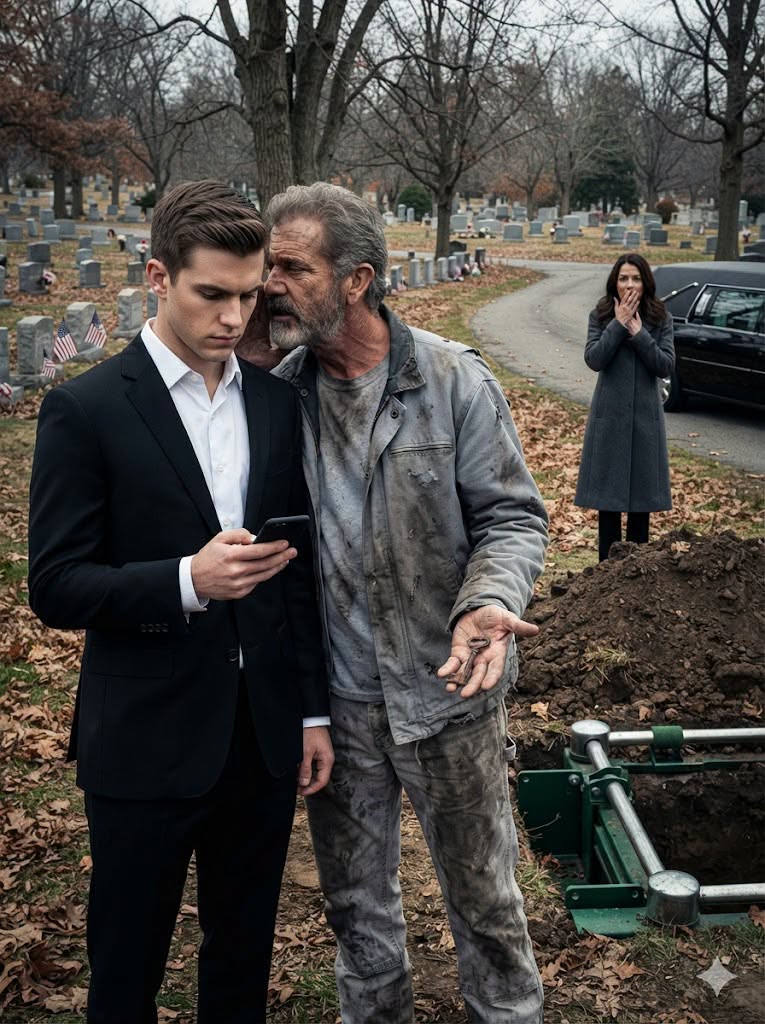
“Your mother paid me to bury an empty casket.”
For a moment, I could not understand him.
My mother had supposedly died six days earlier. I had identified her. I had planned the service. I had chosen the flowers, spoken to relatives, accepted condolences, and stood there with grief sitting like stone inside my chest.
Before I could ask another question, my phone buzzed.
A text message appeared.
It was from my mother.
Go home alone.
I stared at the screen until the letters blurred.
The mourners were still nearby. The casket was still being lowered. People were still wiping their eyes for a woman who, somehow, might not be inside it.
I put the brass key in my purse and drove straight to the storage facility.
Unit 16 sat at the far end of the property, beneath a flickering light. My hands shook as I unlocked it.
Inside were shelves of basic supplies: bottled water, canned food, blankets, batteries, a first aid kit. Near the back sat my mother’s navy handbag and a legal file box.
A handwritten note was pinned to the bag.
People have lied. Take the red folder. Do not wait.
My mouth went dry.
I opened the file box and found the folder exactly where she said it would be.
Then I heard footsteps outside.
A man’s voice came through the metal door.
“Open up.”
I froze.
He said he knew I was inside. He said my mother was gone because she had stopped cooperating with Richard Hale, her boss. His tone was not grief, not concern, not confusion.
It was a warning.
I remembered the note.
Do not wait.
Behind the shelving, I found a narrow opening cut through the chain link at the back of the unit, hidden behind a tarp. My mother had planned even this.
I grabbed the red folder, pushed through the opening, and ran.
By the time I reached the highway, my phone buzzed again.
Find Daniel Brooks. County Recorder’s Office.
I drove there without stopping.
Daniel Brooks was waiting at his government desk as if he had been expecting me for days. His face was tired, but kind. He handed me another letter, written by my mother three weeks earlier.
In it, she explained everything she had been too afraid to say before.
Her boss, Richard Hale, had been stealing client funds through Lawson Financial. When she discovered the fraud, she began copying records. Spreadsheets. Transfers. Property documents. Messages. Names.
Then Richard found out.
He threatened her.
Worse, he threatened me.
My mother believed that if she simply disappeared, Richard would keep searching. But if he believed she was dead, and if everyone else believed it too, we would have a small window of safety.
So she staged her funeral.
Not to abandon me.
To give me time.
Daniel and I opened the hidden flash drive from the storage unit. The files were organized with the careful precision I knew from my mother: folders labeled by date, transaction, property, and contact.
The evidence was larger than either of us expected.
It did not point only to Richard Hale. It linked Lawson Financial to stolen client funds, suspicious property transfers, and communication with local officials who seemed to have protected the scheme for years.
Daniel did not pretend this was something we could handle quietly.
He contacted a federal financial crimes agent named Audrey Marsh.
By that evening, the red folder and the flash drive were in the hands of people who knew how to act on them.
Within forty-eight hours, Richard Hale and several associates were arrested.
The news spread quickly. People called it shocking. A financial scandal. A web of corruption. A betrayal of public trust.
I heard the words, but I kept thinking of my mother’s empty casket.
Nine days after the arrests, my phone rang.
This time, it was not a text.
It was her voice.
She was in Arizona, living under federal protection. She sounded older than she had six days before her funeral. Smaller somehow. But alive.
I cried so hard I could barely answer.
For months, she remained hidden while the case unfolded. When she finally came home, we sat at my kitchen table across from each other like two people returned from different kinds of death.
I wanted to be grateful and angry at the same time.
So I was.
I told her what it felt like to identify her, bury her, and stand beside a grave believing I had lost the only parent I had left. I told her that fear may explain her choices, but it did not erase the wound they left behind.
She listened without defending herself.
Then she reached across the table and took my hand.
“I was trying to keep you alive,” she said. “But I know I hurt you.”
That honesty did not fix everything immediately.
Trust, once shaken by love itself, needs time to find its footing again.
But the truth was finally between us. Not hidden in folders, not locked in storage, not disguised as a funeral.
My mother’s choices had been desperate. They had cost me days of grief I should never have had to carry. But they had also exposed a dangerous man, protected stolen clients, and likely saved both our lives.
I keep the brass key on my dresser now.
Not as a souvenir.
As a reminder.
Love can become complicated when fear enters the room. Protection can wound when it hides the truth too deeply. And sometimes the people who love us make choices we can understand only after the danger has passed.
That key reminds me of the storage unit.
The red folder.
The empty casket.
The mother I grieved before I got her back.
And the painful mercy of a truth that arrived late, but arrived in time.