Then she called me a sad single mother.
She said I had mistaken showing up alone for confidence.
The room laughed.
Not everyone, perhaps. But enough.
I felt my face grow hot. My hands tightened in my lap. Beside me, my nine-year-old son Ethan sat very still, listening to every word.
I looked toward Caleb.
He stared down into his drink.
Then my mother joined in.
Loudly, she compared me to a clearance item with a torn tag, saying no one wanted the trouble of dealing with me.
More laughter.
Something inside me sank.
Not because I believed them, but because Ethan was hearing people who shared our blood speak of me as if I were something damaged and unwanted. A child should never have to watch adults turn cruelty into entertainment, especially not against the person who loves him most.
I stood, ready to leave quietly.
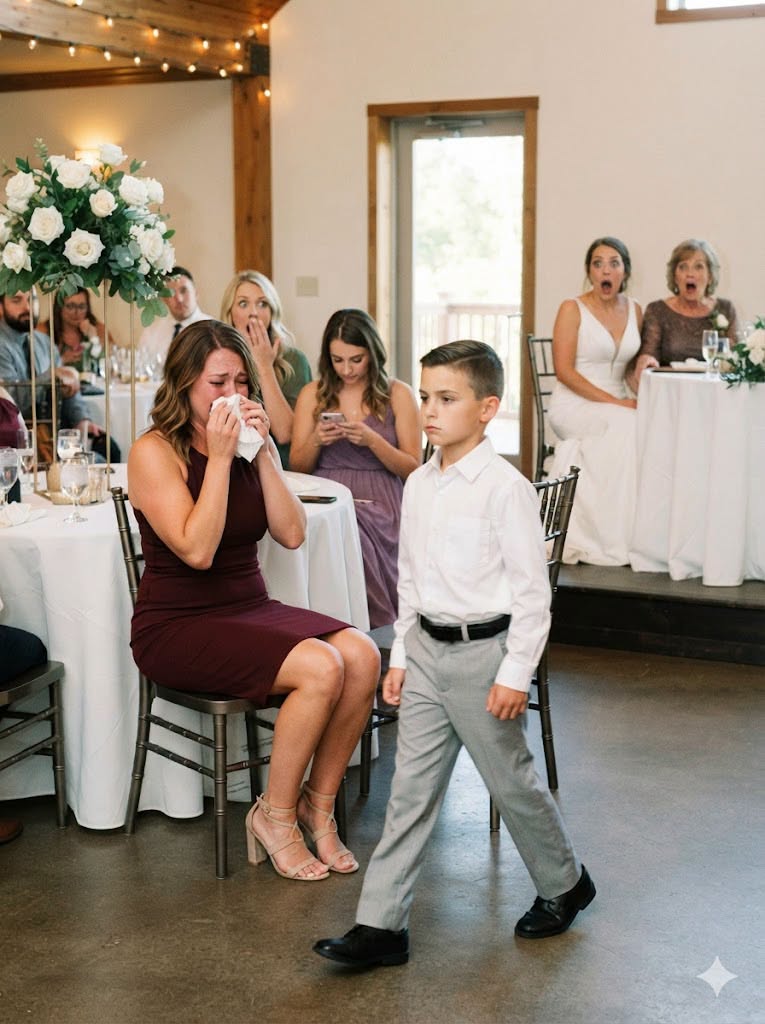
Before I could move, Ethan pushed his chair back.
The sound cut through the laughter.
He walked straight toward the stage.
For a moment, no one seemed to understand what was happening. Tiffany held the microphone, confused, as my son stood in front of her with tears in his eyes and his chin lifted.
“Can I say something?” he asked.
The room went quiet.
Tiffany hesitated, then handed him the microphone.
Ethan turned toward the guests.
“My mom is not a clearance item,” he said.
His voice shook, but he did not stop.
“She is the only person who never made me feel unwanted.”
The silence changed.
He looked out at the room full of adults who had laughed.
“She works two jobs. She takes care of me when I’m sick. She helps me with school even when she’s tired. She gives me the last piece of food when she thinks I don’t notice. She does everything for me.”
Then he looked toward my mother and Caleb.
“You’re supposed to be our family,” he said. “Why would you treat her like trash?”
No one laughed then.
An older woman near the back stood up and said, “That boy is the only decent person in this room.”
Then she began clapping.
Slowly, others joined her.
Within moments, half the hall was on its feet, applauding my son while he stood on the stage trying not to cry.
I rushed to him and wrapped my arms around him.
“You did nothing wrong,” I whispered. “Nothing.”
He buried his face against me, and I held him as tightly as I could.
The applause faded when Caleb took the microphone.
For one brief second, I thought he would try to smooth things over, make it harmless, ask everyone to move on.
Instead, he looked at Tiffany.
“What you did was cruel,” he said.
His voice was low, but firm.
Then he turned toward our mother.
“And you made it worse. You humiliated your own daughter in front of her child.”
My mother opened her mouth, but Caleb did not let her interrupt.
“This reception wasn’t ruined by Ethan,” he said. “It was ruined by adults who forgot what decency looks like.”
The room remained painfully still.
Tiffany’s face hardened. She threw her bouquet onto a chair and stormed away. Guests began leaving quietly, some avoiding my eyes, others offering small apologies that could not undo what had already been said.
I took Ethan home.
That night, my mother called and said it had only been a joke.
I did not accept that.
A joke does not leave a child trembling on a stage because he feels he has to defend his mother from her own family.
A joke does not teach a boy that cruelty is acceptable if enough people laugh.
I told her we needed distance.
Then I blocked her.
Two days later, Caleb came to my house.
He stood on the porch with red eyes and no excuses.
He apologized.
Not perfectly, not dramatically, but sincerely. He admitted he had been a coward. He said he had spent too long letting our mother speak cruelly because confronting her felt harder than staying silent. He told me Tiffany had moved out before they had even filed the marriage license.
I listened.
Trust does not return simply because someone feels regret. But Caleb had finally named what he had done, and that mattered.
So I let him sit on the porch.
Later, I let him speak to Ethan.
Slowly, carefully, they began rebuilding something. Not by pretending the wedding had not happened, but by being honest about it.
My mother did not receive the same place in our lives.
Not because I wanted revenge, but because protecting my son mattered more than preserving appearances. He had already seen enough cruelty dressed as family.
Months later, I sat in a school auditorium and watched Ethan receive a kindness award.
He walked onto the stage in a clean shirt, nervous but proud, while teachers, parents, and students clapped for him.
This time, the room was not laughing at pain.
It was honoring goodness.
I watched my son smile and felt something inside me settle.
That wedding had hurt. It had exposed people I wanted to believe would love me better. It had shown me how deeply silence can wound when it comes from those who should have stood beside you.
But it also showed me something stronger.
I was not unwanted.
I was not alone.
I was loved by a boy brave enough to speak truth in a room full of adults.
And from that day forward, I promised myself that Ethan would never have to defend my dignity because I had failed to protect our peace.
We would build a life where love did not come with mockery.
Where family meant safety.
And where no one’s cruelty would ever again be allowed to call itself a joke.