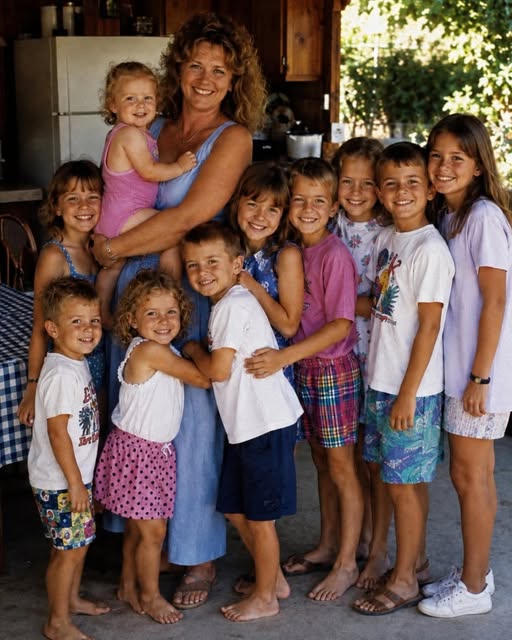
The note was brief, a cruel dismissal of a life they had carefully constructed: “I’m sorry. I can’t do this anymore.” Those words hung in the air like a suffocating shroud. While her relatives urged her to hand the children over to the state, insisting that she had no obligation to a man who had abandoned his own blood, Margaret looked into the eyes of those ten children and saw only her own reflection of grief. She could not walk away.
The years that followed were a relentless marathon of survival. Margaret took on extra shifts, mended worn-out clothes, and navigated the biting judgment of a community that viewed her choice as a form of insanity. Her parents, unable to comprehend why she would sacrifice her youth and prospects for children who were not legally hers, eventually stopped calling. Men who might have offered companionship vanished the moment they realized the scale of her responsibility. She was alone, yet she was never truly solitary.
She learned to stretch a single chicken into a week of meals and found joy in the small, chaotic victories of raising ten distinct personalities. There were birthdays marked by homemade cakes and graduations celebrated with tears of pride. She became the anchor in a storm of their collective growing pains. Every night, she would tuck them in, whispering promises of security that she wasn’t always sure she could keep. Through it all, the memory of Robert remained a jagged, unhealed wound in her heart.
She recalls the specific sting of those early winters, when the furnace rattled and the bills piled up like snowdrifts against the door. She had to be both mother and father, disciplinarian and comforter, all while nursing the secret hope that perhaps, one day, he would return to explain himself. But the silence remained absolute. She became a pillar of strength, not because she was inherently strong, but because she had no other choice. The children were her life, her purpose, and her salvation.
Thirty years of silence passed. The children grew into adults, carving out their own paths, yet they remained tethered to the home Margaret had built. They returned every weekend, filling the rooms with the laughter of grandchildren and the warmth of shared history. It was on one of these ordinary, sun-drenched Saturdays that the rhythm of her life was interrupted by a sharp, rhythmic knocking at the front door. A man in a somber suit stood on the porch, holding an envelope.
He introduced himself as Robert’s lawyer, his voice clipped and professional. He handed over the heavy cream-colored envelope, stating that it was the final wish of a man who had recently passed away. Before Margaret could even process the shock of the name, the man turned and walked away, leaving her standing on the threshold of a past she thought she had buried. The children, sensing the shift in the air, gathered around her in the quiet kitchen.
Her hands trembled as she broke the seal. The letter was written in a hand she recognized instantly, though the script was shakier than she remembered. As she read the opening lines, the world seemed to tilt. Robert had not left because he stopped loving her or the children. He had been diagnosed with a terminal illness, a condition that promised a slow, agonizing decline. He feared that if he stayed, he would leave her a widow burdened by debt and the trauma of watching him fade away.
He had fled to spare them the sight of his disintegration. For three decades, he had lived in the shadows, working through the very lawyer who now stood before her. He had secretly established a trust fund that had quietly paid for the children’s education and the unexpected emergencies that had threatened to break them. He had watched them from afar, hiring people to keep him updated on their milestones, his heart tethered to the home he had abandoned to save them. He wrote of his regret for the pain he caused, yet he insisted that his absence was the only way he knew how to ensure their future stability.
The silence in the room was profound as Margaret finished the letter. The resentment she had nurtured for thirty years, the bitterness that had acted as a shield against the world, began to dissolve. She looked at the faces of her children—strong, capable, and loved—and realized that Robert’s sacrifice, however misguided and painful, had been an act of desperate, protective love. He had chosen to be the villain in their story so that they might have a chance at a better one.
She didn’t cry out in anger or collapse in despair. Instead, she felt a strange, quiet peace settle over her shoulders. The weight she had carried for so long, the burden of being the sole provider and the abandoned fiancée, finally slipped away. She looked at the empty chair at the head of the table, not with the sting of rejection, but with a newfound understanding of the man who had loved them enough to disappear forever. They had survived, and in the end, they were whole. She finally understood the depth of his devotion, and her, enduring devotion.