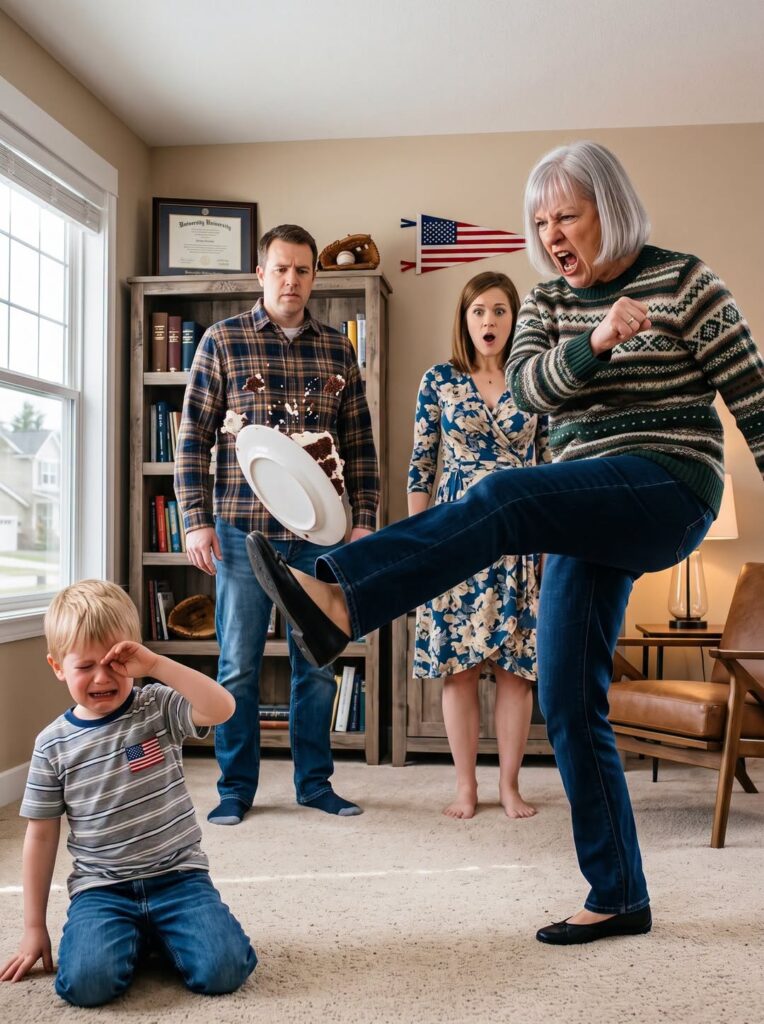
The air grew thick with the cloying scent of spilled blackberry cobbler and the sharp, metallic tang of rising panic. As I knelt to shield Luke from the sight of his grandmother’s cold, unyielding gaze, the boy’s breathing hitched, turning into a series of shallow, ragged gasps that sounded far too fragile for his small frame. He clutched his chest, his tiny fingers digging into the fabric of his white shirt, his face draining of all color until he looked like a porcelain doll about to fracture. Brandon, my husband, stood frozen for a heartbeat, his eyes darting between his mother’s smug, composed expression and the terrifying reality of our son’s distress. The guests, once animated and vibrant, now stood as statues, their eyes wide with a mixture of horror and disbelief at the scene that had unfolded before them. I felt a surge of protective fury that momentarily eclipsed my own fear, but it was quickly replaced by the overwhelming need to reach the hospital.
“Luke, look at me,” I whispered, my voice thick with unshed tears, as I tried to soothe the frantic rhythm of his heart. He couldn’t speak; he could only stare at me with wide, terrified eyes, his mouth open in a silent plea for help. Brandon finally snapped out of his shock, his movements becoming frantic as he swept Luke into his arms. He didn’t look at his mother; he didn’t offer her a final word of condemnation. He simply turned his back on the woman who had just shattered our family’s peace and sprinted toward the car, his boots thudding heavily against the stone walkway. I followed close behind, my mind racing through a thousand worst-case scenarios, each one more devastating than the last.
The drive to the hospital was a blur of neon signs and blurred traffic, with Brandon gripping the steering wheel so tightly his knuckles turned white. Luke’s condition seemed to worsen with every mile; his skin became clammy and cool to the touch, and his small, rhythmic gasps turned into a terrifying, labored wheezing. I kept talking to him, telling him stories of the park, of his favorite toys, of anything that might keep his spirit anchored to this world, even as my own heart hammered against my ribs in a frantic, uneven cadence. When we finally reached the emergency room, the triage nurses moved with a speed that confirmed my deepest fears. They whisked him away behind heavy double doors, leaving Brandon and me in a sterile, fluorescent-lit waiting room that felt miles away from the warmth of our home.
Hours bled into one another as we sat in uncomfortable plastic chairs, the silence between us heavy with the weight of what had been said on that patio. Brandon’s face was a mask of grief and confusion, his hands shaking as he stared at the floor. He kept repeating his mother’s words, trying to make sense of the venom she had spewed. It wasn’t just the cruelty of the act; it was the implication behind her cold, calculated rejection. We had always known she was a difficult woman, but this was something entirely different. The suspicion she had planted in the air felt like a poison, one that threatened to unravel the very foundation of our marriage and our understanding of our own lives. We sat in the fluorescent hum, waiting for a verdict on our son’s life while the echoes of the patio confrontation played on a loop in my mind.
Finally, a doctor emerged, his face etched with a gravity that made my stomach drop. He led us into a small, private consultation room, the walls painted a soothing shade of blue that felt mocking in the face of our anxiety. He explained that Luke had suffered a severe, stress-induced cardiac episode, a rare reaction in a child so young, but one that had been exacerbated by an underlying, previously undiagnosed congenital heart condition. The shock of the incident had acted as a trigger, forcing his fragile system to the brink of collapse. As the doctor spoke about surgeries and long-term monitoring, I realized that the physical damage was only the beginning of our journey. The emotional scars left by that afternoon would linger long after his heart had been mended.
Later that evening, as Luke slept soundly under the hum of the monitors, Brandon and I stood by the window, watching the city lights flicker in the distance. He reached out and took my hand, his grip firm and grounding. He told me that he had spent the last few hours reflecting on his mother’s behavior, not just today, but over the years. He realized then that her bitterness wasn’t about us or our son; it was a manifestation of a deep-seated, lifelong resentment that she had cultivated to protect herself from her own failures. She had chosen to live in a world of her own making, one where she was the perpetual victim, and anyone who threatened that narrative—like an innocent child seeking love—became an enemy to be destroyed. We decided then and there that our lives would no longer be dictated by her toxicity. We would focus entirely on Luke’s recovery, shielding him from the darkness she represented. The path ahead would be difficult, but as I looked at my son’s peaceful face, I knew we would be enough. The broken bowl was a symbol of her cruelty, but it would not be the end of our story. We were a family, and that was a truth no amount of malice could ever truly break.