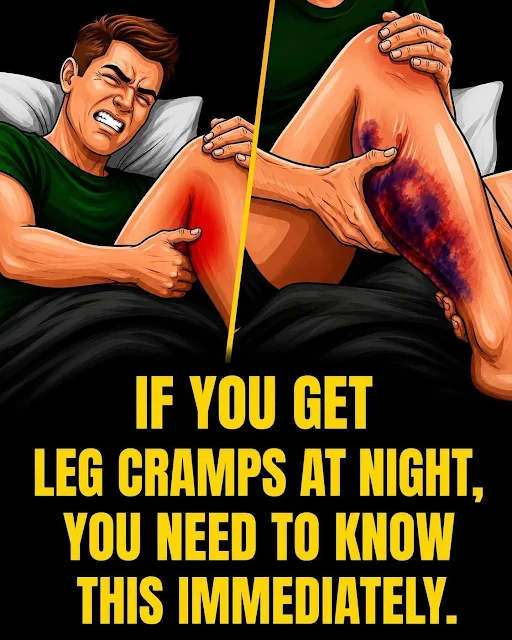
A nocturnal leg cramp is a sudden, painful and involuntary tightening of a muscle during the night. It usually affects the calf, although the muscles of the foot or thigh can also tighten.
The cramp may last only a few seconds or continue for several minutes. During that time, the muscle can feel hard, twisted or visibly knotted. Some people experience tenderness for hours afterward.
Nighttime leg cramps become more common with age and frequently occur in otherwise healthy middle-aged and older adults.
They are different from restless legs syndrome. Restless legs usually creates an uncomfortable urge to move the legs, while a true leg cramp involves a muscle suddenly contracting and refusing to relax.
Why Do Leg Cramps Happen at Night?
In many cases, there is no single identifiable cause.
Medical experts believe muscle fatigue and changes in the nerves controlling the muscles may play a role. Cramps may also be more likely after an unusually active day, prolonged sitting or standing, or holding the leg in one position for too long.
Other possible contributors include:
- Dehydration, especially after exercise or time spent in hot weather
- Low levels of certain minerals, including potassium, calcium or magnesium
- Overworked, strained or unusually tight muscles
- Pregnancy
- Certain medicines, including some diuretics and cholesterol-lowering medicines
- Nerve, kidney, thyroid or blood-flow disorders
A nighttime cramp does not automatically mean that you are dehydrated or deficient in magnesium. Because the cause is often unknown, repeatedly taking supplements without medical guidance may not address the real problem.
Instead, look for patterns. Did the cramps begin after starting a new medicine? Do they follow long walks, yard work or hours spent standing? Are they occurring together with numbness, weakness or swelling?
Those details can help a healthcare professional determine whether further evaluation is needed.
Does a Leg Cramp Mean Poor Circulation?
This is one of the most common fears, particularly among older adults.
Circulation problems can sometimes cause pain or cramping in the legs. However, an isolated cramp that appears during sleep and disappears after stretching is not, by itself, proof of poor circulation.
Problems such as peripheral artery disease more often cause discomfort while walking or exercising because the muscles are not receiving enough blood. The discomfort may improve after resting.
A blood clot in a deep leg vein can cause calf pain, but it is more likely to be accompanied by swelling, warmth or tenderness—usually affecting one leg.
The important lesson is not to panic over every cramp, but not to ignore meaningful changes either.
Wisdom often lies between those two extremes.
What to Do When a Cramp Strikes
When your calf suddenly tightens, your first instinct may be to curl your leg or remain completely still. Gently lengthening the cramped muscle usually works better.
Straighten the affected leg and slowly pull your toes upward toward your shin. Hold the position without bouncing until you feel the muscle begin to release.
You can also:
- Stand carefully and place some weight on the affected leg
- Massage the tightened area with your hands
- Walk slowly around the room once it is safe to do so
- Use a warm towel, heating pad or warm shower to relax the muscle
- Apply a wrapped cold pack later if the muscle remains sore
- Drink some water, particularly if you may be dehydrated
Stretching the affected muscle is one of the most commonly recommended ways to relieve an ordinary cramp.
Avoid forcing the stretch so aggressively that you cause another injury. The movement should be firm but controlled.
How to Reduce Nighttime Leg Cramps
No method can guarantee that a cramp will never return, but a few simple habits may reduce how often they happen.
Stretch before going to bed
Stand facing a wall with your hands against it. Place one foot behind the other, keep the back heel on the floor and gently lean forward. You should feel a mild stretch through the calf.
Hold the stretch, relax and repeat on the other side.
Regular calf stretching before bed is recommended by several medical sources for people who experience nighttime cramps.
Stay reasonably hydrated
Drink fluids throughout the day, especially during hot weather or after physical activity. You do not need to force excessive amounts of water, but persistent dehydration can make muscle problems more likely.
Increase activity gradually
A long walk, hours of gardening or a demanding workout may overwork muscles that are not accustomed to that level of activity. Give your body time to adjust.
Wear supportive footwear
Shoes that fit properly and support your feet may reduce unnecessary strain on the lower legs.
Review your medicines
Never stop a prescribed medicine on your own. However, tell your healthcare professional if cramps began after a medication was introduced or its dose was changed.
Eat a balanced diet
A varied diet normally provides the minerals your muscles and nerves need. A clinician can order tests when an actual deficiency or another medical condition is suspected.
When a Leg Cramp Should Be Checked
Schedule a medical appointment when your cramps:
- Frequently wake you from sleep
- Are becoming more severe or more frequent
- Last longer than about 10 minutes
- Do not improve with stretching and movement
- Are accompanied by numbness, persistent swelling or muscle weakness
- Began after starting or changing a medicine
- Are interfering with your daily activities
The NHS advises seeking medical guidance when cramps repeatedly disturb sleep, last longer than 10 minutes, or occur with numbness or swelling.
Warning Signs That Need Faster Attention
An ordinary muscle cramp usually improves as the muscle relaxes. Pain caused by another condition may behave differently.
Seek prompt medical care for new pain accompanied by noticeable swelling, warmth, redness or tenderness in one leg, especially after prolonged immobility, recent surgery or a long journey.
Chest pain, sudden shortness of breath, fainting or coughing blood alongside leg swelling or pain can indicate a medical emergency and requires immediate help.
Do not attempt to diagnose a possible blood clot by massaging the painful area or waiting to see whether it disappears.
Frequently Asked Questions
What is a charley horse?
“Charley horse” is an informal name for a muscle cramp or spasm, commonly occurring in the leg.
Are nighttime leg cramps dangerous?
Most are harmless and temporary. Frequent cramps or cramps accompanied by swelling, numbness, weakness or persistent pain should be evaluated.
Does magnesium cure leg cramps?
Low magnesium can contribute to muscle problems in some people, but most nighttime cramps do not prove that a deficiency exists. Speak with a healthcare professional before taking supplements regularly, particularly if you have kidney or heart problems or take prescription medicines.
Can dehydration cause cramps?
It can contribute, particularly following exercise, heavy sweating or hot weather. However, dehydration is only one possible factor.
What is the quickest way to stop a calf cramp?
Straighten your leg and gently pull your toes toward your shin. Massage the muscle and carefully stand or walk once the pain begins to ease.
A Final Thought
That first nighttime cramp frightened me because I did not understand what my body was doing.
Learning the difference between a common muscle spasm and a genuine warning sign brought something more valuable than reassurance: it gave me a sensible plan.
We should not live in fear of every pain. But neither should we dismiss what our bodies repeatedly try to tell us.
The body is a gift entrusted to our care. Sometimes it needs nothing more than water, stretching and rest. At other times, it may be asking us to slow down, pay attention and seek help.
Have you ever been awakened by a painful leg cramp? What has helped you find relief?
This article provides general information and is not a substitute for diagnosis or treatment from a qualified healthcare professional.
{"post":105981,"page":2,"next":[{"id":105977,"title":"An Elderly Woman Asked Me to Marry Her as Her Final Wish \u2013 After She Passed Away, Her Lawyer Handed Me Her Hospital Bag and Said, \u2018She Chose You for a Reason\u2019","url":"https:\/\/new24.info\/105977"},{"id":105972,"title":"My Husband Returned from His Cruise with Shocking Surprise \u2014 He Missed One Tiny Detail That Made His Smile Disappear in Seconds","url":"https:\/\/new24.info\/105972"},{"id":105968,"title":"His Father Burned His Life, Then a Letter Arrived Years Later","url":"https:\/\/new24.info\/105968"},{"id":105957,"title":"\u201cShe Married an African Man at 21 and Left Us\u2026 But Every Year She Sent the Same Message\u201d","url":"https:\/\/new24.info\/105957"},{"id":105954,"title":"NBC and CBS Acto, at 39\u2026 -","url":"https:\/\/new24.info\/105954"},{"id":105951,"title":"At 55 Years Old, Jennifer Lopez Stuns Fans with Bold On-Stage Kiss During Pride Celebration -","url":"https:\/\/new24.info\/105951"},{"id":105946,"title":"Desperate Young Woman Escapes Abusive Stepmother And Encounters Powerful Mysterious Billionaire","url":"https:\/\/new24.info\/105946"},{"id":105942,"title":"For Twelve Years She Hid a Tiny Tattoo\u2014Then a Stranger Recognized It and Changed Everything","url":"https:\/\/new24.info\/105942"},{"id":105939,"title":"I returned home from military service, hoping to see my wife\u2019s smile. Instead, I found a coffin in the middle of the living room. \u201cShe d:ied in childbirth\u2026\u201d","url":"https:\/\/new24.info\/105939"},{"id":105930,"title":"While I was on vacation with my cousins, my phone lit up with one message: \u201cGet on a plane home. Don\u2019t tell your parents you\u2019re coming.\u201d When I landed, an attorney and two investigators","url":"https:\/\/new24.info\/105930"},{"id":105935,"title":"These are the signs that he is cr\u2026 See more -","url":"https:\/\/new24.info\/105935"},{"id":105932,"title":"THEY FINALLY ADOPTED THEIR DR -","url":"https:\/\/new24.info\/105932"},{"id":105927,"title":"My mother-in-law hid my wedding dress and left me a maid\u2019s uniform along with a note that read, \u201cKnow your place\u201d; in front of 200 guests, I wore that outfit, held my father\u2019s hand, and walked down the aisle without crying, revealing a secret that would ruin their lives forever.","url":"https:\/\/new24.info\/105927"},{"id":105924,"title":"A widowed father was turned away at his own hotel with his sleeping daughter in his arms\u2026 but by the time the staff realized who he truly was, it was already too late.","url":"https:\/\/new24.info\/105924"},{"id":105921,"title":"He Told Me to Raise the Baby Alone\u2014Eighteen Months Later, He Saw Three Toddlers at Boston Logan Airport and Realized What He Had Lost","url":"https:\/\/new24.info\/105921"},{"id":105918,"title":"With deep sadness, we announce the passing of a multi-talented actor at the age of 82","url":"https:\/\/new24.info\/105918"},{"id":105916,"title":"Police are urging everyone to stay away from this area \ud83d\udc47\ud83d\ude28\ud83d\udea8 Full story below -","url":"https:\/\/new24.info\/105916"},{"id":105913,"title":"If your veins are visible in your hand, it is a signal of ca\u2026 See more\ud83d\udc47\ud83c\udffb -","url":"https:\/\/new24.info\/105913"},{"id":105910,"title":"My Stepdaughter Who Always Despised Me Came Back Holding Twin Babies and Begged Me to Take Her In \u2013 What I Caught Her Doing in My Husband\u0027s Workshop Left Me Speechless","url":"https:\/\/new24.info\/105910"},{"id":105897,"title":"My Father Kicked Me Out After I Married His Driver \u2013 8 Years Later, He Came to Meet His Grandchildren for the First Time and Screamed, \u0027How Is This Possible?\u0027","url":"https:\/\/new24.info\/105897"}]}