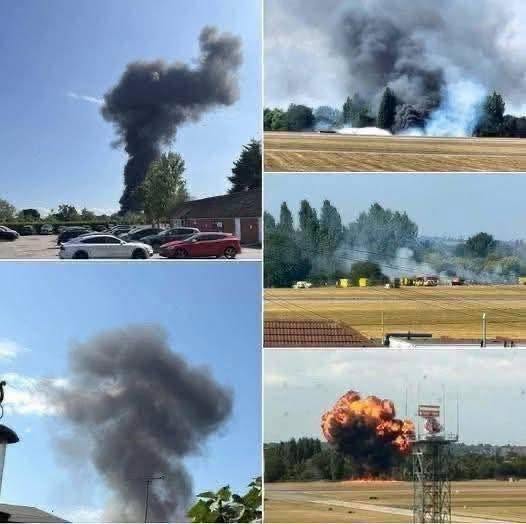
The aircraft, operating as Emirates Flight EK521 from Thiruvananthapuram, India, was approaching Dubai International Airport when an emergency occurred during landing.
The situation required an immediate response from flight crews, airport personnel, and emergency services.
According to airline officials, 282 passengers and 18 crew members were on board.
All were safely accounted for following the evacuation.
For those involved, the experience was undoubtedly frightening. Even a brief emergency can leave a lasting impression on passengers who expected an ordinary arrival and instead found themselves following evacuation procedures under urgent conditions.
Yet amid the uncertainty, the systems designed for exactly such moments functioned as intended.
The Value of Preparation
Aviation safety is often judged by what happens when something goes wrong.
Passengers rarely think about evacuation procedures while boarding a flight.
Few pay attention to safety demonstrations.
Emergency exits, crew training, and airport response plans often fade into the background of travel.
Events like this remind us why those measures exist.
The calm actions of flight attendants, pilots, air traffic personnel, firefighters, and medical teams are the product of years of training and preparation.
What appears to be a rapid response in the moment is usually the result of countless hours spent preparing for situations everyone hopes will never occur.
Seeking Facts Before Conclusions
Investigators have begun reviewing the circumstances surrounding the incident.
Early discussion included the possibility of wind shear, a weather phenomenon that can affect aircraft during critical phases of flight. However, authorities have emphasized that no final conclusions have been reached.
That caution is important.
In the aftermath of major incidents, speculation often arrives faster than verified information. Responsible investigations require patience, technical analysis, and careful review of evidence.
The purpose of such investigations is not to assign blame prematurely but to understand what happened and identify lessons that may improve safety in the future.
Aviation’s strong safety record has been built largely through this willingness to study difficult events honestly and thoroughly.
Remembering Those Who Respond
While the successful evacuation is a cause for gratitude, the incident also carried a profound loss.
A firefighter died while participating in the emergency response.
His role was not to escape danger but to move toward it.
Such sacrifices often receive less attention than the incident itself, yet they deserve careful remembrance.
Around the world, first responders accept risks that most people never see. Their work is often performed quietly and without recognition until moments of crisis reveal how essential they are.
The loss of a life in service to others should not be overlooked amid discussions of aircraft, investigations, and operational procedures.
What Travelers Can Take Away
For most travelers, events like this remain extremely rare.
Yet they offer useful reminders.
Pay attention to safety briefings.
Know where emergency exits are located.
Follow crew instructions promptly.
Exercise patience during disruptions.
Many of the measures that seem routine during ordinary travel become critically important during unusual circumstances.
More broadly, the incident highlights how many people contribute to a safe journey: pilots, cabin crews, mechanics, air traffic controllers, airport staff, emergency responders, and countless others working behind the scenes.
A Different Way to View the Story
It is easy to focus on damaged aircraft, dramatic images, or headlines about disruption.
Those details matter.
But they are not the whole story.
The deeper story is one of responsibility.
Professionals performing their duties under pressure.
Passengers cooperating during uncertainty.
Emergency responders protecting lives.
Investigators seeking understanding rather than speculation.
And hundreds of families receiving the news that their loved ones arrived home alive.
In moments like these, gratitude is as appropriate as concern.
The event serves as a reminder that safety is rarely accidental. It is built through preparation, discipline, and the willingness of many people to carry responsibilities that others may never notice.
When an emergency occurs and lives are preserved, those quiet efforts become visible for a moment.
They deserve to be remembered.
{"post":104828,"page":2,"next":[{"id":104824,"title":"I Was Fired for Helping a Pregnant Woman \u2014 But What She Left in My Pocket Changed Everything - Never Lose Stories","url":"https:\/\/new24.info\/104824"},{"id":104821,"title":"I Saw Three Luxury Cars And Realized My Wife Was Hiding Something - Never Lose Stories","url":"https:\/\/new24.info\/104821"},{"id":104818,"title":"Search for \u0022Breaking: Hospital Locked Down After Active Shooter Report\u0022","url":"https:\/\/new24.info\/104818"},{"id":104815,"title":"From Hollywood Spotlight to Lasting Legacy: How Her Journey Has Grown Over Time","url":"https:\/\/new24.info\/104815"},{"id":104811,"title":"My husband had two children with his secretary, and I remained completely silent. But during a routine medical checkup, the doctor looked at him and asked, \u2018Hasn\u2019t your wife told you yet?\u2019 Immediately, his smile vanished.","url":"https:\/\/new24.info\/104811"},{"id":104808,"title":"Especially after 60: Who should an older person live with?","url":"https:\/\/new24.info\/104808"},{"id":104804,"title":"Surprising Final Gift From Older Wife Forces Young Husband To Change","url":"https:\/\/new24.info\/104804"},{"id":104800,"title":"Buying Warm Meal For Hungry Veteran Changed My Life Completely","url":"https:\/\/new24.info\/104800"},{"id":104797,"title":"My Children Put Me in a Nursing Home Three Weeks After My Husband Passed Away \u2013 Then a Stranger Arrived and Said, \u0027Your Husband Didn\u0027t Tell You the Whole Truth. He Sent Me Instead\u0027","url":"https:\/\/new24.info\/104797"},{"id":104786,"title":"Deaf hiker falls 700 feet, but when rescuers finally find her, she isn\u2019t alone","url":"https:\/\/new24.info\/104786"},{"id":104782,"title":"How An Unexpected Courtroom Arrival Reunited A Billionaire With Her Child","url":"https:\/\/new24.info\/104782"},{"id":104778,"title":"After 50 Years, His \u201cEmergency\u201d Card Changed Everything","url":"https:\/\/new24.info\/104778"},{"id":104774,"title":"At My Father\u2019s Graveside A Gravedigger Revealed The Coffin Was Empty And Handed Me A Key To The Truth","url":"https:\/\/new24.info\/104774"},{"id":104771,"title":"My Mother In Law Told Me To Pay Every Bill So I Revealed The House I Bought Before Marriage","url":"https:\/\/new24.info\/104771"},{"id":104768,"title":"I Paid My Son\u0027s Crush to Ask Him to Prom \u2013 When I Saw Pictures from the Evening, I Couldn\u0027t Believe My Eyes","url":"https:\/\/new24.info\/104768"},{"id":104765,"title":"Nobody Expected the Principal to Stop the Graduation Ceremony for a Late Father \u2013 What He Said Next Left the Entire Room Speechless","url":"https:\/\/new24.info\/104765"},{"id":104762,"title":"Lip reader \u2018reveals\u2019 Donald Trump\u2019s 8-word remark to UFC fighter who called Michelle Obama \u2018a man\u2019","url":"https:\/\/new24.info\/104762"},{"id":104757,"title":"How My Shocking Military Return Uncovered A Massive Family Financial Fraud Scheme","url":"https:\/\/new24.info\/104757"},{"id":104753,"title":"Why Stopping For Stranded Sisters Saved My Auto Repair Business","url":"https:\/\/new24.info\/104753"},{"id":104749,"title":"BREAKING NEWS: Trump and Iran Reach Tentative Agreement as World Watches Closely","url":"https:\/\/new24.info\/104749"}]}