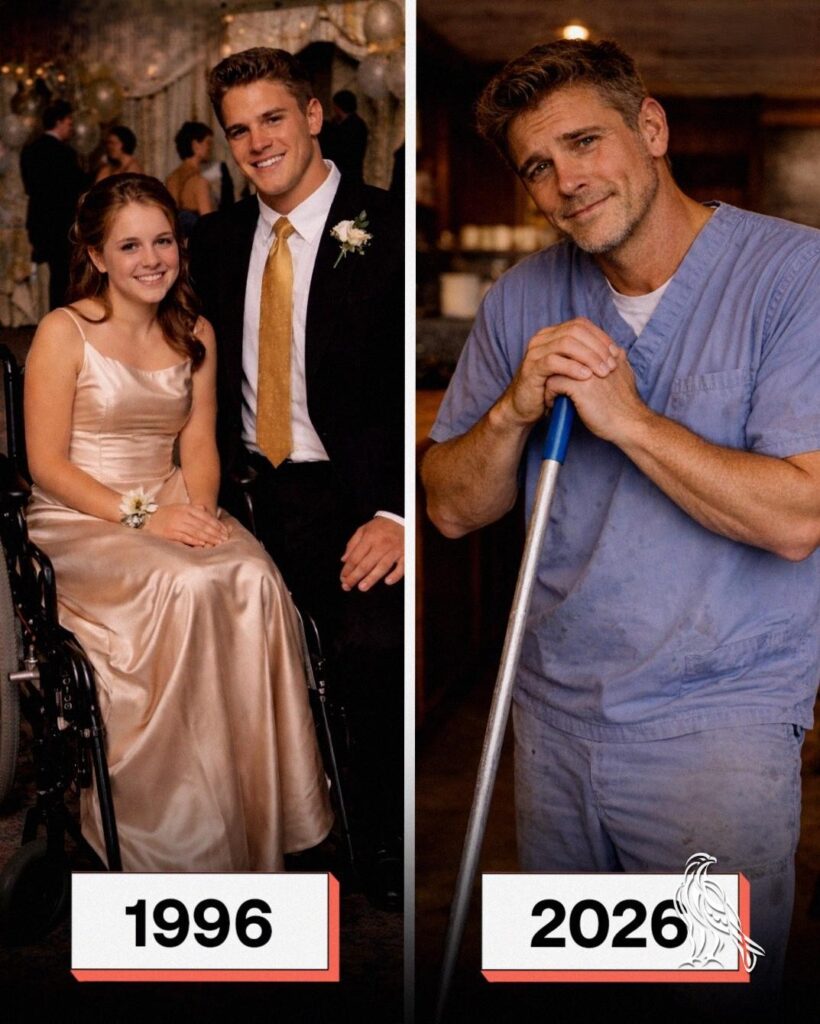
Prom brought all of that to the surface.
I told myself I didn’t care much about going. I acted relaxed about it. But the truth is, once I got there, sitting in my wheelchair at the edge of that decorated gym, watching everyone dance under the lights, I felt completely separate from it all.
The music was loud. The room was full.
And somehow I felt invisible.
I watched couples laughing, spinning, moving through the crowd like they belonged naturally in that moment. Meanwhile I stayed at the edge convincing myself I was fine being there but not really part of it.
Then Marcus walked over.
He didn’t hover awkwardly. He didn’t give me a pity smile. He didn’t act like he was doing charity work.
He just came up to me like nothing was unusual at all.
Then he asked:
“Would you like to dance?”
That question landed harder than I can explain.
Because it didn’t feel like sympathy.
It felt like recognition.
Like someone was looking directly at me and saying: I still see you here.
That dance didn’t magically heal everything.
I didn’t suddenly become confident. The world didn’t instantly become accessible. Buildings didn’t grow ramps overnight. People didn’t stop making assumptions.
But something shifted inside me.
For the first time since the accident, I stopped feeling like I needed to shrink myself to fit the world around me.
I started noticing how many spaces quietly exclude people—not always intentionally, but constantly. Schools. Events. Offices. Public buildings. Places that say “everyone is welcome” while being built in ways that clearly aren’t for everyone.
I realized accessibility isn’t some bonus feature.
It’s dignity.
And I realized I didn’t need to wait for permission to belong.
Years passed.
Life moved on. Both Marcus and I lived full lives, complicated lives. We changed. We carried different scars than we had at seventeen.
When we met again years later, it didn’t feel dramatic or cinematic.
It just felt… unfinished in the best possible way.
Like a conversation paused a long time ago finally continuing.
Eventually we ended up building something together: a community center designed around inclusion from the start.
Wide entrances.
Accessible spaces.
Thoughtful layouts.
No afterthought design.
No “special accommodations” added later.
Just a place built with the assumption that everyone deserves to enter with ease.
And on opening day, standing there surrounded by people filling a space we had worked so hard to create, Marcus turned to me again.
Same calm voice.
Same steady energy.
And he asked:
“Would you like to dance?”
This time it felt different.
The first dance reminded me that I was still worthy of being seen.
The second reminded me how much life can grow from a single moment when someone chooses to truly see you.
And how sometimes the smallest gestures end up changing everything.
{"post":103294,"page":2,"next":[{"id":103290,"title":"A Teen\u2019s Sentence Sparks Debate About Justice, Choices, and Consequences","url":"https:\/\/new24.info\/103290"},{"id":103286,"title":"This legendary actress made a rare public appearance at 90","url":"https:\/\/new24.info\/103286"},{"id":103281,"title":"Inside the life of a global superstar: Love, loss, and the fight to keep performing","url":"https:\/\/new24.info\/103281"},{"id":103278,"title":"\u00abWhat is the reason of Gwen Stefani\u2019s tears?\ud83d\ude2b SHe shared her horrible emotions with us in her recent post!\u00bb\ud83d\udc94","url":"https:\/\/new24.info\/103278"},{"id":103275,"title":"Search Results for \u201cInside the life of a global superstar: Love, loss, and the fight to keep performing\u201d \u2013 Tbdig Divaxo","url":"https:\/\/new24.info\/103275"},{"id":103270,"title":"The entertainment world is mourning the sudden loss of a beloved television personality","url":"https:\/\/new24.info\/103270"},{"id":103266,"title":"What to Do If You Find Ticks in Your Child\u2019s Hair (Without Panicking)","url":"https:\/\/new24.info\/103266"},{"id":103261,"title":"FDA approves many drugs that predictably increase heart and stroke risk","url":"https:\/\/new24.info\/103261"},{"id":103257,"title":"Young woman puts both babies inside the fir\u2026 See more","url":"https:\/\/new24.info\/103257"},{"id":103240,"title":"You would watch the clip, your heart thudding dully against your ribs like a trapped bird","url":"https:\/\/new24.info\/103240"},{"id":103237,"title":"The life and career of Brian Connolly: from fame to later years - Terbv","url":"https:\/\/new24.info\/103237"},{"id":103234,"title":"Terrifying moment gunshots rang out outside White House captured on camera","url":"https:\/\/new24.info\/103234"},{"id":103231,"title":"The Case That Still Leaves One Painful Question No One Can Fully Answer","url":"https:\/\/new24.info\/103231"},{"id":103226,"title":"These are the consequences of sleeping with the\u2026See more","url":"https:\/\/new24.info\/103226"},{"id":103222,"title":"Police Arrest Suspect in Unusual Wildlife Case in U.S. Woodland Region","url":"https:\/\/new24.info\/103222"},{"id":103217,"title":"20 Minutes ago in New York City, Kelly Ripa was confirmed as\u2026See more","url":"https:\/\/new24.info\/103217"},{"id":103215,"title":"kaylestore.net","url":"https:\/\/new24.info\/103215"},{"id":103212,"title":"Why Stretching Your Ring Finger Might Feel Surprisingly Good","url":"https:\/\/new24.info\/103212"},{"id":103209,"title":"Former AG Pam Bondi diagnosed with cancer weeks after being fired by Trump: report","url":"https:\/\/new24.info\/103209"},{"id":103203,"title":"Here\u2019s what the sticker says. What do you think??\u2026\u2026","url":"https:\/\/new24.info\/103203"}]}