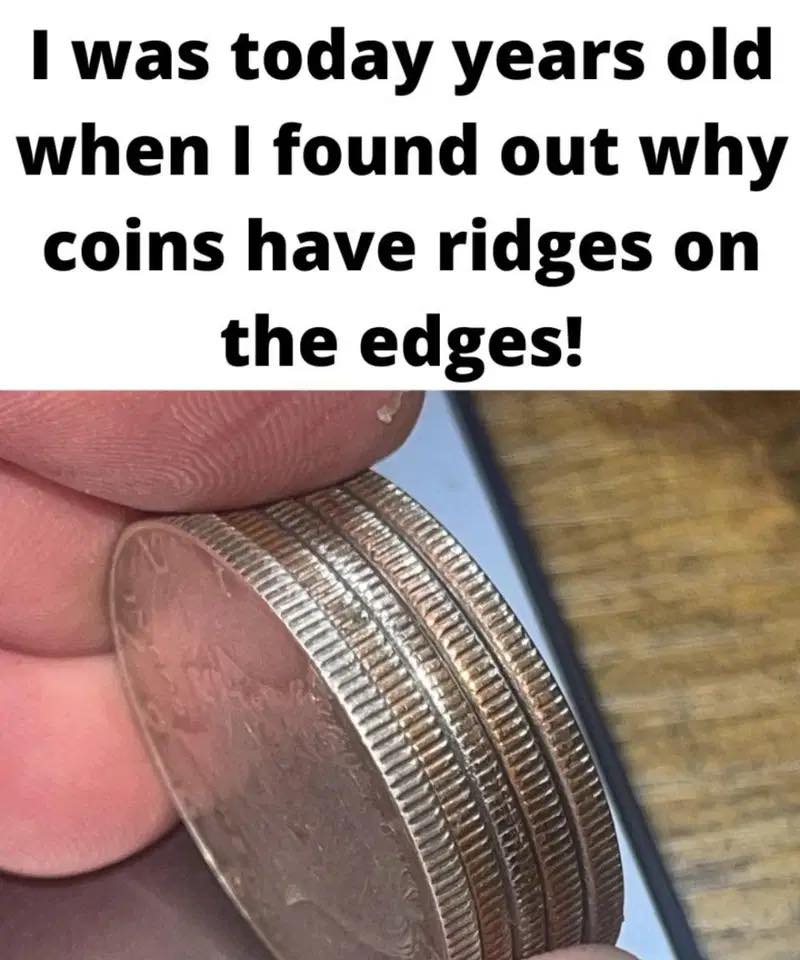
You’ve probably held thousands of coins without ever thinking about the tiny ridges running along their edges. Quarters passed through your hands at checkout counters, dimes dropped into parking meters, and coins rattled around in pockets so often that their details became invisible through familiarity. But those small grooves are not decorative. They exist because, centuries ago, entire economies were being quietly drained one coin at a time.
Hundreds of years ago, coins were made from real silver and gold. That made them valuable not only as currency, but also for the precious metal they contained. Criminals discovered they could shave tiny amounts of metal from the edges of coins without making the coins look noticeably different. This practice became known as coin clipping.
A clipped coin could still be spent at full value, while the stolen silver or gold shavings were collected and melted down separately. One coin alone barely mattered, but across thousands of coins the losses became enormous. Merchants began losing trust in currency, governments lost valuable metal reserves, and financial systems started weakening under the damage caused by widespread clipping.
The solution came from an unexpected figure: Isaac Newton.
In 1696, Newton was appointed Warden of the Royal Mint. Rather than treating the position as ceremonial, he aggressively tackled counterfeiting and coin fraud. One of the most effective innovations introduced during that period was the use of reeded edges—the evenly spaced grooves still found on many coins today.
Once coins had ridges, clipping became much easier to detect. If someone shaved metal from the edge, the groove pattern would immediately appear broken or uneven. A legitimate coin, meanwhile, displayed a continuous and precise pattern that counterfeiters struggled to reproduce accurately.
The ridges worked as an early form of anti-fraud technology, helping restore confidence in the currency system.
Even though modern coins are no longer made from valuable silver or gold, the ridges remain for several reasons. Modern vending machines and coin validation systems still use edge patterns to help detect counterfeit coins. The grooves also help visually impaired individuals distinguish different coins by touch alone. A smooth-edged nickel or penny feels very different from a ridged dime or quarter.
Tradition also matters. The textured edges have become part of how coins are expected to look and feel, connecting modern currency to centuries of monetary history.
Pennies and nickels generally remain smooth because they were never historically valuable enough to make clipping worthwhile. Dimes and quarters, however, kept their ridges as a legacy of the time when even the smallest piece of metal could become the center of economic fraud.
Those tiny grooves may seem insignificant today, but they are actually surviving evidence of a centuries-old battle over trust, money, and human ingenuity.
{"post":101473,"page":1,"next":[{"id":101442,"title":"Lisa Rinna Stuns in Daring Feathered Gown at Bezos Pre-Met Gala Party \u2013 Photos","url":"https:\/\/new24.info\/101442"},{"id":101438,"title":"At 2 p.m., in the middle of a company meeting, I nervously checked the bedroom camera to see how my wife and our two-week-old son were doing. She was still frail from a life-threatening postpartum hemorrhage, and what I saw made my heart stop. My mother was ruthlessly snatching the baby from her arms and shoving her toward the kitchen, even though her surgical wound had barely begun to heal. My mother hissed, \u0027Blood loss is no excuse for a dirty house; get up and scrub the floor.\u0027 As my wife collapsed in pain, clutching her stitches, I walked out of the meeting, called a locksmith, and vowed that my mother would never set foot in our home again.","url":"https:\/\/new24.info\/101438"},{"id":101434,"title":"I stared at the laptop screen, my breath hitching as the grainy footage confirmed my worst nightmare","url":"https:\/\/new24.info\/101434"},{"id":101431,"title":"Savannah Guthrie Suddenly Walks Off \u2018Today\u2019 Set Mid-Show","url":"https:\/\/new24.info\/101431"},{"id":101428,"title":"Karoline Leavitt Shares First Photo with Newborn Daughter in Adorable Nursery Shot","url":"https:\/\/new24.info\/101428"},{"id":101422,"title":"Fans buzz over Brad and Angelina\u2019s son Knox Jolie-Pitt","url":"https:\/\/new24.info\/101422"},{"id":101417,"title":"My parents promised to babysit while I was in surgery. I woke up in recovery and checked my phone. There were 14 missed calls from my neighbor: \u0027Your kids are on my porch. Your parents left two hours ago.\u0027 I called my mom, and she said, \u0027Your sister needed us more.\u0027 I was released at 5 PM. By 9 PM, I had changed every lock, every emergency contact, and every line of my will.","url":"https:\/\/new24.info\/101417"},{"id":101415,"title":"Michelle Obama Reflects on Motherhood, Privacy, and Raising Children in the Public Eye","url":"https:\/\/new24.info\/101415"},{"id":101410,"title":"My husband repeatedly sla:pped me in the face over a trivial matter. The next morning, he saw a lavish feast and said, \u201cIt\u2019s good that you\u2019ve finally come to your senses!\u201d But he panicked and nearly fainted from shock after seeing the guests seated at the table\u2026","url":"https:\/\/new24.info\/101410"},{"id":101406,"title":"Which Glass Has More Water: Your Answer Reveals If You\u2019re A Giver Or A Taker","url":"https:\/\/new24.info\/101406"},{"id":101404,"title":"Search Results for \u201cFans Reflect on the Legacy of a Familiar Face From The Shawshank Redemption and Gilmore Girls\u201d \u2013 Tbdig","url":"https:\/\/new24.info\/101404"},{"id":101398,"title":"What a tragedy! The whole country is mourning the passing. \u2026 See More","url":"https:\/\/new24.info\/101398"},{"id":101394,"title":"Leadership Changes at FEMA Spark Debate Over the Agency\u2019s Future","url":"https:\/\/new24.info\/101394"},{"id":101391,"title":"WHO finally issue statement on likelihood of hantavirus becoming the \u201cnext covid\u201d","url":"https:\/\/new24.info\/101391"}]}